

Earlier this summer, Whitewall joined DRIFT at SCAD Lacoste in France to experience the opening of its latest commission, “Unfold.” Presented on the university’s campus, on a historic cobblestone street overlooking the valley, was a door that beckoned us in. Once inside, a dark, small room hosted a reclining chair—and that’s it.
This was a striking contrast to most works DRIFT is known for, based on communality: Franchise Freedom, a bustling swarm of countless drones performing a synchronized dance for hoards of people underneath; Shylight, including folds of silk fabric opening and closing to rhythmic tunes above onlookers; and Fragile Future, LED lights covered in the whisps of dandelions, mesmerizing lines of people looking for a closeup.
 “Unfold” by DRIFT, courtesy of SCAD.
 “Unfold” by DRIFT, courtesy of SCAD.
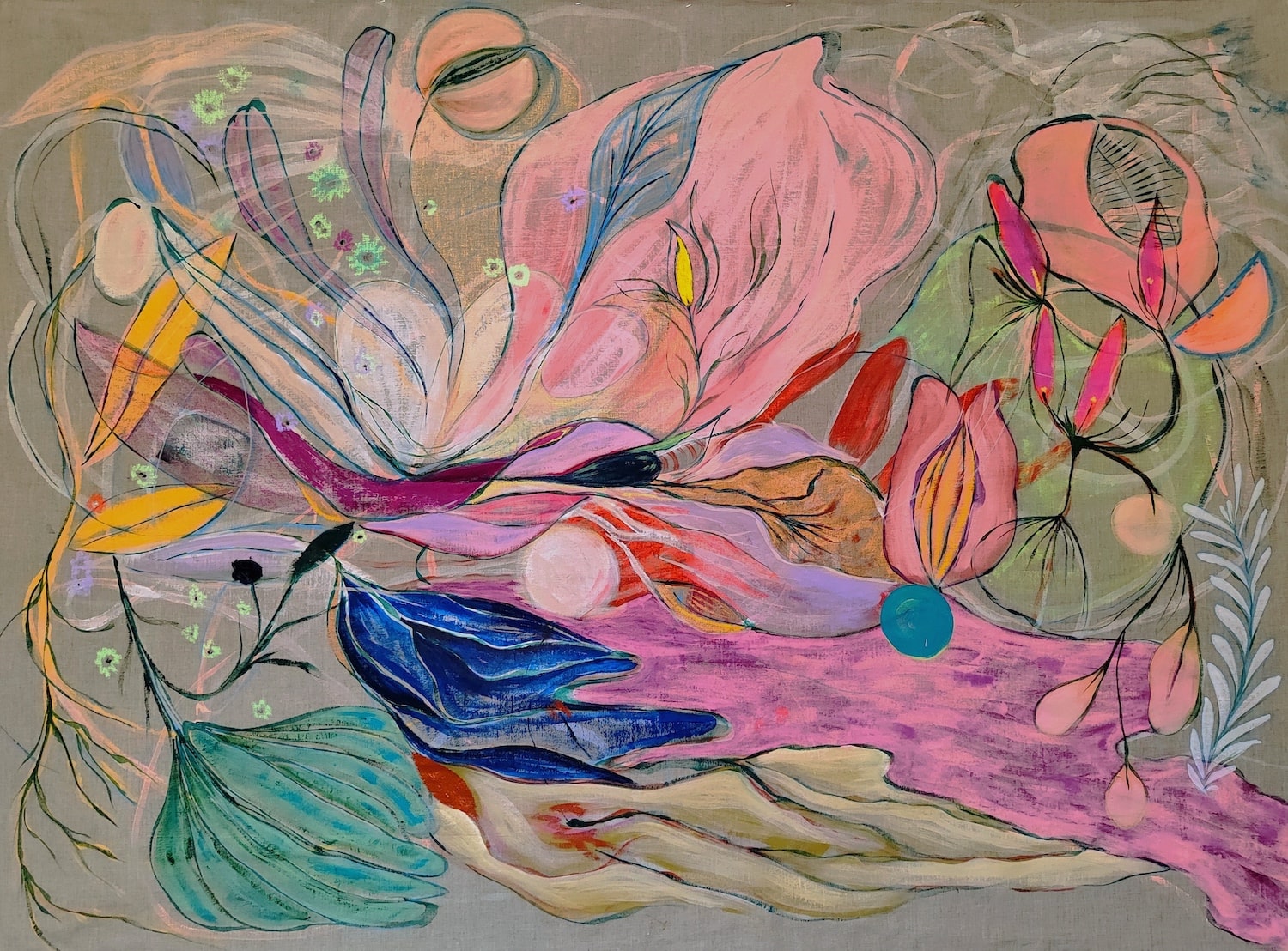
“Unfold,” rather, was a singular experience for the viewer. After taking a seat and placing their hands on the biometric reader panels, a video projection of a flower begins to take shape on the ceiling above them. Data points—from heart rate to temperature—are programmed and regurgitated by DRIFT and AI into colors and patterns. Each piece is unique and is meant to reflect the viewer’s experience in that exact moment.
Ralph Nauta, the studio’s co-founder, spoke with Whitewall about the installation and how the region speaks to the artwork, arguably more than any other work DRIFT has created before.
Inside DRIFT’s “Unfold”
 “Unfold” by DRIFT, courtesy of SCAD.
 “Unfold” by DRIFT, courtesy of SCAD.
WHITEWALL: So much of your work is communal, and part of its power is bringing people together, but this focused on a singular person’s emotional journey.
RALPH NAUTA: That’s what’s so great about this commission. We had the restrictions of such a small historic building that we are almost forced to make an intimate, one-off experience. We’ve always been fascinated by the micro and the macro—zooming in, zooming out. When you have a beautiful mountain walk, that’s what’s the beauty of that. On the hillside, you see all these little animals working together in harmony, and then you zoom out, and you see the large mountains. That scale, we always try to incorporate that in our work—like when you zoom in on the dandelions and you see all the separate hairs, the intricacy of the work, and then you zoom out and then you see the larger vision of tech and nature merging together.
Here, we have that intimacy that we could work on. It forces us to look very closely at nature again. There’s nothing more nuanced than flowers—the color palette, the way they put all their energy and glory into becoming the most beautiful, attracting thing before they die off. They go to the max to get the maximum results, and you see that, obviously. That’s what we relate to—that energy. I saw a very strong link between the individual flowers and individual humans and how they express themselves. I thought it would be a very interesting link.
 SCAD Lacoste – Scenes and Lifestyle, Summer 2014 – Olivier Complex. Photography by Chia Chong, courtesy of SCAD
WW: Tell us how this works. Basically, as a viewer, we put our hands on these readers of sorts, sit back in a chair, and it gains data. What do you track and how is that visualized?
RN: There’s a whole scale of data that we can track—heart rate variability, heart rate in general, skin connectivity, temperature. Temperature is a really tough one because it doesn’t say a lot if you have a different temperature. You can just come in because it’s hot outside and therefore your body temperature’s up a little bit. So, with all this data combined, you have to make ends meet out of it. It’s quite complicated. There’s a lot of universities around the world that are trying to link it to our emotional state of being. But because it’s so nuanced and it’s very hard to do, nobody’s figured it out yet. We have these bio-trackers, watches and everything, that claim that they do that, but after extensive research, it’s not scientifically proven yet.
It’s actually better to track your emotions by putting a camera on your face and reading your eye movement. That’s pretty accurate, but it’s a bit intrusive. So, we had to figure out through our life experience what a certain set of data could mean and then relate to that with color. What does a color mean, and how does it relate to an emotional response? It’s a lot of guesswork. It’s a lot of interpretation.
As artists, it’s our interpretation of what a color could mean to a certain emotion or a certain petal. And then, of course, we have the AI level on top that scrapes the internet for certain patterns that we think relate to the data that we get. And that’s the interpretation of that AI algorithm.
Working with AI and Nature
 Superblue presents “Shy Synchrony” by DRIFT, © Ossip van Duivenbode.
WW: Tell us a bit more about working with AI. How did you make use of that? How did you interpret these data points into visuals with the help of AI? When someone’s flower appears, we see your interpretation of emotions through color, but also movement, shapes, and more.
RN: The patterns on top are AI-generated. The rest is through algorithms that we determine a specific outcome by a specific measurement that we do. We want to push that forward in the future, as well—that the whole flower becomes AI-generated. But you need such a complicated LLM behind that it that we’d need to step up our game. That’s the next step.
WW: So, this artwork will be updated? Or would that be for a future artwork?
RN: This artwork. This is something we can easily update. That’s the cool thing about it.
WW: Will this artwork continue to evolve as newer technologies evolve?
RN: I don’t know. Maybe it’s the OG piece. We have to talk about that. That’s the interesting thing about digital work. Do you keep it where it was or do you update it? If you think about like the old Star Wars movies, like A New Hope, I want to see the OG—the first cuts from George Lucas. I don’t want to see the Disney-manipulated stuff. I was talking to students about this last night, saying, “Make sure you’ve got hard copies of old movies, the VCRs or the Blu-rays, because you never know in the future if something will be changed. And if some dictator starts changing the narrative of a society, you’re screwed.
A Futuristic Artwork Immersed in History
 Studio Drift
Fragile Future, presented at Cidade Matarazzo
Courtesy of the artists and Galleria Giorgio Franchetti Alla Ca’d’Oro.
WW: Did the region we’re in—the history, the landscape—inspire the piece, or did you predetermine the piece’s concept?
RN: My team had a site visit, which was more technical. At this point, I know the region, and we are also very trained in reading architectural drawings because of the commissions that we do. A lot of times, the client wants me to go to the space to experience it and to see it because they’re not trained to read those drawings. I can read the drawings—and I build it three-dimensionally in my head. Especially in space like this, because it’s a dark space. You close the door, and that’s the only place you are. It doesn’t have a relationship to the outdoors. It could be anywhere. So, in this case, that wasn’t needed.
WW: Even though it is behind a closed door, when you’re back outside, there are a lot of flowers around and the natural landscape feels like it speaks to the nature of the work.
RN: I was wondering if it would work because it’s almost too much. Normally, we do these experiences in industrial buildings and in cities, because people don’t have that relationship with the natural environment anymore—and that’s what the work is about, to create the dialogue within yourself and to make you to understand that what you’re missing is that connection with nature, so that you can start asking the right questions again in your life and start thinking clearly.
Here, you walk out of the door, and you’re there—what we’re preaching. So, I was wondering if that would work, but I kind of like the dialogue when you walk outside, and you see the flowers that you just generated in front of you. It’s kind of cool.
WW: You’re also seeing flowers that may or may not exist outside here in France—like mine, the passionflower.
RN: It’s not regional, but it’s such a weird alien flower, in a cool way. I’m always hoping to get that flower when I step in, but I haven’t.
WW: How long did this project take to create?
RN: About eight months. With this project, we were so aligned that we didn’t have to waste time on all the bureaucracy and problems that you normally face. We didn’t have any hard discussions; it was very clear what it needed to be. And they gave us the room to artistically express ourselves. It was great.