



This spring, tucked away in the undulating hills of the Alpes-Maritimes in the South of France, the artist residency Dragon Hill welcomed abstract and figurative painters Jo Messer and Alex Gibson to immerse themselves amidst the house’s eccentric interiors, tangled gardens, and resonant stillness, culminating in a series of paintings that reflected a deep symbiosis with their surroundings, dissolving seamlessly into the world around them.
A Gaudí-esque structure set in 5,000 sq m of lush, landscaped grounds overlooking Antibes Bay, Dragon Hill is more than a house—it’s a sculpture one lives in. Built in 1964 by idiosyncratic French architect Jacques Couëlle, the villa was relaunched as a residency in late 2023 by Unit London co-founders Joe Kennedy and Jonny Burt—inviting artists and writers to pause, reflect, and create in a place steeped in decades of artistic legacy and visionary thought.
The Magic of Dragon Hill
 Courtesy of Dragon Hill.
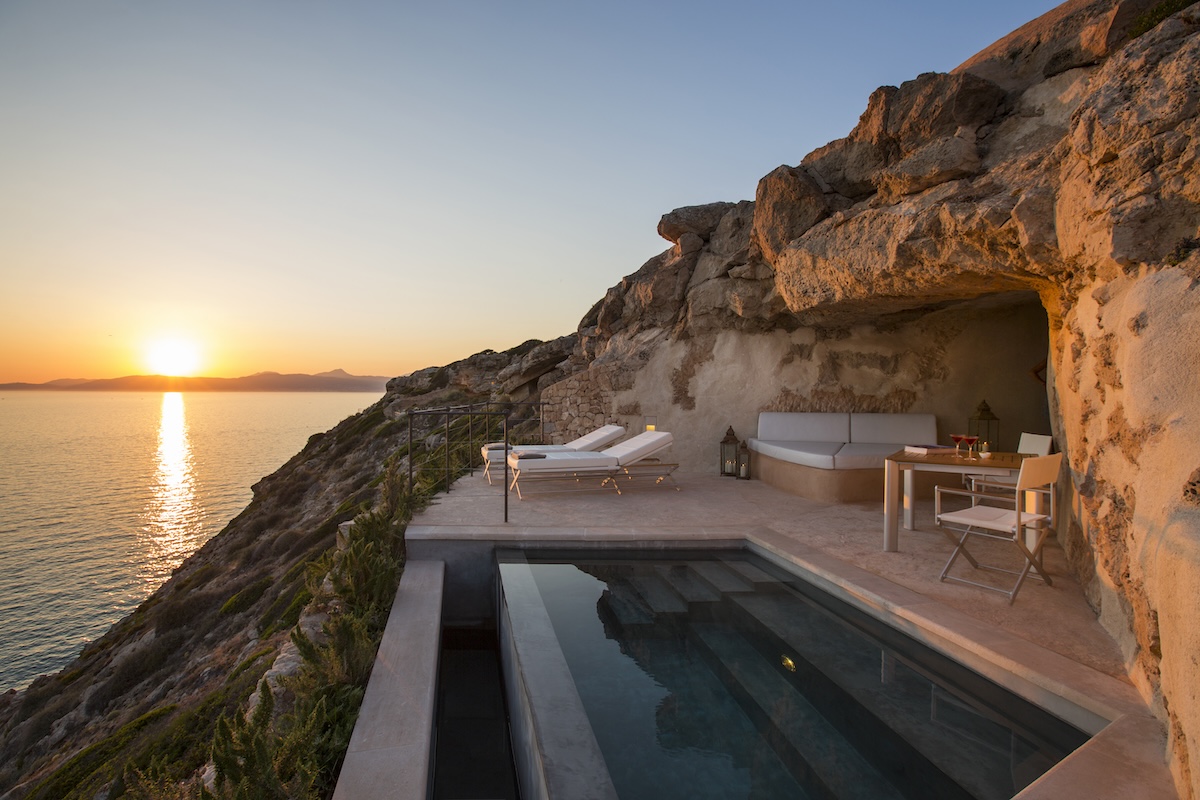
One of Couëlle’s five experimental maisons-sculptures in the region, the house was crafted in defiance of modernist rationalism, embracing instead the principles of organic architecture. With its sinuous curves and ornamental surfaces, the villa cleaves as closely as possible to the natural terrain—its off-white cave-like walls spiraling like a ring of calamari around a central courtyard, granite boulders protruding from the facade, ironwork curling like seaweed across small, irregular windows.
“A Gaudí dream softened by the French sun, barely a sharp angle or straight line inhabits the premises,”
A Gaudí dream softened by the French sun, barely a sharp angle or straight line inhabits the premises, mirroring much of Messer’s own painterly language: intuitive, fluid, and a little strange. A fitting host to her shape-shifting figures, the architecture’s supple, curvilinear lines and defiance of symmetry echoes her visual logic, forming together a space where anatomy fractures, boundaries blur, and clarity gives way to suggestion.
Jo Messer and the Artist Residency
 Jo Messer, photo by © Jean-Christophe Lett.
 Jo Messer, photo by © Jean-Christophe Lett.
Residents of the house chosen for their singular, idiosyncratic visions and resistance to convention, Jo’s practice sits squarely within this ethos—seeming to inhabit the very same world Couëlle once imagined, made up of sensual curves and intuitive construction. With an affinity for seafood platters, we almost expect a matching calamari ring to seep its way into her canvas—among figures that not unlike the villa itself morph, distort, and resist containment.
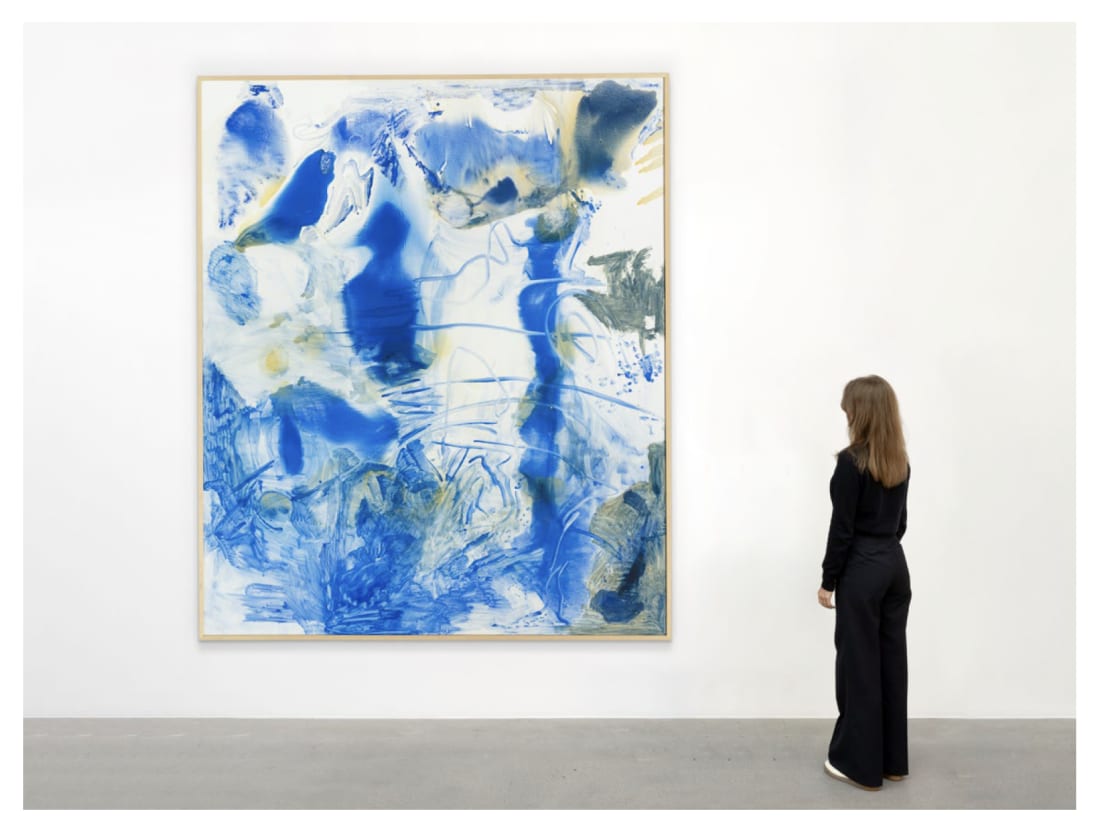
At the end of her residency, as we sat in her studio with her, we attempted to decrypt the figures within her work along with the bemusing intent of their creator. Awash with earthy tones and organic forms, her paintings revealed languid limbs that morphed into gaping fish mouths; torsos that bent into painterly folds almost mimicking the local terrain, and surfaces lush with coral pinks, bruised purples, and the dusty ochres of the Provençal earth.
Ushering us into absurd sylvan realms, she conjured dusky groves where amorphous shapes would twist and fade—limbs looping like vines amongst leafy canopies and boughs tangled overhead, gaping fish plonked about in curious clusters, sprouting like mischievous fungi from mossy forest floors. Akin to a warped, fetishist rendering of BFG’s whimsical glades—she opens the gates to a foresty riddle world, part podophilic fairy-tale, part dinner gone strange.
The Surreal Paintings of Jo Messer
 Jo Messer, photo by © Jean-Christophe Lett.
Lyrical and lush, Jo’s surreal environments house objects not as nature would place them. Abandoning the standard laws of evolution, figures, and objects are curated through a visual taxonomy defined by shared geometry, formal echoes and the peculiar logic of the artist’s psyche. Forms repeat, curves align. A nose mirrors a toe, a fish mouth echoes a breast.
“Lyrical and lush, Jo’s surreal environments house objects not as nature would place them,”
Defying phylogeny and evolutionary logic, the creatures of the artist’s oddlands drift in an ecosystem where gravity is suspended—structured not by biology, but the visual rhymes of form and the artist’s surreal and strange painterly impulse. Bulbous limbs and overflowing bodies swell within the frame, threatening to burst free of the canvas that contains them—inviting both desire and disorientation. The body is teased as limbs balloon, vanish, or double back, and feet bloat like overripe fruit. Tethering between the erotic and the absurd, the sensual and the surreal, the viewer is unsure whether to feast or gaze.
 Courtesy of Dragon Hill.
Unfolding through snapshot-like works, indistinctive female forms appear in varying states of deconstruction—slipping in and out of focus, flickering into disappearance. Slouched and crouched, her signature stray limbs are found nestled in improbable places—some stretched beyond their usual proportions, others missing entirely. Engorged feet emerge like gluttonous relics, anchoring the viewer’s gaze. Propped in cosmic disbelief, fish with wide goggly mouths plop into the scene as if summoned by nonsense itself. Slippery with dream, figures coil in on themselves, freed from anatomy’s demands, as the surrounding marine life gape in quiet astonishment at the nonsensical feast unfolding before their eyes.
While unmistakably hers—balancing Abstract Expressionism and veiled figuration, Surrealism and satire—these new paintings lean into something notably quieter than the artist’s previous work. Seeping in from the enveloping atmosphere, a meditative hush seems to ooze its way through the canvas, striking a more hushed, introspective chord, the compositions seemingly asking the viewer to linger and—trace a breast, a gesture, a grimace—only to have it flicker into something else. Like open-ended questions, her figures seem to carry their own agendas—meandering across the canvas, less concerned with being understood than with simply existing on their own terms. Drifting freely with quiet autonomy, they tease the viewer with whispers rather than declarations—hinting at stories that seem to be willed by the work itself rather than its maker.
 Jo Messer, photo by © Jean-Christophe Lett.
True to Jo’s broader artistic intent, these pieces are a resounding example of the artist’s penchant for eschewing solemnity in favor of engaging, unsettling, and amusing both herself and her audience. Recurrently showing bodies that inhabit tables dressed in “consumables and consumers,” women fragmented into their ‘consumable’ parts, flesh becomes meat as body becomes banquet—figures butchered and served up like cold dead fish. While gesturing toward a critique of the objectification and commodification of women, upon inspection, one finds the weight of such critique deliberately light—inviting reflection rather than imposing meaning—striking a tone that balances playfulness and provocation in a ratio left entirely as the viewer’s decision.
In the end, she wants her work to be ‘open to interpretation’, and to be felt and read as one wishes, inviting a dialogue that delights and amuses more than it preaches. Across the works born at Dragon Hill, this spirit lingers, if only softened—drifting us into a dream state where the body still breaks apart but does so in slow motion—luxuriating in the theater of its own quiet absurdity.
 Courtesy of Dragon Hill.
 Courtesy of Dragon Hill.


