

“An Old Master painting was, in its own time, a contemporary work,” Colnaghi observes this year, and the line could serve as a motto for both fairs. Art fairs traditionally trade in the new; this October, the most intelligent stands at Frieze London and Frieze Masters trade in context. Some set living artists beside their forebears: Flora Yukhnovich alongside Jan Brueghel the Elder, and Ilana Savdie among Klimt, Dalí, and Louise Bourgeois, while Sasha Gordon riffs on Holbein. Others align their booths with the city’s museum calendar, from Tate Modern to Whitechapel. What follows is a guide, fair by fair and booth by booth, to the presentations that reward attention, and the reasons they do.
Your Guide to Frieze London 2026
Gagosian, Booth D14
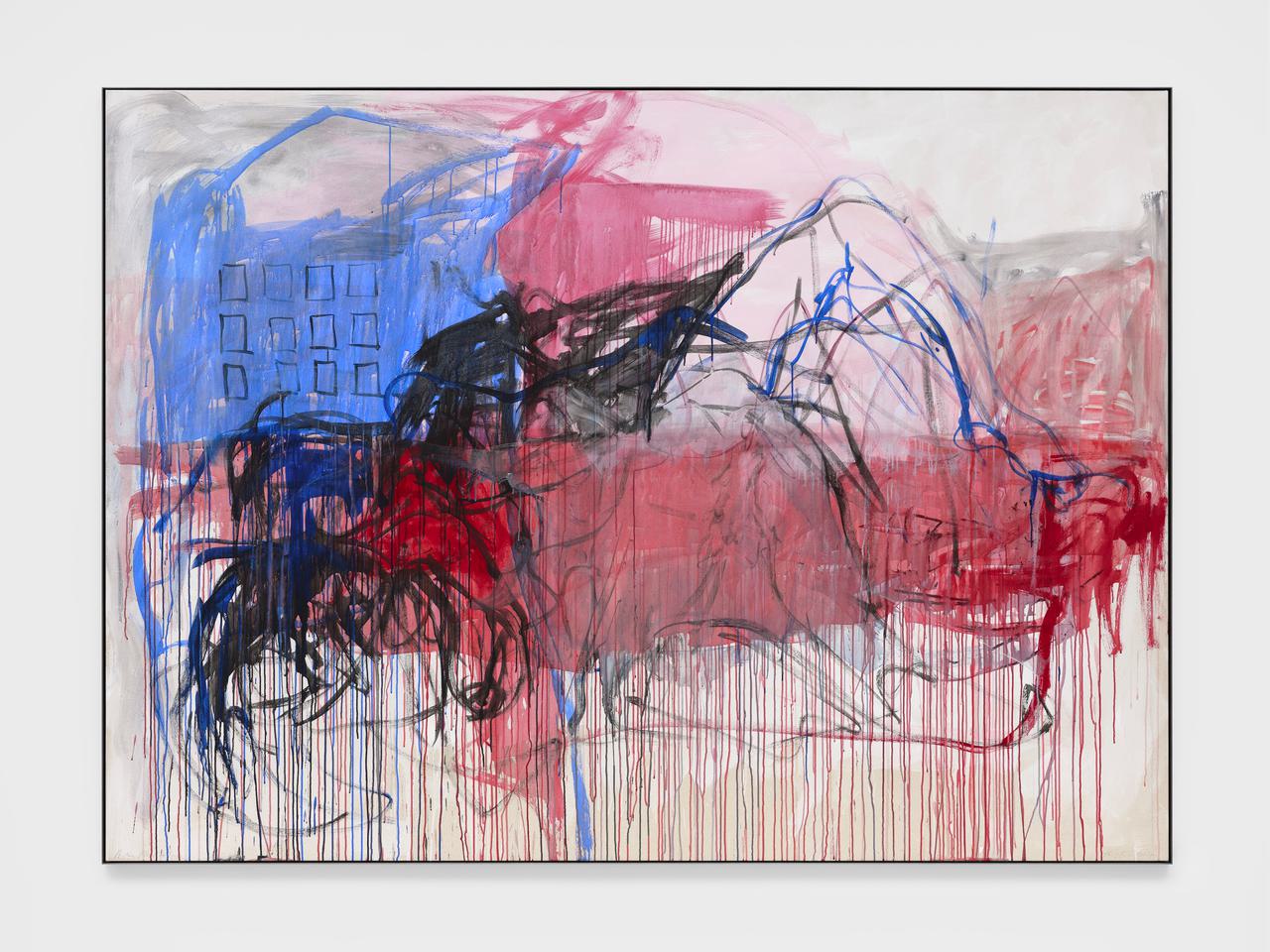
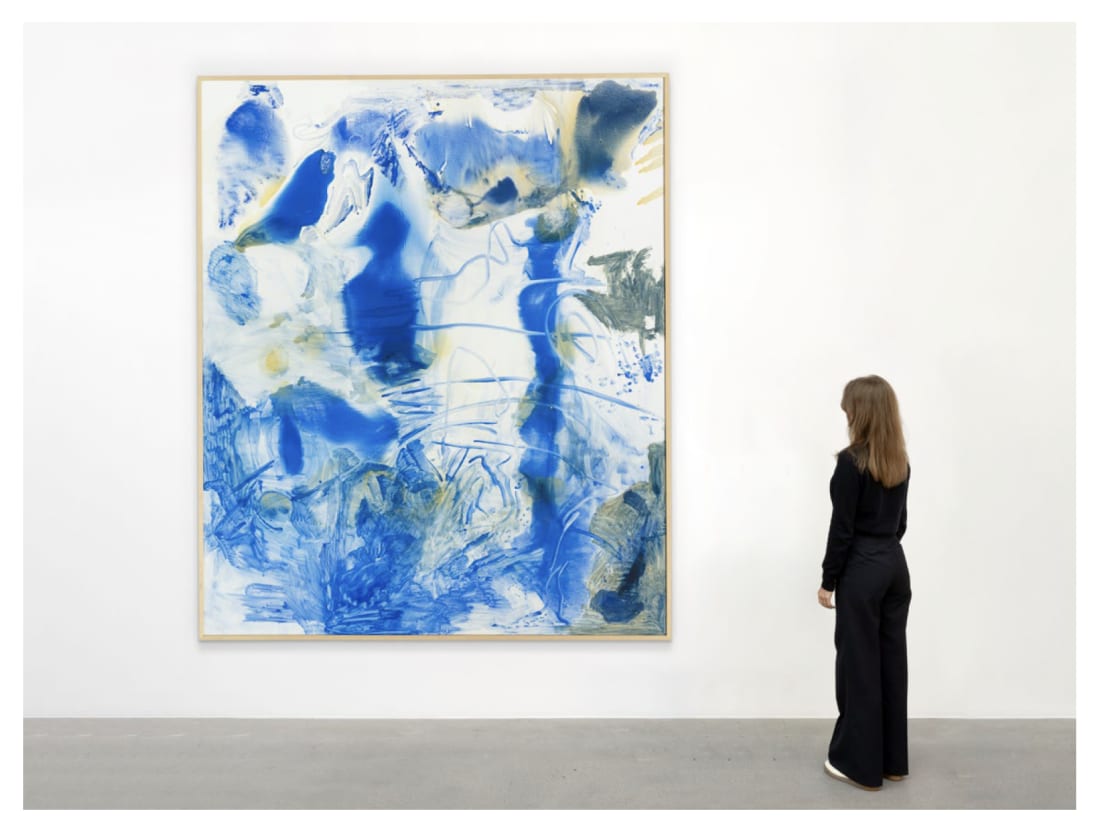
 ALBERT OEHLEN,
“Untitled,” 2020–26,
Oil on canvas,
90 5/8 x 98 1/2 inches ,(230 x 250 cm),
© Albert Oehlen,
Photo: Simon Vogel
Courtesy Gagosian.
Albert Oehlen has spent four decades demonstrating that painting’s supposed exhaustion is its richest resource. For Frieze London, Gagosian devotes its entire booth to six major new large-scale canvases. A figure Oehlen has quoted repeatedly, a man with an extravagant mustache, surfaces and dissolves among drips, graphic strokes, and abrupt collisions of color. The true subject is color itself, deployed in lines, layers, and interjections that seem to emit light and even sound, so that no element is ever allowed to settle. The critic John Kelsey has described Oehlen’s practice of basing decisions on a “self-imposed cancellation” of his own powers. The virtuosity lies in concealment, and the task of finding it is left, pleasurably, to the viewer.
Why it matters: A solo booth of six new large-scale paintings is an unusual commitment at any fair, and the most concentrated statement on painting in Regent’s Park.
Hauser & Wirth, Booth D20
 Nicole
Eisenman,
“Drawing for Stack,”
2026,
Graphite on paper,
63.5 x 41.9 cm / 25 x 16 1/2 in,
© Nicole
Eisenman,
Courtesy the artist and Hauser & Wirth,
Photo: Sarah Muehlbauer.
 George Condo,
“Figure Composition,”
2026,
Acrylic and pastel on paper,
151.8 x 104.1 cm / 59 3/4 x 41 in.,
© 2026 George Condo / Artist Rights Society
(ARS), New York and DACS, London,
Courtesy the artist and Hauser & Wirth,
Photo: Roger Edwards.
Hauser & Wirth builds its booth around artists working in London, from Frank Bowling to Sonia Boyce, Allison Katz, Christina Kimeze, Anj Smith, Thomas J Price, Michaela Yearwood-Dan, and Keith Tyson, alongside work by the late Phyllida Barlow. Read together, they form a cross-generational portrait of the city. New and recent works by George Condo, Leonardo Drew, Camille Henrot, William Kentridge, Glenn Ligon, and Nicole Eisenman, whose monumental new sculpture was unveiled in the courtyard of the Royal Academy in September, open the view outward.
Why it matters: It’s the clearest single survey of London painting and sculpture at the fair. Angel Otero’s Dreams and Salt is installed nearby at Frieze Sculpture.
Thaddaeus Ropac, Booth D22
 Robert
Rauschenberg, “Treadle / ROCI USA (Wax Fire
Works),” 1990,
Silkscreen ink and fire wax on
mirrored aluminium,
245.7 x 125.3 x 4 cm (96.73 x
49.33 x 1.57 in),
(RR 1288,), © the artist, Courtesy Robert
Rauschenberg
Foundation / ARS New
York 2026, and Thaddaeus Ropac gallery, London · Paris · Salzburg ·
Milan · Seoul.
 George Baselitz, “Die Hand (Remix),” 2007,
Oil on canvas,
Canvas 250 x 200 cm, (98.43 x
78.74 in),
Frame 254 x 204 x 5 cm (100 x
80.31 x 1.97 in),
(GB 1267), Photo: Pierre Tanguy, © the artist, Courtesy Thaddaeus Ropac gallery, London · Paris · Salzburg ·
Milan · Seoul.
Ropac arrives with news: its first presentation of Denzil Forrester since announcing his representation. Two recent canvases by the Grenada-born, UK-based painter, Professor Version and Yard (both 2025), carry the energy of the dub and reggae scene of early-1980s London, where he began drawing in nightclubs, translating the music’s sampling, mixing, and looping into line and color. They hang alongside Georg Baselitz‘s Die Hand (Remix) (2007), in which the blazing houses cradled in oversized hands of his 1960s paintings return as dilute black strokes, as though four decades had extinguished the fire. Two works by Robert Rauschenberg coincide with his new ARTIST ROOMS display at Tate Modern.
Why it matters: It’s a first look at Forrester with his new gallery, ahead of his Ropac solo show and a five-decade survey at The Box, Plymouth, in June 2027. Pair the Baselitz with Ropac’s “Heroes” exhibition at Ely House.
White Cube, Booth D21
 Ilana Savdie,
“Syncitia No. 2,”
2026,
Oil, acrylic, and beeswax on canvas stretched on panel,
165.1 x 203.2 cm | 65 x 80 in.,
© Ilana Savdie. Photo © White Cube (Frankie Tyska).
White Cube‘s booth is an art-historical argument made in space. Ilana Savdie‘s new paintings and works on paper hang behind an open lattice of works by Leonor Fini, Salvador Dalí, Hans Bellmer, and others, which acts as a filter both physical and conceptual. At its center is Louise Bourgeois‘s suspended sculpture The Couple (2002), an image Savdie keeps pinned to her studio wall. In new canvases such as The Harbingers and A Wild Unclean (both 2026), she treats the body as spectacle, from carnival procession to anatomical theater, in thin washes, stippled beeswax, and passages of trompe-l’oeil fur and flesh. For Savdie, raised in Barranquilla, Colombia, the unruly body is a form of resistance.
Why it matters: The booth stakes a claim for a painter born in 1986 within a lineage that runs from Klimt and Schiele to Bourgeois and Pollock. Savdie discusses the work with Hettie Judah at the Old Operating Theatre on October 13.
David Zwirner, Booth D15
 Katherine Bernhardt,
“Algo Bueno,” 2026,
Acrylic and spray paint on canvas,
© Katherine Bernhardt
Courtesy the artist, David Zwirner, and Canada.
Zwirner brings new work by Katherine Bernhardt, Michaël Borremans, Louis Fratino, Yu Nishimura, Dana Schutz, Wolfgang Tillmans, and Lisa Yuskavage, among others. The most incisive picture is Sasha Gordon‘s new bathhouse scene. Below three bathers, a cross section reveals the artist’s own likeness, stretched like the anamorphic skull in Hans Holbein‘s The Ambassadors (1533), poking her fingers up through the drain. New paintings by Jem Perucchini, presented with Corvi-Mora, precede his solo exhibition at David Zwirner in New York in November.
Why it matters: Gordon’s painting rewards an oblique way of looking, and Holbein’s original hangs at the National Gallery, where the Yinka Shonibare and Thomas Gainsborough pairing opens on October 15.
What Not to Miss at Frieze London 2026
Lisson, Booth D01
 Artwork by Dalton Paula, Courtesy of the artist and Lisson.
Lisson devotes its booth to the Brazilian artist Dalton Paula, winner of the 2024 Chanel Next Prize, under a single question: “Who nourishes freedom?” Six paintings and a new work from his Retrato Silenciado (Silenced Portrait) series, painted directly onto the covers of books, center on the abolitionist lawyer Luiz Gama (1830–1882), who used the courts to win freedom for around 500 enslaved people. Okra laid across the blades of a fan, bells, and goat horns take on the weight of ritual, lending history painting the intimacy of still life.
Why it matters: The presentation coincides with Paula’s major solo exhibition at Inhotim in Brazil.
Pace, Booth D23
 Installation view,
Marina Perez Simão at
Frieze London, Booth
D23, Pace Gallery, Photography by Damian Griffiths, courtesy
Pace Gallery.
Pace replaces the conventional booth with a bespoke architectural environment for new paintings by Marina Perez Simão, arranged in three chromatic families of magenta, blue, and gray. Prompted by NASA‘s discovery of GJ 504 b, a pink gas giant veiled in salt clouds, the canvases shift in hue and temperature as the viewer moves. “They are not really monochromes,” the artist notes.
Why it matters: These are paintings whose effect depends on the viewer’s movement, so they have to be experienced in the room.
Victoria Miro, Booth D12
 Khalif Tahir Thompson,
“Canarsie Light House,” 2026,
Oil, acrylic, and handmade paper on canvas,
180 x 150 cm,
70 7/8 x 59 in,
©
Khalif Tahir Thompson,
Courtesy the artist and
Victoria Miro.
 Kudzanai-Violet Hwami,
“Animus,” 2025,
Oil and acrylic on linen,
180 x 146 cm,
70 7/8 x 57 1/2 in,
© Kudzanai-Violet Hwami,
Courtesy the artist and Victoria Miro.
Victoria Miro gives the center of its booth to Kudzanai-Violet Hwami, whose recent paintings and a sculpture appear in an installation conceived by the artist, marking her inclusion in British Art Show 10. A significant group of drawings by Paula Rego precedes “Dog Woman,” her exhibition at the Courtauld in February 2027. A new painting by Khalif Tahir Thompson coincides with his first solo show at the gallery, and works by Hernan Bas, Clare Woods, Chris Ofili, and Celia Paul complete a preview of the gallery’s season.
Why it matters: The Rego drawings are reason enough to visit, particularly for collectors of works on paper.
Sadie Coles HQ, Booth D13
 Karimah Ashadu,
“Machine Boys [Still]”
2024, Courtesy of the artist and Sadie Coles.
Alex Da Corte‘s new monumental sculpture Princess Daffodil (2026) presides over the booth: an outsized flower assembled, without alteration, from a glass drinking straw, a heart-shaped eraser, and the plastic skirt of a Disney Princess toy. Readymade logic meets the scale of a monument. Karimah Ashadu‘s Machine Boys (2024), the film that won her the Silver Lion at the Venice Biennale, follows motorcycle-taxi riders in Lagos, and Yu Nishimura‘s dreamlike new painting Model (2026) precedes his first major European institutional exhibition at Lafayette Anticipations in Paris.
Why it matters: Da Corte’s sculpture is likely to be one of the most photographed works of the fair.
Perrotin, Booth C8
 Izumi Kato,
“Untitled,” 2026,
Oil on canvas, frame,
Framed : 136 x 146 x 6 cm,
130 x 141 cm | Framed : 53 9/16 x 57 1/2 x 2 3/8
inches,
51 3/16 x 55 1/2 inches,
©Photo: Tanguy Beurdeley,
Courtesy of the artist and Perrotin.
Perrotin pairs a focus wall of new paintings by Oli Epp with a corner devoted to Izumi Kato‘s mask-like figures, which hover between the human and the unknowable. The remainder of the stand maps the season. Bharti Kher echoes her exhibition at the V&A, Sophie Calle accompanies “Something Missing?” at Turner Contemporary, and an early-2000s painting by Jesús Rafael Soto answers his “Pénétrable” in Kensington Gardens.
Why it matters: A single booth that connects to three major institutional exhibitions on view this season.
Lehmann Maupin, Booth C14
 Cecilia Vicuña, “Santa Bárbara,” 1978/2024, oil on canvas, 69 x 28 x 1 inches, 175.3 x 71.1 x 2.5 cm, 70.35 x 29.35 x 2 inches (framed), 178.7 x 74.5 x 5.1 cm, Photo by Daniel Kukla. Courtesy the artist and Lehmann Maupin, New York, Seoul, and London. © 2026 Cecilia Vicuña/Artist Rights Society (ARS), New York.
 Catherine Opie, “Kate & Laura,” 2012, pigment print, 77 x 58 inches (print), 195.6 x 147.3 cm, 80 3/4 x 61 1/2 x 2 1/4 inches (projected framed), 205.1 x 156.2 x 5.7 cm, © Catherine Opie. Courtesy Lehmann Maupin, New York, Seoul, and London and Regen Projects, Los Angeles.
Marking its 30th anniversary, Lehmann Maupin anchors its booth with Teresa Solar Abboud‘s large-scale sculpture Self-portrait as a Pregnant Woman (2025), an inquiry into the dislocation between body and psyche in pregnancy. Paintings by Cecilia Vicuña coincide with her first major UK exhibition at Whitechapel Gallery, and a focused section brings Rana Begum, Teresita Fernández, and Shirazeh Houshiary into dialogue around light, space, and perception.
Why it matters: Vicuña’s paintings here coincide with her survey at Whitechapel, so you can see both in the same week.
Société, Booth A18
 Salim Green,
“Untitled,” 2026,
Oil on wool felt on wood panel,
23 x 23 x 4 cm,
9 x 9 x 1 1/2 in, Courtesy of the artist and Société, Berlin,
Ph: Trevor Good.
 Salim Green,
“Untitled,” 2026,
Oil on wool felt on wood panel,
23 x 23 x 4 cm,
9 x 9 x 1 1/2 in, Courtesy of the artist and Société, Berlin,
Ph: Trevor Good.
Within a group presentation that includes Petra Cortright, Bunny Rogers, and Marianna Simnett, Société gives special focus to new paintings by Salim Green. Worked in oil on wool felt mounted on board, his intimately scaled abstractions carry weathered surfaces of crackle, drip, and accreted mark. Green draws on Dark Forest Theory, the speculation that civilizations remain hidden in order to survive, and his paintings practice a strategic withdrawal of their own, insisting on interiority and the right not to be fully legible.
Why it matters: The fair’s most compelling discovery. His solo exhibition “Sugarshack” is on view at Société in Berlin through October 24.
Vadehra Art Gallery, Booth A20
 Zaam Arif,
“The Shape of Time,” 2026,
Oil on linen,
16 x 20 in, courtesy of the artist.
Vadehra presents five South Asian artists across two generations, Atul Dodiya, Sudhir Patwardhan, Sunil Gupta, Biraaj Dodiya, and Zaam Arif, each approaching the modern city through painting or documentary photography. Gupta’s series “Mr Malhotra’s Party” records queer life in early-2000s New Delhi.
Why it matters: Sunil Gupta’s photographs arrive ahead of his retrospective at Kettle’s Yard in Cambridge, a timely chance to see his work.
Galerie Max Hetzler, Booth B14
 JANAINA TSCHÄPE,
“End of summer,” 2025,
oil and oil stick on linen
219 x 407 cm.; 86 1/4 x 160 1/4 in..
(73349), © Janaina Tschäpe, courtesy the artist and Galerie Max Hetzler Berlin | Paris | London | Marfa.,
Photo: def image.
Max Hetzler‘s stand surveys the gallery’s program across generations, from Martin Kippenberger and Günther Förg to Glenn Brown, Katharina Grosse, Rebecca Warren, and Eddie Martinez. Among the highlights are Janaina Tschäpe‘s End of summer (2025), a four-meter-wide expanse of looping, gestural color, and Edmund de Waal‘s the burning now (2023), three vitrines of small porcelain vessels arranged across white shelves. Leilah Babirye’s Kalinda from the Kuchu Monkey Clan (2022–2025), a glazed-ceramic head crowned with burnt wood, wire, copper, and bicycle inner tubes, adds a rougher, more personal note.
Why it matters: The stand moves between extremes of scale, from Tschäpe’s four-meter canvas to de Waal’s small porcelain vessels.
Expert view
Before crossing the park to Frieze Masters, we asked art dealer and curator Maria Stocker what collectors should look for when old and new meet.
“This cross-generational dialogue is expanding far beyond art fairs into major institutional shows in London, such as the pairing of Yinka Shonibare and Thomas Gainsborough at the National Gallery, as well as the brilliant Salman Toor exhibition at the Courtauld Gallery,” said Maria Stocker, art dealer and curator. “At the Courtauld, Toor’s contemporary narratives directly reframe the museum’s permanent collection masterpieces, including Édouard Manet‘s A Bar at the Folies-Bergère. When navigating these different timeframes, collectors prioritize conceptual rigor, ensuring the contemporary work actively interweaves with its historical predecessor. Ultimately, investing in these thoughtful juxtapositions allows you to build a fluid, living collection, whereby Old Master masterpieces receive ‘a second life’ and immortality through new contemporary lenses.”
“Ultimately, investing in these thoughtful juxtapositions allows you to build a fluid, living collection,”
—Maria Stocker, art dealer and curator
Your Guide to Frieze Masters 2026
Hauser & Wirth, Booth D01
 Installation view of Hauser & Wirth at Frieze Masters, London, courtesy of the artists and Hauser & Wirth.
The fair’s most persuasive dialogue between centuries. Flora Yukhnovich’s Perfume (2026) was painted in direct response to Jan Brueghel the Elder’s Still Life of Flowers in a Stoneware Vase (ca. 1607–08), and the two hang side by side. Yukhnovich, whose painting splices rococo, baroque, and Abstract Expressionism with film and consumer culture, answers Brueghel’s meticulous blooms in her own idiom. Works by Hans Arp, Max Beckmann, Georges Braque, Alberto Giacometti, Philip Guston, Gabriele Münter, and Carol Rama surround the pairing.
Why it matters: It shows most clearly what Frieze Masters can be. Yukhnovich discusses the pairing at the Royal Academy on October 15.
Johnny Van Haeften, Booth E-04
 ESAIAS VAN DE VELDE
(Amsterdam 1587 – 1630 The Hague), A Winter Landscape with Farm Buildings and Skaters
on a frozen Waterway, Signed and dated, lower right: E ⋅V ⋅VELDE⋅1625.
Oil on panel, 11⅛ x 15⅝ ins. (28.3 x 39.7 cm)
Framed dimensions: 15⅝ x 20 ins. (39.7 x 51.4 cm), courtesy of Johnny Van Haeften.
The fair’s second Brueghel is A Still Life of Flowers in a Blue and White Vase by Jan Brueghel the Elder, in immaculate condition, its colors fresh and untouched on an original panel bearing a geometric motif on the reverse. Johnny Van Haeften pairs it with Job Berckheyde‘s Interior with a Man Smoking a Pipe, a strikingly modern piece of Dutch genre painting, and Esias van de Velde‘s Winter Landscape with Skaters, dated 1625 and remarkably well preserved.
Why it matters: Seen together, the fair’s two Brueghels show the same master as both a point of departure for a living painter and a collector’s masterpiece in near-pristine condition.
Colnaghi, Booth C04
 Émile Claus (Waregem 1849–1924 Astene), “The Afternoon Rest,” c. 1900, signed and inscribed upper left “Emile Claus Tlemcen”, oil on canvas, 65.5 × 100.5 cm. Courtesy of Co.
Colnaghi recreates the logic of a collector’s interior, where works were gathered by conviction rather than chronology. At its center hangs Anthony van Dyck‘s Portrait of a Nobleman, Traditionally Identified as Paolo Giordano Orsini, Duke of Bracciano (ca. 1627–32), nearly two meters tall. Around it are Marc Chagall’s La Famille (1954), María Blanchard‘s Cubist Composition (1917–18), Leonor Fini drawings hung with Tiepolo, and a 19th-century Fang reliquary head from Gabon, formerly in the collection of Paul Guillaume and exhibited at the Museum of Modern Art in 1935.
Why it matters: Distinguished provenance throughout, and an object lesson in how works from different centuries can live together.
Salomon Lilian, Booth E05
 Jacob Marrel, Flowers Still Life, courtesy of Salomon Lilian.
 Jacob Marrel, Flowers Still Life Frame, courtesy of Salomon Lilian.
Signed and dated 1635, at the height of the Dutch tulip speculation, Jacob Marrel‘s flower piece is the work of a 21-year-old already in full command. Prized red-and-white “broken” tulips crown a bouquet set within a stone niche, attended by a stag beetle, grasshoppers, and a butterfly. Marrel went on to produce the Rijksmuseum‘s tulip album, which records the weights and prices of individual bulbs and remains a primary document of the trade. Salomon Lilian also brings Michael Sweerts‘s A Young Man Wearing a Turban Holding an Upturned Glass, which will feature in the Museo Thyssen-Bornemisza‘s Sweerts exhibition in 2029.
Why it matters: A painting made at the height of history’s first great speculative bubble, shown alongside a Sweerts portrait already selected for a museum exhibition.
David Zwirner and Victoria Miro, Booth D09
 Alice Neel, “Kris Kirsten,” 1971,
Oil on canvas,
121.6 x 76.2 cm,
47 7/8 x 30 in,
© The Estate of Alice Neel,
Courtesy the Estate of Alice Neel, David Zwirner and
Victoria Miro.
 Alice Neel,
“John Cheim,” 1979,
Oil on canvas,
115.6 x 76.2 cm,
45 1/2 x 30 in,
© The Estate of Alice Neel,
Courtesy the Estate of Alice Neel, David Zwirner and
Victoria Miro.
The two galleries co-present paintings by Alice Neel within the fair’s new curatorial section “Queering Modernism: Visual Languages of the 20th Century.” Drawing on Hilton Als‘s exhibition “At Home: Alice Neel in the Queer World,” the presentation gathers Neel’s portraits of people from queer communities and their circles, from philanthropists, lawyers, and writers to friends and neighbors, among them Richard Gibbs‘ Friend (1962). Archival material restores the lives behind the likenesses.
Why it matters: Neel painted people the art world overlooked, and this booth returns their histories to view.
Frieze London and Frieze Masters run October 14–18, 2026, at The Regent’s Park, London.