


Fashion month has always been a cultural journey as much as a commercial one. New York, London, Milan and Paris may be connected by runway schedules, but increasingly it is what happens between the shows that gives the journey its texture. September and October bring a new gallery season, with established names returning alongside younger artists who may well define the conversations of the months ahead.
Rather than attempting to see everything, here is the autumn route worth following.
NEW YORK — September 10–15
 Photo by BFA, Courtesy of Dior.
New York opens the season at full speed, but a few exhibitions deserve to rise above the inevitable opening-night noise.
At Hauser & Wirth, Lee Bul‘s The Anatomy of Every Setting Sun is one of the more compelling openings of the season. Her new sculptures continue her long investigation into technology, utopian ambition and the uneasy relationship between nature and systems of control. It is also the artist’s first exhibition with the gallery, making it a particularly significant arrival.
At Sean Kelly, Anthony McCall‘s Solid Light, 1973, 2020, 2026 offers a completely different experience. McCall’s relationship between light, sculpture and cinema has always demanded physical participation rather than passive viewing. Alongside it, Luke Agada‘s When the Center Holds makes the gallery a particularly strong stop this season.
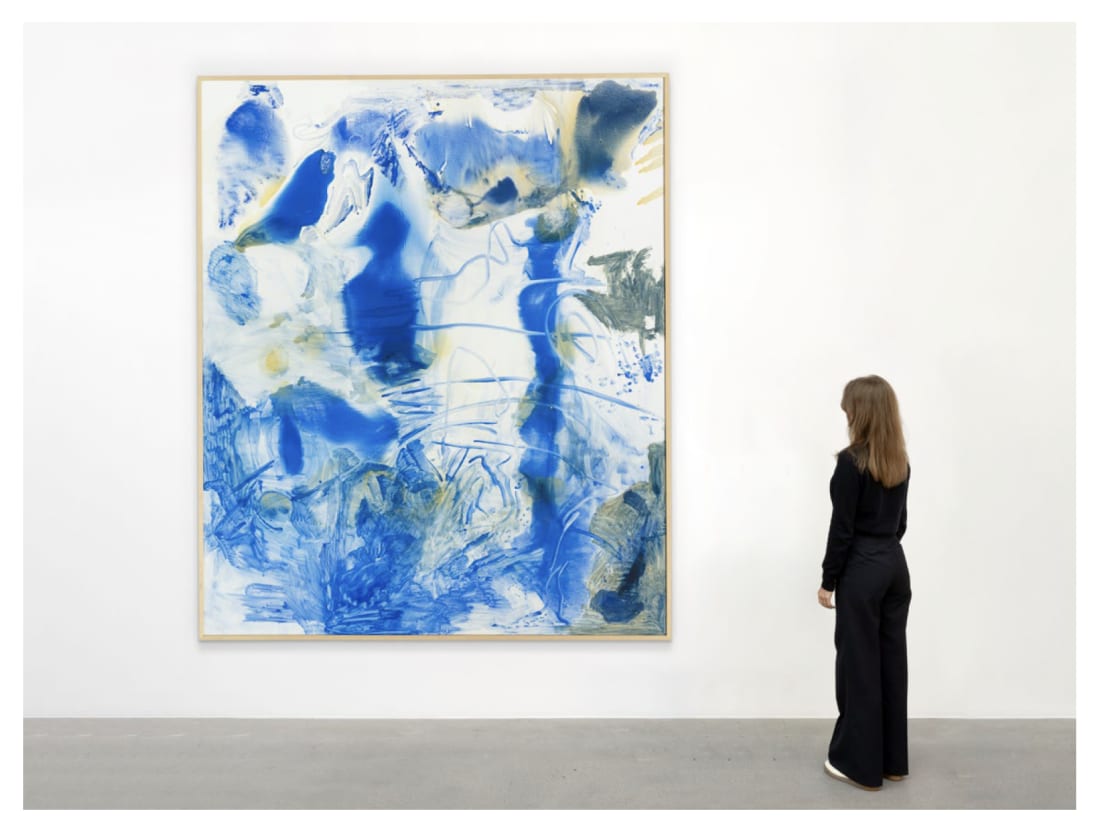
There is also a quieter discovery at Nicola Vassell, where Na Kim‘s Blue brings together three series exploring the territory between portraiture and landscape. It is precisely the kind of painting exhibition that can be missed amid the larger names, and shouldn’t be.
And at Galerie Lelong, Alfredo Jaar revisits his seminal A Logo for America, originally conceived as a Times Square billboard in 1987. Nearly forty years later, its questions around national identity and the meaning of “America” have acquired an entirely different urgency.
LONDON — September 16–21
 Courtesy of Waldorf Astoria London Admiralty Arch.
London‘s gallery programme becomes particularly interesting as Frieze approaches.
At White Cube Bermondsey, Gabriel Orozco‘s Chronotopic White brings together a new body of work across sculpture, photography and painting. Nearby, Teresa Solar Abboud‘s Atlantic Ridge Multiplicity at Lehmann Maupin is another exhibition to put on the list, particularly for those interested in artists working between materiality, landscape and constructed environments.
For something more intimate, Pilar Corrias presents Mary Ramsden‘s The Feeling of What Happens, while GRIMM presents Jonathan Wateridge‘s Some Distance Apart. Both offer a welcome counterpoint to the blockbuster rhythm of Frieze week.
Then there is Massimo De Carlo, where Xue Ruozhe‘s One Table, Two Chairs turns the domestic interior into a strangely charged space of memory and observation. It feels particularly appropriate in a city where design, fashion and art increasingly occupy the same vocabulary.
If there is time for one institutional detour, make it the Tate Modern‘s Ana Mendieta retrospective. The scale is justified by the artist’s continued relevance: her relationship to the body, landscape, displacement and ritual still feels remarkably contemporary.
MILAN — September 22–28
 Courtesy of Il Salumaio di Montenapoleone.
Milan is the pause in the route, and perhaps that is precisely why it works.
The most interesting opening is Nuria Maria‘s Blues Rouge at Cadogan Gallery, opening September 17. But the city is better approached through its smaller contemporary spaces and the dialogue between art, design and fashion rather than as a traditional gallery circuit.
For those extending into October, Gió Marconi‘s Song of the Sirens by Nathalie Djurberg and Hans Berg opens October 1, bringing together the Swedish duo’s unsettling combination of sculpture, animation and sound.
PARIS — September 29–October 6
 Courtesy of Cheval Blanc Paris.
Paris is where the season reaches its most concentrated point.
Start at Galerie Chantal Crousel, where Wolfgang Tillmans‘ Glade / Clairière offers a new perspective on one of the most influential photographers of his generation. Across town, Johan Creten‘s Les Chiens de Pavlov at Perrotin brings together sculpture and myth with the artist’s characteristic mixture of sensuality and unease.
At White Cube, Christian Marclay‘s exhibition should be high on the list. His work has always existed somewhere between visual art, music and popular culture, making the show particularly resonant during Paris fashion week.
And one of the more interesting discoveries is Sungi Mlengeya‘s Earth and Sky at Les Filles du Calvaire, bringing the Tanzanian artist’s intimate figurative language into a Paris context.
Finally, Jennifer Guidi‘s Waterfall at Gagosian offers a more immersive, materially seductive conclusion to the route.


