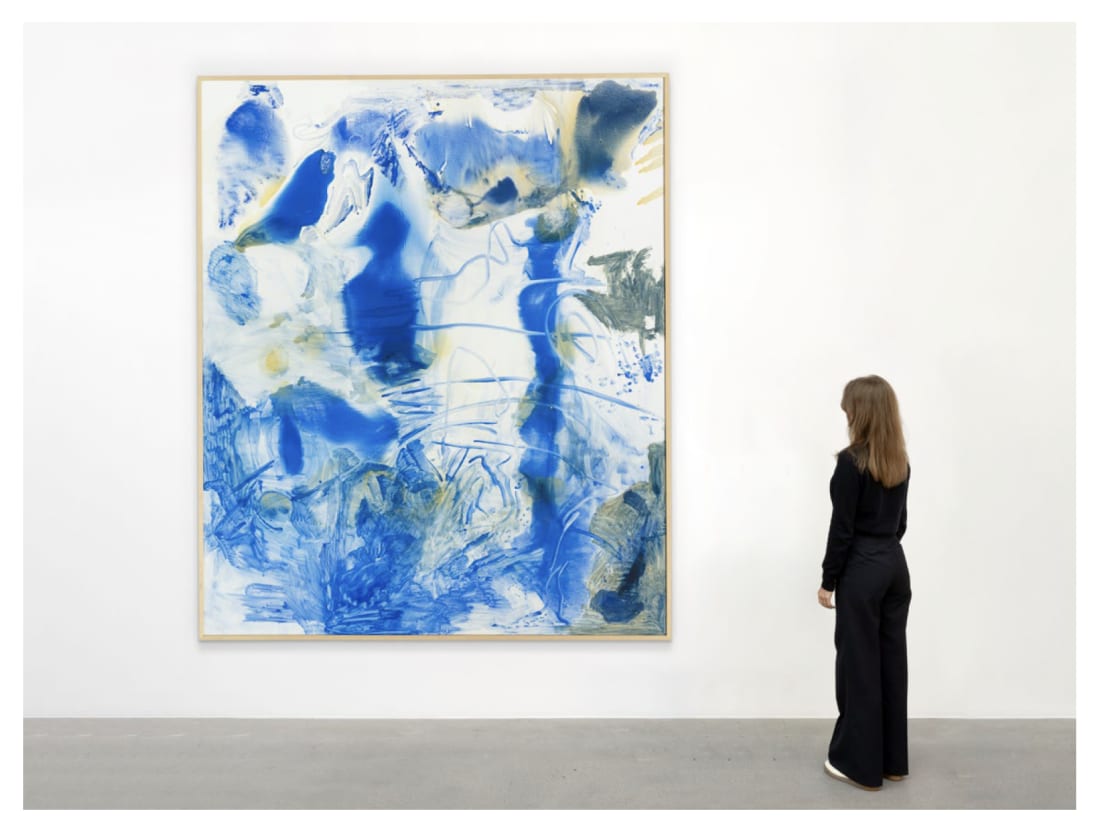


At Lafayette Anticipations, Hélène Fauquet’s “Vivresse” brings together recent works in which photographs, shells, frames, and bubbles slip between the natural and the artificial. The exhibition takes its title from an invented contraction of vivre and ivresse, suggesting an exaltation of living. It is also a fitting lens for an artist whose objects seem to emerge from a space between waking and dreaming, where images become sculptures, familiar things become strange, and perception is never quite still. “Vivresse” is Fauquet’s first institutional exhibition in France.
 Hélène Fauquet, “life-world (detail),” 2023. Prints, frames, table, 75 × 85 × 135 cm. Courtesy the artist and Kunsthaus Glarus. Photo Gina Folly © Hélène Fauquet _ ADAGP, Paris, 2026.
WHITEWALLER: What does “Vivresse” mean to you?
HÉLÈNE FAUQUET: It is an invented word, a contraction of vivre and ivresse, suggesting a form of “exaltation of living.” It’s also exuberant with lyricism, but it’s the lyricism of motivational, corporate culture, of optimized well-being.
WW: How do your assemblages take shape?
HF: The assemblages first take shape mentally; there isn’t really a method as such, perhaps more like sleepwalking. They may have something in common with the Surrealists’ automatic writing. Many of these ideas come together in a semi-dreamlike state that happens just before falling asleep or just after waking up. The piece Melo diadema, for example, is at once an egg, a Fabergé egg, an extraterrestrial being, and a princess’s crown but with little teeth all around it. Turbo sarmaticus looks like a small sock folded back onto itself. I’m also interested in silverware as much as artillery, in the way a table is set.
 Hélène Fauquet, “Untitled,” 2024. Courtesy the artist © Hélène Fauquet _ ADAGP, Paris, 2026.
“Many of these ideas come together in a semi-dreamlike state that happens just before falling asleep or just after waking up.”
—Hélène Fauquet
WW: What led you from photography toward sculpture?
HF: I came to the shell assemblages while working on a self-published book about the pictures that were displayed as sculptures in the shows Phenomena (Kunsthaus Glarus, 2023) and Nuit de Cellophane (Ulrik, 2024). The images reached a point of saturation that lead me to try covering them with seashells I had already been gathering. So the first impulse was one of obliteration, and maybe also of preservation, or shielding.
WW: What fascinates you about shells and bubbles?
HF: Some mollusks have an organ called the mantle, a kind of soft tissue that surrounds its body that eventually solidifies into a shell. The container and the contained therefore co-produce one another. It is an object calculated by the living that takes shape continuously along with itself. The shells are an expression of self-production and auto-generated fortification.
My photographs were initially inspired by scientific macrophotography, then by advertising for moisturizers, perfumes and soft drinks, which borrows the abstract language of scientific imagery while conveying ideals of purity, transparency and beauty. They embody the implicit promise of transforming something in our lives.
WW: What continues to interest you about images?
HF: In the exhibition “Phenomena” at Kunsthaus Glarus, I was thinking of the tables as sections of a brain or of the unconscious—blocks of memories, but also blocks of data that could be uploaded. I also wanted to push this accumulation of images so that they are received at the same time. Maybe I have become interested in animating the way we think through images—the punctum, when an image speaks to us and we don’t know why.
What to Know
 Hélène Fauquet, “Phenomena,” 2023, Kunsthaus Glarus. Installation view. Courtesy of the artist and Kunsthaus Glarus. Photo: Gina Folly © Hélène Fauquet _ ADAGP, Paris, 2026.
Don’t Miss
Hélène Fauquet’s “Vivresse,” her first institutional exhibition in France.
Why It Matters
A strange and sensual investigation of perception, images, nature, and artifice.
Dates
October 21, 2026–January 3, 2027.
Venue
Lafayette Anticipations, 9 rue du Plâtre, 75004 Paris.
Special Program
Explore Fauquet’s shell-covered photographs, sculptural assemblages, and shimmering bubble forms across “Vivresse.”
 Hélène Fauquet, “Orange colored sky,” 2022. UV print on wood, 70 x 46 cm. Courtesy of the artist and Edouard Montassut, Paris. Photo: Gina Folly © Hélène Fauquet _ ADAGP, Paris, 2026.
 Hélène Fauquet, “Gel (detail),” 2024. Prints, frames, table, 99.1 x 139.7 x 61 cm. Courtesy of the artist and Ulrik, New York. Photo: Stephen Faught © Hélène Fauquet _ ADAGP, Paris, 2026.