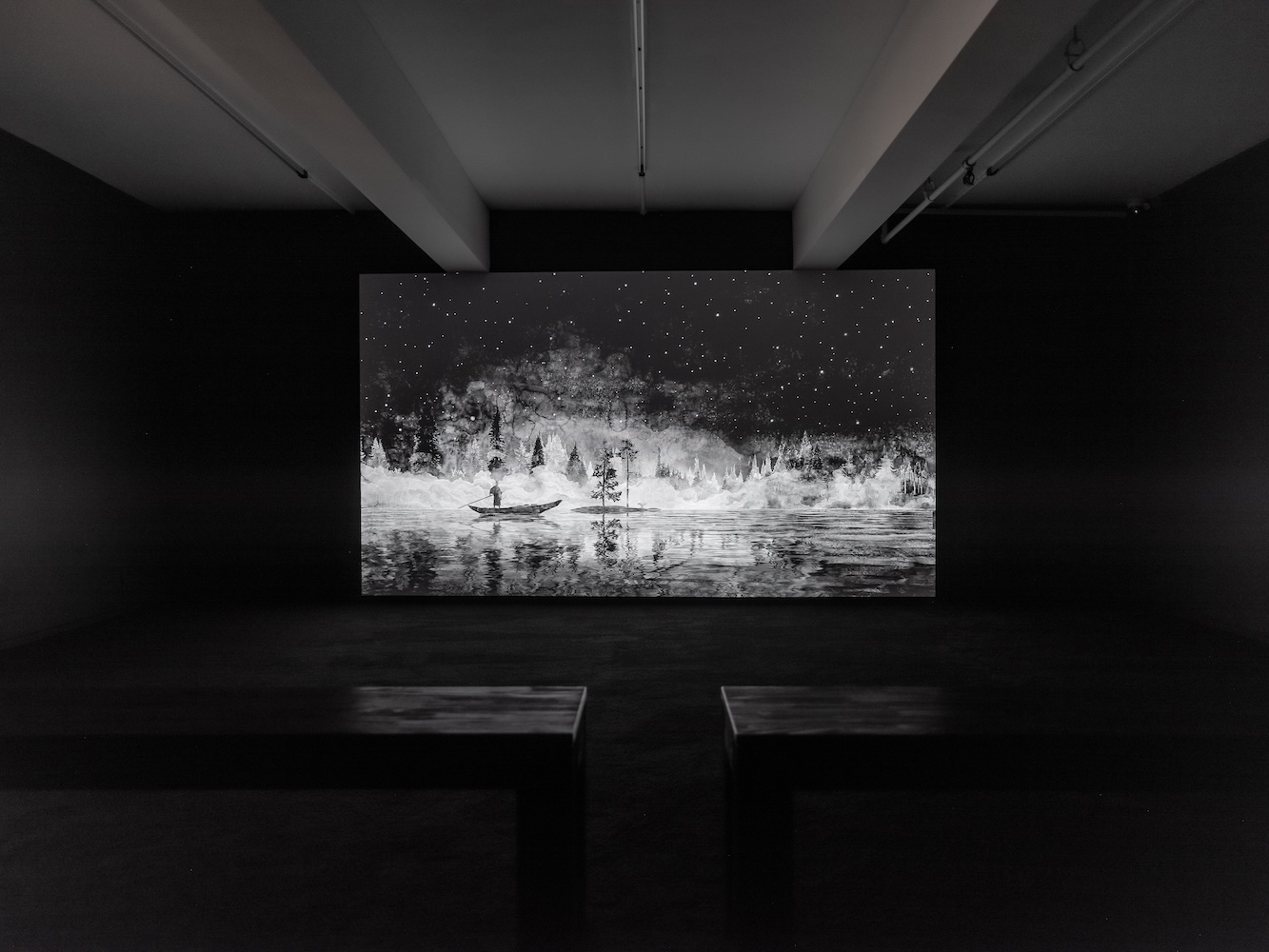


Delvaux has opened the Arsenal, its headquarters and historic atelier on the eastern edge of Brussels, to the Belgian artist Hans Op de Beeck. Inside a building where leather is cut, assembled and finished every day, the artist has installed a full sculptural environment: a long black pond planted with white lilies, a bamboo enclosure, Chesterfield sofas cast in fiberglass, and a slowly turning sphere of words. The Maison has lent its name and its archive to artists before, notably through its long relationship with the Magritte Foundation, but it had not handed over the floor of its own workshop.
What makes the project unusual is not the scale. It is the refusal to clear the room first. The artisans are still there, still working, and the sound of their tools runs underneath the ambient soundtrack Op de Beeck composed for the space. This is not a white cube, and the piece does not pretend otherwise.
Delvaux Opens the Arsenal, Its Historic Brussels Atelier


The Arsenal sits in Etterbeek, in a district that takes its name from the former military barracks and depot that once occupied the site. Delvaux’s headquarters there is less a corporate address than a working ecosystem: an active leather goods atelier, a leather library, a design studio, the Musée Delvaux, and the archive the house calls its Livre d’Or, which holds more than 3,000 handbag models accumulated since 1829.
Founded in Brussels that year by Charles Delvaux, a year before Belgian independence, the house describes itself as the oldest fine leather goods company in the world and has been an official purveyor to the Belgian Royal Court since 1883. It filed a handbag patent in 1908, for the model called le “Princesse”. The Brillant arrived in 1958, the Tempête in 1967, the Pin in 1972, the Cool Box in 2018. Since 2021 the Maison has belonged to Richemont. Jean-Marc Loubier, who first invested in Delvaux in 2011, returned as chief executive the same year.
What Hans Op de Beeck Installed Inside the Workshop
 Photo by Yohann Fontaine, courtesy of Delvaux.
The centerpiece is a long, shallow pond, its surface a black so still it reads as glass, scattered with white lilies that will never open further than they already have. Bamboo rises around the perimeter, chosen by the artist for what it stands for rather than how it looks: resilience, flexibility, an absence of arrogance. Tufted sofas, sculpted rather than upholstered, invite people to sit down in a place nobody normally sits down in. Classical plinths of varying heights ring the water, each carrying a Delvaux creation, the Brillant among them.
Everything is grey. The installation is monochrome from end to end, in the register Op de Beeck has worked in for years, and the effect inside a workshop is disorienting in a specific way: the bags on the plinths, the only objects in the room that are meant to be colored, are pulled into the same suspended palette as the lilies and the bamboo.
Two Children, a Crystal Ball and a Rotating Orrery


At either end of the water sit two figures. Brian, a bald boy, meditates on a rock with his eyes closed and a crystal ball resting in his hands, entirely at peace. At the other end, Zhai-Liza, a small girl with angel wings and a magic wand, sits on a low footstool with her chin in her hand, gazing at nothing. She has clearly stopped believing in her own fairy tale. Between them, tranquility and melancholy, the two things that tend to arrive together when a person finally stops moving.
Rising from the center is a reinterpretation of an eighteenth century mechanical planetarium, its spheres turning slowly, words inscribed among them: infinity, emptiness, letting go. Elsewhere in the space, a work made on the artist’s own initiative sets two small birds nestled against each other on top of a Brillant. Op de Beeck has said the bag, to him, reads as a sculptural soul.
Why Grey: A Shared Position on Color
 Photo by Yohann Fontaine, courtesy of Delvaux.
The monochrome is the hinge of the whole project, and it is where the two practices genuinely meet rather than merely coexist. Op de Beeck strips color out to remove distraction, so that form, weight and surface carry the emotion and time appears to stall. Delvaux spends enormous development effort in the opposite direction, on shades that behave correctly on natural leather, from pastels and whites, notoriously difficult to master, through to the deepest tones, with the aim that the material stays visible rather than buried under the finish.
Opposite methods, identical conviction: color is not decoration, and neither party is interested in a season. As the artist puts it in the project statement, arts and crafts are fundamentally about deep dedication, whether the act in question is making an object or telling a child a bedtime story.
A Maison That Would Rather Share Than Sell
 Photo by Yohann Fontaine, courtesy of Delvaux.
Loubier frames the collaboration as a place and an encounter rather than a product story, an exploration of the two worlds where, in his words, atmosphere, soul, objects, work, colors and sound converge in unexpected harmony. No capsule bag has been announced alongside it. Nothing in the Arsenal is for sale. For a luxury house in 2026, that restraint is the statement: the installation asks visitors to spend time in the building where the objects are made, rather than in the store where they are sold.
Hans Op de Beeck’s Brussels Autumn: “Vanishing Point” at Almine Rech
 Photo by Yohann Fontaine, courtesy of Delvaux.
The timing is not accidental. Op de Beeck opened “Vanishing Point” at Almine Rech Brussels on 10 September, his first exhibition with the gallery and his first solo presentation in the city in more than fifteen years, on view through November 7. Seen together, the two projects make an argument the artist has been building for two decades: the Arsenal installation places his suspended world inside a working building, while the gallery show pursues the same threshold in a room designed for looking.
Born in Turnhout in 1969, Op de Beeck lives and works between Ghent and Brussels. His “Danse Macabre” runs at Tenuta Dello Scompiglio near Lucca through 25 October 2026, with solo exhibitions to follow at Ron Mandos in Amsterdam in early 2027 and Galeria Continua in San Gimignano in the spring.