

For more than a century, the Île Seguin was a place of production. The island in the Seine at Boulogne-Billancourt was home to Renault’s factories and closed to the public. This October, its tip opens with a new purpose. Large, cultures contemporaines, an art center backed by Groupe Emerige and directed by Paula Aisemberg, opens on October 17 with an exhibition that looks back at the site’s industrial past.
Architecture for a New Cultural Landmark
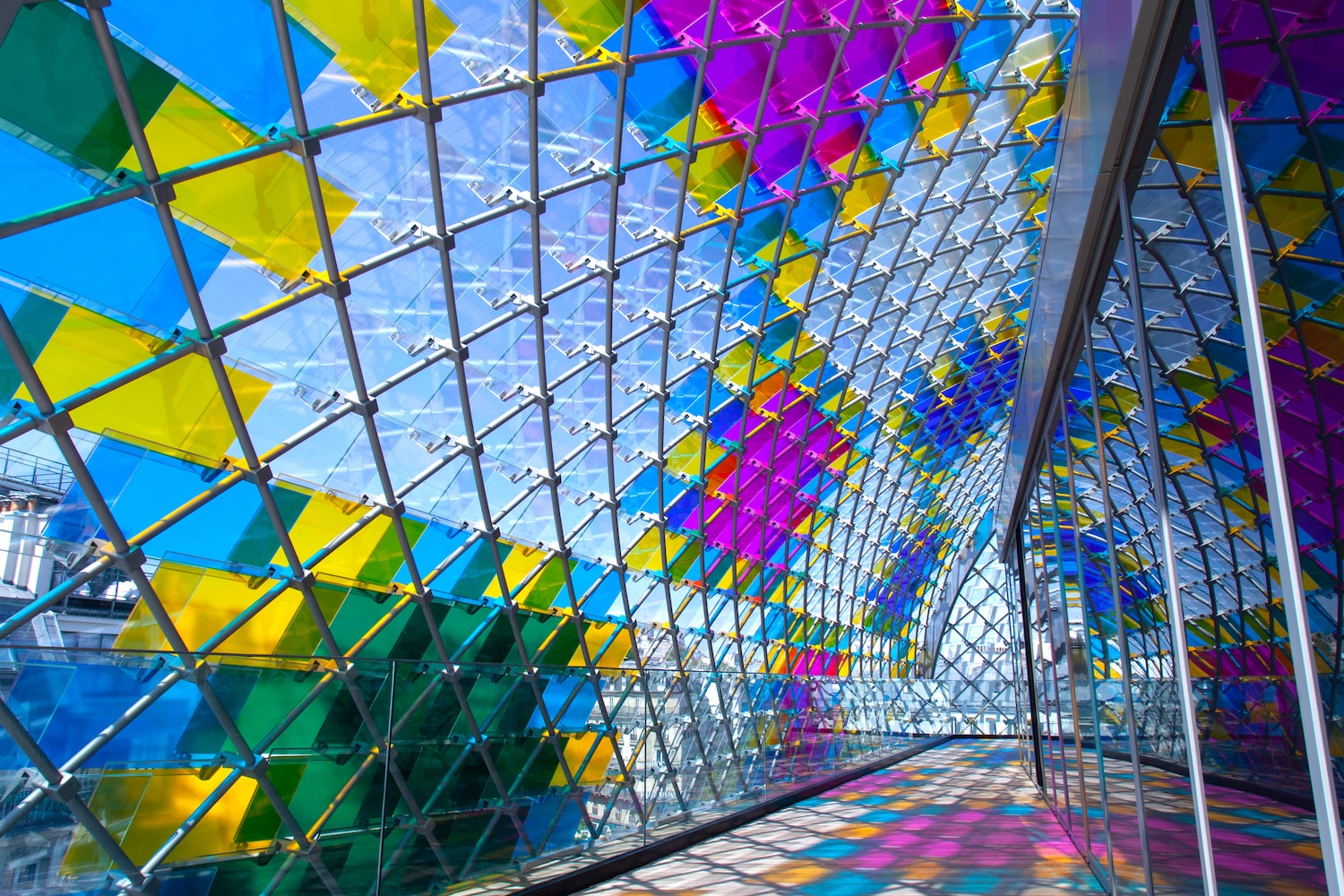
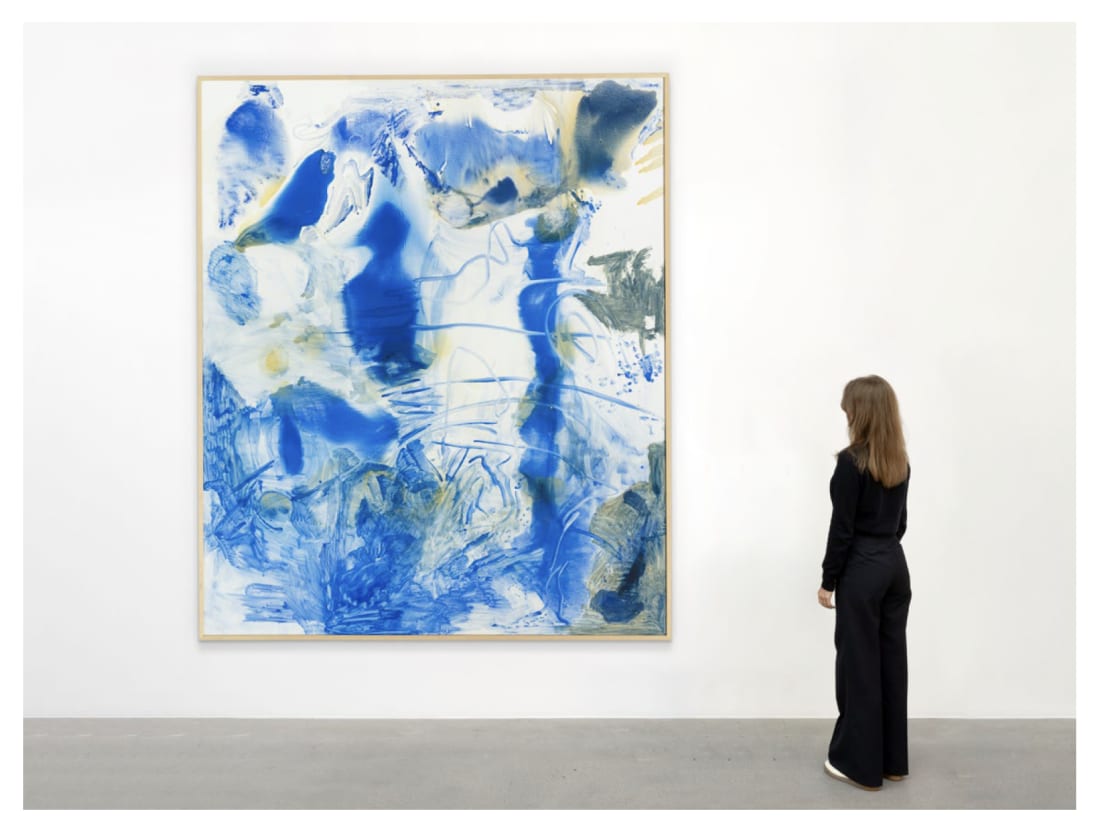
 Madeline Hollander, “Sunrise/Sunset,” 2021, installation view, Deitch LA, 2022, photo by Joshua White, © Madeline Hollander and Bortolami, New York.
The building was designed by RCR Arquitectes, winners of the 2017 Pritzker Prize, with the CALQ agency. Of its 5,000 square meters, 2,500 are for exhibitions. The visit moves from the tight spaces of the coffee shop into a 1,000-square-meter main gallery, with daylight filtered through aluminum moucharabiehs, putting physical encounters with art first. The name carries two meanings. In French, prendre le large means to set sail. It evokes the open horizon around the island and an ambition: to reach the widest possible public. Large describes itself as a hybrid, both an exhibition space and a supporter of French artists, from emerging practices to major 20th-century figures.
For the opening, Large invited the curator Cecilia Alemani. Her exhibition, “Imaginary Engine: From Masterpieces of the Collection Renault to Artists of Today,” is presented with the Fonds Renault pour l’Art et la Culture and explores the relationship between humans and machines, with a focus on the automobile. Works from the carmaker’s collection by Victor Vasarely, Jean Dubuffet, Jean Tinguely, and Robert Doisneau hang alongside 17 new commissions, by artists including Théo Mercier, Sara Sadik, Bianca Bondi, Clément Cogitore, Bertrand Lavier, Mohamed El Khatib, Oliver Beer, Bertille Bak, Thu Van Tran, and Giulia Andreani.
The Art of Reinvention
 Clément Cogitore, Untitled, 2026. Video, 12 min, 4K, color, silent. © Clément Cogitore, ADAGP 2026.
The exhibition unfolds in five chapters, from “The Factory of My Thoughts” to “The Human Machine,” moving from the industrial utopias of the last century to the technological and social changes of today, on the very ground where the cars were once built.
“While our visions of industry and of the automobile continue to evolve, at Renault we know that the magic still remains,” said Jean-Dominique Senard, chairman of Renault Group, whose ties to artists go back to the 1960s. For Laurent Dumas, chairman of Emerige, the project began ten years ago as “an ambition: breathing new life into the Île Seguin by creating a space where art, architecture and the public could encounter one another freely.”
What to Know
 Jean Dubuffe, “Le Mur bleu,”1966–1969. Photograph by Georges Poncet. © Renault Fund for Art and Culture. © Dubuffet Foundation, Paris. © ADAGP 2026.
Don’t Miss: The 17 new works commissioned for the opening, shown alongside masterpieces from the Renault collection.
Why it Matters: A former industrial island opens to the public with a new art center dedicated to the French scene.
Dates: October 17, 2026–March 7, 2027.
Venue: Large, cultures contemporaines, Pointe des Arts, Île Seguin, Boulogne-Billancourt. Metro lines 9 and 15.
Special Program: Five chapters curated by Cecilia Alemani, in partnership with the Fonds Renault pour l’Art et la Culture.