


A lone rider crosses a darkening shore beneath an orange sun: a late Magritte in Mayfair, and worth the journey on its own. Around the corner, Cindy Sherman‘s newest characters are draped in fabric from Chanel‘s archives, while Tate Britain relives the nineties, from Hirst to McQueen. As Frieze returns to Regent’s Park this October, London‘s finest exhibitions are looking back: to artists no longer with us, to series rarely seen together, to careers that began in this city. Here are ten shows to see around Frieze week, arranged as a route from Mayfair to Millbank, plus one discovery to catch before the fair opens.
“This Is Still Not a Pipe: The Afterlife of Magritte”
Gagosian
Mayfair
 René Magritte, “Le Lampe philosophique (The Philospher’s Lamp),” 1936, oil on canvas, 19 3/4 x 26 inches. © 2026 C. Herscovici/Artists Rights Society (ARS), New York. Courtesy Private Collection, Brussels, Kingdom of Belgium.
Bowler hats, apples, and cloud-filled skies drift through Gagosian‘s Grosvenor Hill gallery this fall. Organized with the Fondation Magritte, the exhibition traces René Magritte’s career from Les Fleurs du voyage (1926), which hung in his first solo show, to the late Les Orgues de la soirée (1965), where a lone rider crosses a darkening shore beneath a low orange sun. Around him, more than 40 artists, from Vija Celmins to Dana Schutz, take up his questions about what an image can hold, many in works made especially for the show.
What we love: It is a museum-quality show in a commercial gallery, and a reminder of how much of today’s art still runs through Magritte.
“This Is Still Not a Pipe” at Gagosian, 20 Grosvenor Hill, Mayfair, London W1K 3QD
September 24 – December 12, 2026
Georg Baselitz: “The Heroes 1965–66”
Thaddaeus Ropac
Mayfair
 Georg Baselitz, “B.j.M.C, – Bonjour Monsieur Courbet,” 1965, oil on canvas, 162 x 130 cm. Photo by Ulrich Ghezzi. © Georg Baselitz 2026. Courtesy Thaddaeus Ropac gallery, London · Paris · Salzburg · Milan · Seoul.
 Georg Baselitz, “Kopf (1, Head), 1966, oil on canvas, 100 x 81 cm. Privately owned,
Austria. Photo by Friedrich Rosenstiel, Köln. © Georg Baselitz 2026. Courtesy Thaddaeus Ropac gallery, London · Paris · Salzburg · Milan · Seoul.
In 1963, police closed Georg Baselitz‘s first solo exhibition in West Berlin and confiscated two paintings. Within two years he had begun the “Heroes,” large, battered figures that became one of the defining series of postwar European painting. Opening months after the artist’s death, this is the first U.K. exhibition devoted to the series alone, with loans from Tate and several major German museums.
What we love: Sixty years on, these paintings have lost none of their unease.
Georg Baselitz at Thaddaeus Ropac, Ely House, 37 Dover Street, Mayfair, London W1S 4NJ
October 13 – December 18, 2026
Cady Noland
Gagosian
Mayfair
 Cady Noland’s two-volume book “The Clip-On Method,” 2021. Photo by Maurico Zelaya. Courtesy of Gagosian.
Cady Noland rarely exhibits, so an exhibition of new work at Gagosian‘s Davies Street gallery is news in itself. It coincides with the relaunch of The Clip-On Method (2021), a two-volume, 600-page book Noland designed herself and treats as an artwork. Her subject for four decades has been American culture: its myths, its violence, its fixation on celebrity.
What we love: New work from Noland doesn’t come around often, and collectors will be watching closely.
Cady Noland at Gagosian, 17–19 Davies Street, Mayfair, London W1K 3DE
October 12 – December 19, 2026
Cindy Sherman and Lorna Simpson
Hauser & Wirth
Mayfair
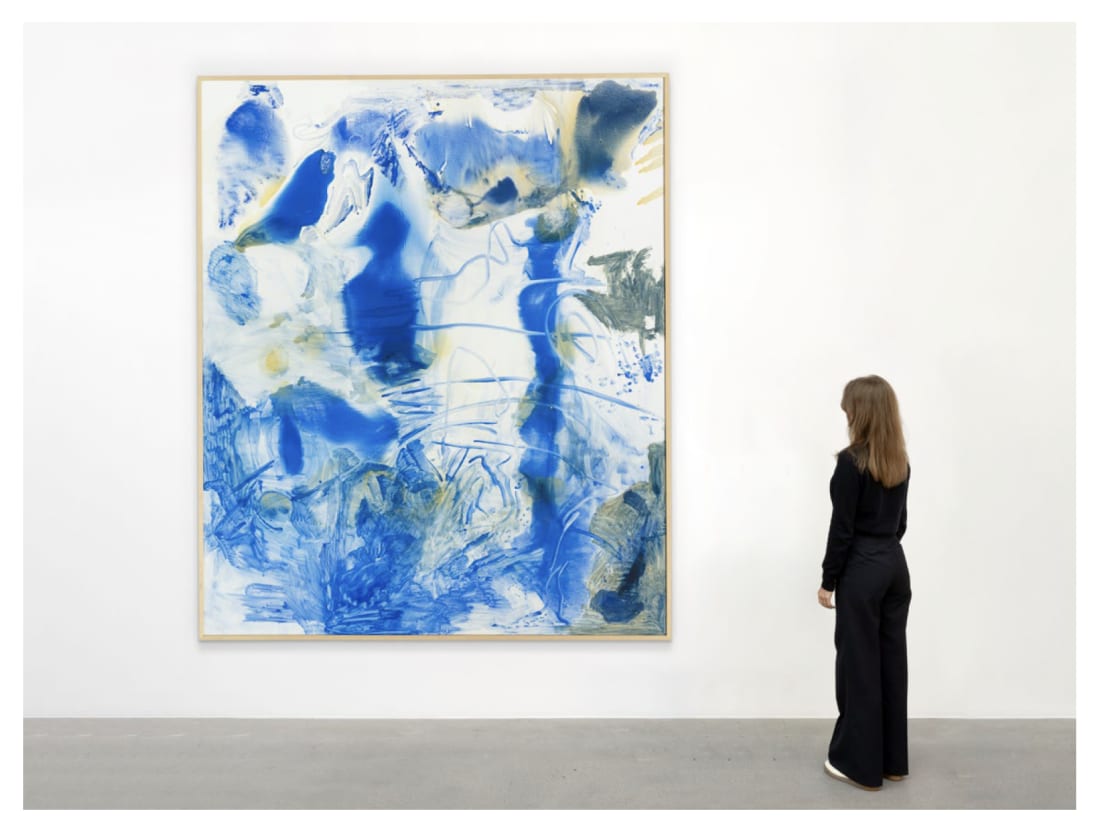
 Lorna Simpson, “Constellation,” 2026, acrylic and screen print on gessoed fiberglass, 191.8 x 149.9 x 3.8 cm / 75 1/2 x 59 x 1 1/2 in. © Lorna Simpson. Courtesy of the artist and Hauser & Wirth. Photo by James Wang.
 Cindy Sherman, Untitled #704, 2026. Chromogenic color print. 101.6 x 67.6 cm / 40 x 26 5/8 in. © 2026 Cindy Sherman / Artists Rights Society (ARS), NY. Courtesy of the artist and Hauser & Wirth
Cindy Sherman‘s new series, “Fabric Matrons,” deals with beauty, aging, and femininity, and many of the photographs incorporate fabrics from Chanel’s archives. At the same Savile Row gallery, Lorna Simpson returns to the U.K. for the first time in eight years with new paintings, collages, and sculpture built on archival news photography, particularly from Ebony magazine. It follows her survey at the Metropolitan Museum of Art. The two shows open on the same day and make a good pair.
What we love: Both artists have spent decades asking who controls the image of a woman, and seeing them side by side sharpens the question.
Cindy Sherman and Lorna Simpson at Hauser & Wirth, 23 Savile Row, Mayfair, London W1S 2ET
October 13 – December 23, 2026
Salman Toor: “Someone Like You”
The Courtauld
Strand
 Salman Toor (b. 1983), “Bar Boy,” 2019, oil on plywood, 121.9 x 152 cm. Collection of the Whitney Museum of American Art, New York. © Salman Toor; Courtesy of the artist, Luring Augustine, New York, and Thomas Dane Gallery. Photo by Farzad Owrang.
In 2017, Salman Toor stood before Édouard Manet‘s A Bar at the Folies-Bergère (1882) at the Courtauld; two years later he answered it. The Bar on East 13th (2019) replaces Manet’s detached barmaid with a bartender in braids and nail polish, surrounded by couples absorbed in each other. Borrowing the staging of old masters from Manet to Lotto, Toor paints queer and immigrant lives those traditions left out. His first solo exhibition in Europe gathers 19 paintings never before seen in Britain.
What we love: Toor rewrites Manet’s most solitary scene as one of belonging.
Salman Toor at the Courtauld, Somerset House, Strand, London WC2R 0RN
October 2, 2026 – January 10, 2027
Robert Ryman: “The Real Thing”
Barbican
City of London
 Robert Ryman, “Untitled Study,” 1963. Kenneth C. Griffin Collection. © 2026 Robert Ryman : DACS, London. Photo by Stephen Arnold, courtesy David Zwirner.
 Robert Ryman, “Untitled, Surface Veil,”, ca. 1970–71, 22″ × 19”. San Francisco Museum of Modern Art. Purchase through a gift of Mimi and Peter Haas. © 2026
Robert Ryman / DACS, London. Photo by Bill Jacobson Studio, © The Greenwich Collection, New York.
Robert Ryman moved to New York in 1952 to play jazz saxophone and ended up spending nearly 60 years on painting, most of it in white. This is his first major U.K. survey in over 30 years, with more than 60 works on linen, steel, fiberglass, and even coffee filter paper. He often left the fasteners and tape visible. “You cannot understand painting by explaining something,” he said, and the show is best seen slowly.
What we love: Give it time, and white turns out to hold endless variety.
Robert Ryman at the Barbican, Silk Street, City of London, London EC2Y 8DS
October 8, 2026 – February 28, 2027
Cecilia Vicuña: “Living Threads”
Whitechapel Gallery
Whitechapel
 Cecilia Vicuña, “Witoto,” 2024, oil on canvas, 94 x 132.1 cm. © 2026 Cecilia Vicuña/Artist Rights Society (ARS), New York. Courtesy the artist and Xavier Hufkens, Brussels. Photo by Thomas Merle.
Cecilia Vicuña came to London in the early seventies and, after the 1973 coup in Chile, stayed on in exile, studying at the Slade and working from a studio in Stepney Green. Her first major U.K. exhibition brings six decades of painting, poetry, textile, and film back to the East End, including the “Palabrarmas” series she began here and the only surviving work from her London “precarios.” It closes with Foraging Quipu (2025–2026), a vast participatory work inspired by the quipu, the ancient Andean system of knotted cords, and woven with plant matter gathered by Londoners.
What we love: The show makes clear how much of Vicuña’s work began here.
Cecilia Vicuña at Whitechapel Gallery, 77–82 Whitechapel High Street, Whitechapel, London E1 7QX
October 7, 2026 – February 14, 2027
Gabriel Orozco: “Chronotopic”
White Cube Bermondsey
Southwark
Twenty years after his White Cube debut, Gabriel Orozco returns with “Chronotopic,” more than 100 works spanning sculpture, painting, photography, and assemblage. Curated by Briony Fer, the show unfolds like a travel log through time, in which everyday objects gain new meaning as they pass from one place and moment to the next. Look out for Sundial (2026), a luminous painting in tempera and gold leaf that folds the ordinary into the cosmic.
What we love: Orozco finds wit and poetry in the most ordinary objects.
Gabriel Orozco at White Cube Bermondsey, 144–152 Bermondsey Street, Southwark, London SE1 3TQ
September 16 – November 8, 2026
Sabine Moritz: “Lie Down in Green Pastures”
Garden Museum
Lambeth
 Sabine Moritz, “Heaven,” 2015. © Sabine Moritz. Courtesy the artist and Pilar Corrias, London.
Sabine Moritz‘s first U.K. museum exhibition unfolds in a former church beside Lambeth Palace. A painter who moves fluidly between figuration and abstraction, Moritz works from memory: here, the concrete housing blocks of her East German childhood in Neulobeda are slowly overtaken by plants. Floral still lifes and a vast new abstraction, painted especially for the show, complete an exhibition made up largely of works never exhibited before.
What we love: Memory and loss run through these paintings, but the flowers win.
Sabine Moritz at the Garden Museum, 5 Lambeth Palace Road, Lambeth, London SE1 7LB
October 8 – December 20, 2026
“The 90s: Art and Fashion”
Tate Britain
Millbank
 Alexander McQueen, AW98. Photo Guy Marineau, Vogue © Condé Nast.
Edward Enninful, who became fashion director of i-D at 18, has curated Tate Britain‘s look back at the nineties. More than 100 works by nearly 70 artists and designers include Damien Hirst, Tracey Emin, Wolfgang Tillmans, Juergen Teller, Alexander McQueen, and Vivienne Westwood. It covers the years when British art, photography, and fashion were closer than they had ever been, and it will be one of the most talked-about shows of the season.
What we love: Enninful was there, and it shows.
“The 90s: Art and Fashion” at Tate Britain, Millbank, London SW1P 4RG
October 8, 2026 – February 14, 2027
One to Watch: Polina Piëch, “Air I See”
Art Elsewhere
Mayfair
 Polina Piëch, “SUN SHINE,” 2025 (printed 2026) C-type (chromogenic) print on Fujiflex mounted on aluminum, 119 x 173 cm / 122 x 176 cm framed. Edition of 3 + 2AP. Courtesy of the artist and Art Elsewhere.
Polina Piëch turns air into form, color, and shape through photography. Air is invisible, known only through what it moves. Working on analog film, Piëch uses blur to trace wind and shifting light, and at large scale the images feel less like views than spaces to step into. Scent drifts from suspended natural materials, and singing bowls hum through the room. Catch it before it closes on October 8.
What we love: Piëch asks us to feel what we cannot see, and for a few quiet minutes, we do.
Polina Piëch at 14A Hay Hill, Mayfair, London W1J 8NZ
October 2–8, 2026
Also on our radar: William Kentridge at Goodman Gallery, Ha Chong-Hyun and Carmen Herrera at Lisson Gallery, and Ana Mendieta and Tarek Atoui at Tate Modern.