


Each March London’s auction houses perform a ritual temperature check with the first round of auctions for Modern and Contemporary Art. No different this year, after a long winter-lull where most art market players eagerly leapt onto any form of escapism (happily chasing sunny art fairs from Mexico City, Doha to Los Angeles, or at least warming in the glow of occasional optimistic headlines).
I started browsing the previews as New York was still contending with thick blankets of snow acute enough to trigger states of emergency and widespread disruption. While you could have easily likened the emptied streets and grounded flights grounded to the state of the market itself. But while the situation was serious in both cases, the long-term data tells a calmer story. From November’s strong results to a gentle resurgence of the Old Master market, there is a palpable sense of renewed confidence.
As a London-based advisor I always look forward to the March sales. They bring a particular energy to the city and more importantly, reveal artworks that have been often long unseen, offering young and seasoned collectors alike the chance to acquire works of enduring beauty and significance. The auction houses read the signs of a slower and shifted market and carefully converted this in their offerings of historical collections and material that stands out for its timeless quality and distinguished provenance. I´ve gathered some picks that I believe reward a closer look and here are some of my personal favourites.
Christie’s: Museum-Quality Masterworks
 Henry Moore (1898-1986), “King and Queen,” 1952-53. Bronze with a dark green and brown patina. Height 64.5 in (164 cm). Courtesy of Christie’s in London.
Standing out for its commanding scale and rarity amidst Christie´s evening sale is King and Queen (1952–53) by Henry Moore. Cast in bronze a year after the artist turned down a knighthood, he traced his inspiration for this work back to ancient art, notably a limestone double portrait of an Egyptian king and his wife at the British Museum and the fairy tales that he read to his daughter.
Moore who is more widely associated with the female form as his enduring subject, turns from the solitary figure to a pair, who´s posture evokes an archaic, formal dignity infused with an unmistakably modern and deeply human sensibility. Having always distilled the landscape within the body and the body within landscape, it reveals Moore’s ability to make bronze breathe and suggest flesh and soul beneath metal skin. There is something intimate about this couple beyond their sovereign poise, a palpable togetherness, maybe even slight unease that gives them a uniquely human pulse. Held in the same collection for over seventy years, this sculpture now comes to market with an estimate of £ 10-15 million.
Christie’s also presents two formidable works by Gerhard Richter: Schober (Haybarn) (1984) revisits landscape through a blurred lens. Based on a photograph, with brushworks dissolving the boundaries of naturalistic representation, this haybarn shimmers with hazy nostalgia and a longing for a simple life. Richter conjures a picture of nature and his native Germany suspended between documentation and dream, reality and memory. (Estimate £ 6–9 million).
With Abstraktes Bild (1991) you will find Richter’s journey into abstraction distilled in an radiating red squeegee. Subtle greens and yellows emanate beneath its surface, revealing Richter’s choreography of chance and control. (Estimate £ 4.5–6.5 million).
 Sonia Delaunay (1885-1979), “Rythme couleur (no. 132),” 1946. Oil on canvas. 68 7⁄8 x 59 in. (175 x 150 cm.). Courtesy of Christie’s London.
 Bridget Riley, “Arrest 4,” 1965. Emulsion on canvas. 75 ¼ x 73 5:8in. (191.3 x 187cm.). Courtesy of Christie’s London.
Among my personal favourites are a few pieces from the Vanthournout Collection, assembled by this Belgian couple whose passionate collecting began in the mid-1950s and evolved into a shared intellectual adventure. Roger selected artists, Josette chose the works. Installed in their refined home in Izegem, the pieces were placed in deliberate conversation bridging eras and artistic movements. From the three uncanny and somewhat comical aluminium figures of Thomas Schütte´s Kleine Geister to the mirrored reflections of Michelangelo Pistoletto, the collection demonstrates how juxtaposition generates meaning and connoisseurship can express itself in a silent yet powerful choreography.
Infinity Nets (1960) by Yayoi Kusama is a historic example from a foundational series. Built from obsessive, hand-painted loops, the canvas oscillates between repetition and dissolution. This is an early articulation of Kusama’s lifelong exploration of self-erasure and infinity. (Estimate £ 2–3 million)
Equally poignant is Pablo Picasso´s Nu debout et femmes assises (1939). Painted in the grim grisaille tones that followed Guernica, the work juxtaposes a standing nude Dora Maar with her seated, clothed counterpart. Created shortly after the outbreak of World War II it captures Picasso’s torn state, having later remarked that his paintings from this period carried the unfolding war turmoil in them. The work stages a deliberate polarity: exposure and concealment, stillness and tension, also reflecting Picasso´s simultaneous entanglement with two women. Standing in front of the small canvas for the first time, I was struck how a painting of such intimate dimensions could contain the weight and ambition of something far grander. It doesn´t feel compressed but delicate, existentially loaded and of sublime elegance. (Estimate £ 3–5 million).Further highlights at Christie´s include Rythme Couleur by Sonia Delaunay (est. £1–1.5 million), a vibrant orchestration of colours and form; Arrest 4 by Bridget Riley (est. £3.5–5.5 million), whose pulsating geometry destabilises your perception and Yagenko by Kazuo Shiraga (est. £1–1.5 million), where the Gutai master’s foot-painted dynamism animates the canvas with visceral force and an unusual array of colours.
Sotheby’s: Contours of Modernity
 René Magritte (1898-1967), “L’Automate,” 1962. Gouache on paper laid down on board. 34.7 by 27 cm. 13⅝ by 10⅝ in. Courtesy of Sotheby’s.
 Andy Warhol (1928-1987), “Four Marilyns (Reversal Series),” 1986. Acrylic and silkscreen ink on canvas. 91.5 by 71 cm. 36 by 28 in. Courtesy of Sotheby’s.
Sotheby’s Contours of Modernity: A Private European Collection offers another insight into a connoisseur´s choice of defining moments of 20th and 21st century, featuring works from Magritte to an Outrenoir by Pierre Soulages, an ochre Josef Albers and a refined 1958 achrome Piero Manzoni, attractively priced and exemplary in provenance.
In Four Marilyns (Reversal Series) (1986) Andy Warhol revisits the ultimate icon of his earlier works. He renders Monroe in negative register, quadrupled and spectral. In the 1980s, he effectively quotes himself – aligned with a renewed practice of appropriation instigated by younger contemporaries such as Cindy Sherman. Warhol reasserts his authorship as brand and myth. This work encapsulates that late-career self-reflexivity with an irresistibly chic glamour. (Estimate £ 1.800.000 – 2.500.000)
Staying on the darker hues, Sotheby´s will also offer one of the most ambitious works by Lucio Fontana I have seen in a long time. Concetto Spaziale, (1960), comes to market for the first time after being held in a visionary German collection for over sixty years. It immerses you as the viewer in a vast, almost cosmic field stabbed with holes. Fontana´s signature Buchi pierce the surface, radically breaking through the flatness of painting, opening it to the infinite space beyond. These Buchi rupture not only the canvas, but the boundary between painting and sculpture. The richly worked surface is punctured with a dense yet expansive feel, forming an abstract and thickly impastoed landscape. If it reminds you of spatial views of the earth or lunar structure, this is no coincidence given the artist´s fascination with space and the race to conquer it at the time of the work´s creation.
The work emits a rare tactile and energy – and as much as I love the elegance of a Fontana slash (of which that same German collection is selling a superb and large example) this wild vibration of black and turquoise had a captivating spell. (Estimate £ 8.5-12 million)
The Royal Academy Benefit
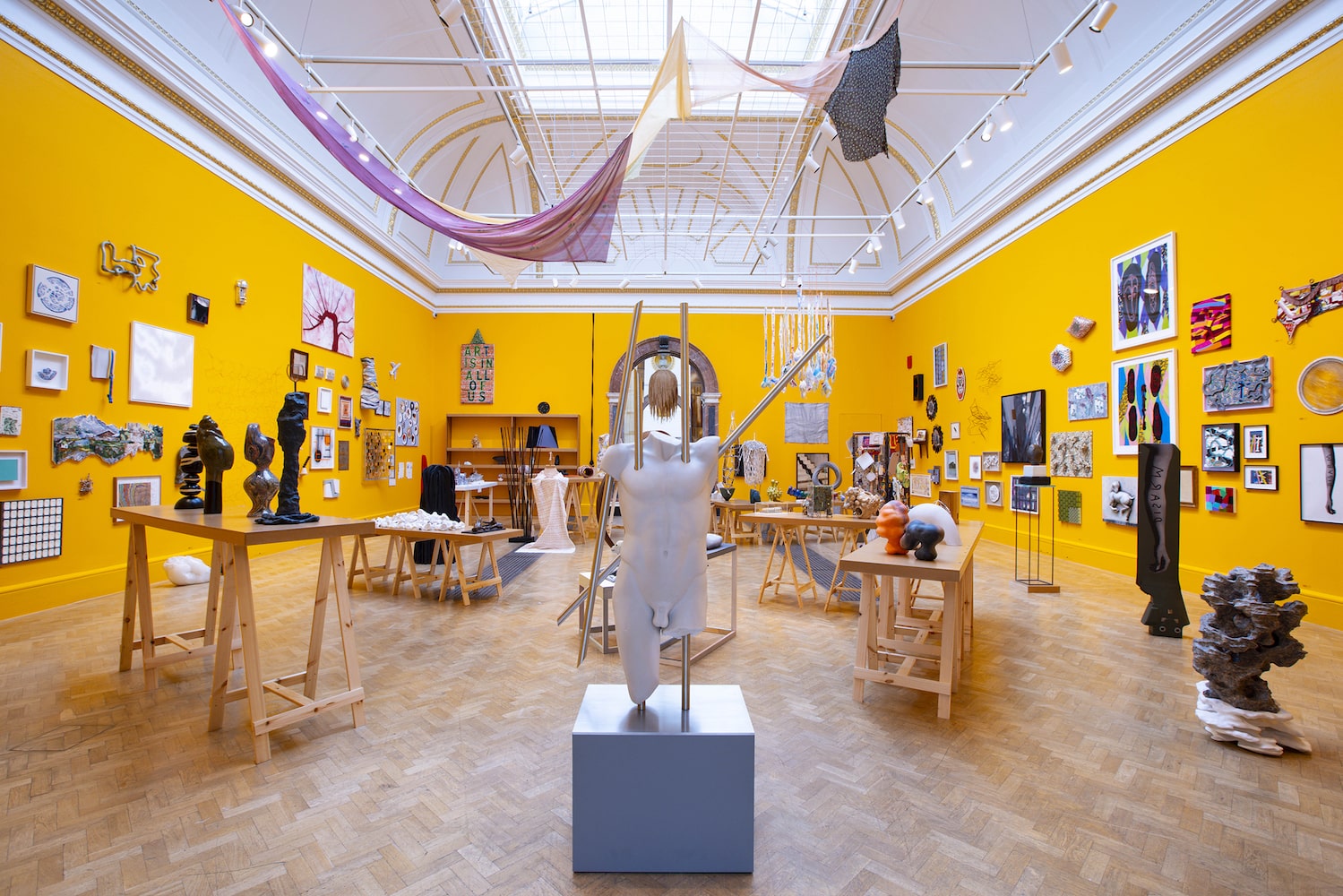 Royal Academy of Arts Summer Exhibition 2024, photo courtesy of Royal Academy of Arts.
This season also features a group of works generously donated by living Royal Academicians and honorary RAs like El Anatsui, Sean Scully, William Kentridge, Tony Cragg, and many more in support of the Royal Academy of Arts, which since its founding in 1768 has remained artist-led and independent. The proceeds (hoping to raise about £ 2m) will directly contribute to the education and exhibitions programs. In times of dwindling public financing and serious economic challenges, raising funds in creative ways is ever so crucial to the survival of our cultural landscape that gives us so much back in return. There is something fantastic about artists supporting artists and this effort deserves a closer look.
Masterpieces from the Lewis Collection
 Leon Kossoff (1926-2019), “Children’s Swimming Pool, 11 o’clock Saturday Morning, August,” 1969. Oil on board. 152.4 by 205.7 cm. 60 by 81 in. Courtesy of Sotheby’s.
A final note must be made of the masterworks from the Joe Lewis Collection: four formidable paintings that encapsulate the psychological intensity of postwar British art. Featuring a brimming, boisterous and large theatrical composition of a swimming pool by Leo Kossoff and two portraits by Lucian Freud that demonstrate the forensic scrutiny of the human body rendering skin as terrain. But leading the group is undoubtedly a self-portrait by Francis Bacon, in which flesh seems to hover between violence and vulnerability, the figure suspended in existential isolation with that unmistakable chromatic brutality.
Painted 1972 in the shadow of profound personal loss after the death of his partner George Dyer, this self-portrait by Francis Bacon was initially gifted to the physician who saw the artist through this tough period, before entering distinguished collection of Joe Lewis in 1994 from where it is now offered at an estimate of £ 8-12 million. Bacon confronts the velvety darkness with radiant light, recalling Degas’ pastels with twisted, scraped and viscerally applied paint animating the surface with raw immediacy. He is wrestling with his own image: electric colours that are at once abstract and naturalistic, forming a record of solitude and melancholy, and a ferocious investigation of the self.
Women who dare: Intimacy and Provocation at Bonhams
 Ana Mendieta (1948-1985), Untitled, 1982. Design on leaf. 20 x 13.5cm (7 7/8 x 5 3/8in). Courtesy of Bonhams.
At Bonhams, Untitled by Ana Mendieta offers a quiet, radical gesture: the outline of a female figure inscribed on a delicate leaf. Within this modest form lies the complexity of Mendieta’s practice moving through feminism and anti-colonial critique. The fragility of the leaf mirrors bodily vulnerability, yet its preservation suggests endurance and continuity. (Estimate £35.000–45.000)
Louder and more audacious is Gold Cup Maradona (2015) by Sarah Lucas, first presented on the portico of the British Pavilion at the 56th Venice Biennale in 2015. Sprawled across the neoclassical façade, its boldly masculine, fluid contours disrupted architectural decorum. Mischievous and unapologetically provocative, the sculpture embodies Lucas’ confidence and subversive wit. (Estimate £ 300.000–400.000)
Finds at Phillips
 Rebecca Warren, “Fascia V,” 2012. Bronze and painted MDF plinth. Courtesy of Phillips.
To say that Rebecca Warren’s sculptures are tactile feels like an understatement. In Fascia V, presented at the Phillips Evening Sale in London, she transmutes disparate references from Willem de Kooning to Alberto Giacometti into a rough-hewn, unashamedly exuberant form. But there is also a strong echo of the Venus of Willendorf. All of which are knowing nods to sculptural lineage that Warren honours and disrupts. Worked first in clay and then cast in bronze, the sculpture deliberately preserves the raw physicality of the artist’s touch. Estimated at £250.000–350.000, Fascia V is a bold, materially intelligent work that affirms Warren’s relevance as one of the most compelling sculptors of her generation.
Philips will also feature a selection of historical Danish works from the collection of former U.S. ambassador to Denmark, Ambassador John Loeb Jr., with several works by the master of interior light and stillness Vilhelm Hammershøi.
Speaking of interiors, there is a small still life titled Fleurs fines, formes légères (1937) by James Ensor. Featuring pearlescent shells, chinoiseries, masks and flowers into something dramatic and poetic at once, as if beauty and mischief were sharing the same table. There’s a modernity in the way he blurs object and emotion. The masks hover between ornament and alter ego which feels uncannily relevant now, in a world still negotiating performance and authenticity. It’s airy, tender and impossibly alive with colour. I’d take it home in a heartbeat, to live with its light and let its opalescent quirkiness unfold a little differently every day. (Estimate £ 180.000–250.000).
 James Ensor, “Fleurs fine, formes légères,” 1937. Oil on canvas. 40 x 50 cm (15 3/4 x 19 5/8 in.). Courtesy of Phillips.
I wish I could also include my selection of works at more affordable price-points, but I feel like I have already taken up enough of your time and will a keep a few thoughts for my clients as we hunt for discoveries.
But in sum these London auctions do more than signal the market’s confidence. They are rare opportunities to acquire works long hidden in private collections. For seasoned collectors and first-time buyers alike, they offer the thrill of scholarship and seduction: art-historical significance paired with personal adventures.