

Over the last two decades, Lucas Arruda has cultivated a body of work that feels intimate and expansive, where the horizon stretches beyond geography and light becomes a language unto itself. Painted on modestly scaled canvases that ask the viewer to move closer, his compositions carry an immense sense of space. They arise from observation, recollection, and intuition, gathering fragments of lived experience into landscapes that hover between dawn and dusk, presence and remembrance. Every brushstroke holds its breath, allowing atmosphere to settle with extraordinary delicacy.
Working from São Paulo, Arruda has remained closely connected to the flow of daily studio life even as his paintings have found audiences in museums and collections across the globe. His practice evolves through repetition and patience, with each canvas developing over time through countless adjustments, revisions, and moments of discovery. Arruda’s work resists haste. It rewards sustained attention, revealing hushed transitions of color, shifting veils of luminosity, and spaces that deepen the longer they are observed. Rooted in painting, his artistic language has also embraced projection and light-based installations, broadening his ongoing inquiry into perception while preserving the contemplative spirit that defines his work.
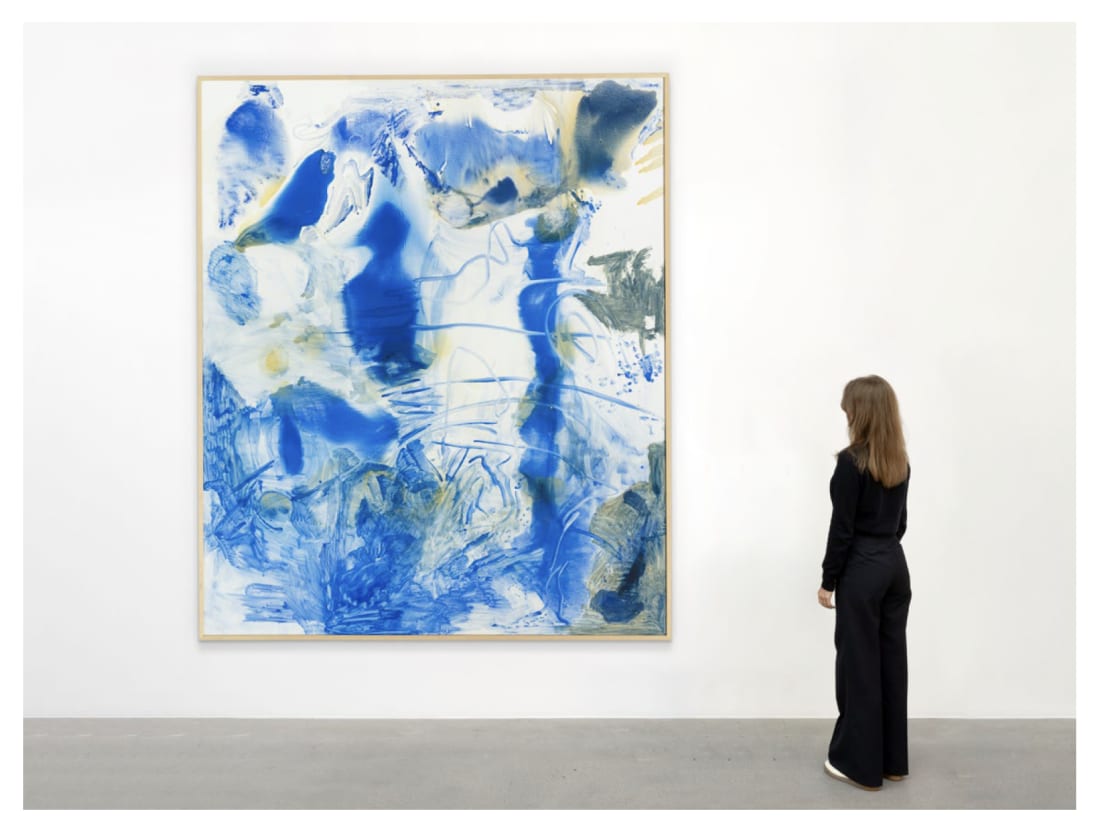
 Lucas Arruda, Untitled (from the Deserto-Modelo series), 2025, [oil on canvas], 24 x 30 cm, 9 1/2 x 11 3/4 in, photo: Everton Ballardin, copyright: © Lucas Arruda, courtesy the artist, David Zwirner and Mendes Wood DM.
This past year marked an especially meaningful chapter. Significant museum presentations invited Arruda’s paintings into new conversations, placing them alongside celebrated works of art history while also allowing his own visual vocabulary to unfold across distinct architectural settings. These exhibitions affirmed the timeless quality of his practice, demonstrating how his restrained compositions can resonate within vastly different environments without ever losing their singular voice. Throughout it all, the artist continues to return to the studio with notable consistency, welcoming routine as the tranquil foundation from which each new work begins.
Whitewall spoke with Arruda about the transformative presence of light in his paintings, the value of slowness in an accelerated world, and the open-ended process that continues to guide his practice.
Between the Museum and the Studio
 Lucas Arruda, Untitled (from the Deserto-Modelo series), 2020, oil on canvas, 30 x 30 cm, 11 3/4 x 11 3/4 in, photo by Everton Ballardin, © Lucas Arruda, courtesy the artist, David Zwirner and Mendes Wood DM.
WHITEWALL: This past year has brought significant institutional presentations, from the Musée d’Orsay in Paris to Carré d’Art in Nîmes. How has seeing your work unfold across these different museum contexts influenced the way you think about your paintings today?
LUCAS ARRUDA: Showing my work at the Musée d’Orsay was a very special experience. It placed my paintings within a broader dialogue, both with the museum’s historical context and with the way it displays many works together. I had the opportunity to choose specific paintings from the collection and think about the relationships between them, so my paintings became part of this larger conversation, surrounded by the Impressionists.
And just a few weeks later, at Carré d’Art, that experience was still very much with me, but the exhibition opened up other possibilities. The larger spaces allowed the paintings to stand more independently, and I could also bring together a video and the light installation. While at Orsay I was thinking about how my work could exist in relation to other artists and other moments in art history, at Carré d’Art the focus shifted more toward the relationships between my own works.
They were two very different contexts, and seeing the work in those different places reminded me that a painting is never completely isolated; it is always affected by what surrounds it… and whether in conversation with other works or on its own, the work is fundamentally the same.
WW: Your paintings often leave viewers suspended between memory, atmosphere, and place. When you begin a new work in the studio, do you start with a specific visual experience, or are you chasing a more elusive emotional condition?
LA: Usually I begin with a vague idea, but already with a certain structure in mind. It’s much more subjective and abstract than a specific place or visual experience. It can come from art history, from the real world, from imagined places… they’re never direct references.
Painting always begins with this leap into the unknown, with the work slowly telling you where it wants to go. Then there is a series of decisions to be made: what stays, what disappears, what gets erased, what gets transformed. Those decisions are very intuitive and gradually build the painting and give me direction.
The paintings might reveal an emotional condition, but that’s not something I’m consciously trying to represent; it happens through the process itself, and there’s always a gap between what I initially imagine and what the painting eventually becomes. Chance, accidents, and unexpected turns are an essential part of the process… That’s where the work really happens.
“Painting always begins with this leap into the unknown.”
-Lucas Arruda.
WW: You have lived and worked in São Paulo throughout your career while exhibiting around the world. How does returning to your studio in Brazil help you maintain a sense of continuity amid an increasingly international exhibition schedule?
LA: I actually really like routine. I like going back to the same places, having my habits, and repeating small rituals, like going to the studio every day; that’s really important to me.
Traveling and having exhibitions in different places around the world is something I enjoy because it opens me up to new experiences and different ways of seeing. I usually come home carrying all these new ideas with me, and then, when I’m back in the studio, I return to my own rhythm, and things start to settle. I feel like I need to come back to the same place every day, and I need some time to let these experiences slowly become part of the work.
The Language of Light and the Ritual of Looking
 Installation view of Lucas Arruda, 2025, Carré d’Art, photo by Nicolas Brasseur, courtesy of the artist.
WW: Light has become one of the defining elements of your practice. Has your understanding of light changed over the years, and are there moments in your daily routine when you find yourself observing it differently than before?
LA: My understanding of light has certainly changed over the years, mostly because I’ve become more aware of the emotional experiences it creates. Certain moments, like a sunset or when everything suddenly turns pink for a few minutes, can be profoundly moving. Light has this ability to transform a place, to alter its atmosphere and our state of mind.
I also think we’re deeply affected by its rhythms, often without realizing it. The light suddenly fading at the end of the day can carry a quiet sense of urgency, almost like a silent threat. Those experiences remind me how light can shape how we feel.
That’s why I’m interested in thinking about light beyond its visual qualities. Light has its own time. It doesn’t reveal itself all at once; it appears gradually. I think a lot about how light can suggest something beyond what we immediately see. It has a kind of transcendent quality. Perhaps that’s why light is fundamental to any painting.
WW: Your paintings reward slow looking, revealing subtle shifts in color and atmosphere over time. In an era shaped by fast-moving images, what role do you hope sustained attention plays in the experience of your work?
LA: Perhaps the pace of the world today is something we all should think about. The time of painting doesn’t move at the same pace as the world around us. I think it belongs to a different kind of time. The process is slow—it’s the nature of the medium—and I think looking at a painting also asks for that same slowness.
There are things you only notice if you stay with the work long enough. The surface, the material, and the small details and shifts in light and color that don’t reveal themselves immediately… It’s almost the opposite of scrolling through images.
“Light has this ability to transform a place.”
-Lucas Arruda.
WW: Can you describe a typical day in your São Paulo studio? Are there rituals, routines, or moments of quiet that have become essential to entering the mindset needed to paint?
LA: I have a studio in downtown São Paulo, but I also have a small studio at home, and I like painting every day; it keeps me grounded. I would say that music is very important to have in the background, and I often work late at night, when everything gets quieter. The city slows down, the phone stops ringing, and it’s much easier to disconnect from the outside world. I need to clear my mind and leave all the external noise behind so I can focus on what’s happening within the work.
Beyond Painting: New Forms and Returning Perspectives
 Lucas Arruda, Untitled (from the Deserto-Modelo series), 2025, oil on canvas, 24 x 30 cm, 9 1/2 x 11 3/4 in, photo by Everton Ballardin, © Lucas Arruda, courtesy the artist, David Zwirner and Mendes Wood DM.
WW: Your practice has expanded beyond painting to include projections and installations, yet your work always feels remarkably cohesive. How do you decide when an idea belongs on canvas and when it calls for another medium?
LA: I don’t really think in terms of different mediums, but sometimes my work calls for another form and naturally needs to expand.
Although these works often emerge from questions that begin in painting, each medium has its own language and possibilities, and at the same time they constantly inform each other. What’s important to me is to respect these particularities rather than to make one medium behave like the other.
“There are things you only notice if you stay with the work long enough.”
-Lucas Arruda.
WW: Looking ahead, are there new directions, collaborations, or exhibitions that are opening fresh possibilities for your practice? What questions are you most interested in exploring in the next chapter of your work?
LA: Every body of work helps me understand what comes next, although I rarely know where it’s heading in advance. I feel that elements from the past are constantly resurfacing, and I often think about William Blake’s Jacob’s Ladder (1805), which evokes the idea of a spiral. It suggests that we move in circles, returning to the same place again and again, but each time from a different position, with a new perspective.