


Abstraction, in the hands of Manuel Mathieu, is never empty. It is a house with the lights left on: pigment poured, scraped, and layered until a face, a gesture, or a ghost surfaces from the paint. The Montreal-based artist, who earned his MFA at Goldsmiths, University of London, moves between canvas, ceramic, mosaic, video, poetry, and even scent, as though each medium were another room in the same dwelling.
Recognition has followed him through those rooms. He was the first Haitian-Canadian artist whose work was acquired by the Montreal Museum of Fine Arts, and in 2025 he received the Ordre des arts et des lettres du Québec. That same year he completed Le Mont habité, a permanent commission of monumental mosaics for the Réseau Express Métropolitain, Montréal’s new rail network. The work turns a place of transit into a living mountain animated by invisible forces.
This year, his path widened again. At the Venice Biennale, he was among the few of 111 artists chosen by Koyo Kouoh to show in both the Giardini and the Arsenale. In the Arsenale, his film Pendulum, winner of Best Short Film at the 2023 International Festival of Films on Art in Toronto, unspools inside an olfactory diffusion system that carries scent through the entire room. In the Giardini, ceramics, paintings, and mosaics, including Abundance and Drought (2024) and his most recent work, GENOCIDE (2026), hold the walls. Beyond the studio, he has created the perfume house Manuel Mathieu Parfums with perfumer Juliette Karagueuzoglou. He has also funded a program at AWARE (Archives of Women Artists, Research and Exhibitions), named after his grandmother, Marie-Solanges Apollon.
Now he brings that momentum to the French capital. After presenting at Frieze London, Mathieu showed at Art Basel Paris at the Grand Palais, where Galerie Poggi‘s booth paired his new paintings and drawings with a work by Kapwani Kiwanga. Meanwhile, his first solo exhibition in France, “Ayizan,” is on view at the gallery through December 23. Just days before it opened, we spoke with the artist about names, history, and the spiritual weight of beauty.
 Artist Manuel Mathieu, 2025, photo by Jeanne Tétreault.
WHITEWALL: “Ayizan” is the name of a Vodou spiritual figure, and it is also the name you were given at birth. What did it feel like to place something so personal at the heart of your first solo exhibition in France, at Galerie Poggi?
MANUEL MATHIEU: I would have never thought in the last few years that I would be using my first name as the title of a show. I think what triggered it is that Haiti and Paris, France, have a very complicated past that is embedded in the legacy of colonialism, the legacy of art. When you think about Henri Matisse and Surrealism, revisiting that. And also, I think the situation in the world right now is underlining how strong and still present the colonial legacy is, in the island, in different places and countries.
It felt like, as a Haitian and as someone who’s so vocal about injustice in the world, if I wanted to enter Paris, I needed to bring some spiritual guidance, a spiritual aura, to resonate with the legacy here.
A Name as Invocation
 Installation view of Manuel Mathieu’s “Ayizan at Galerie Poggi, 2026, courtesy and © Manuel Mathieu and Galerie Poggi, photo © Younes Lagrouni.
WW: Did you want the show to confront that history directly?
MM: I didn’t want to go into rants about slavery or anything like that. The show will talk about that, but I love the idea that people will have to say Ayizan over and over and over. It’s like creating an energy here, particularly in the city. And people are reading it, putting it on, singing. It’s creating more life and space for it.
Sound is vibration, right? That’s why people pray. Singing is so important in certain cultures because it’s basically people vibrating together. So for me to bring Ayizan like that is a way to connect the spiritual legacies, considering the Haitian Revolution started with a Vodou ceremony. Everything happens for a reason. I think that name is also a way to signify the prayer in this space, not just physically, but also spiritually. It ticks many boxes. It’s not the typical title of a show. There are other things at stake.
The Table and the Bed
 Installation view of Manuel Mathieu’s “Ayizan at Galerie Poggi, 2026, courtesy and © Manuel Mathieu and Galerie Poggi, photo © Younes Lagrouni.
WW: You describe setting a symbolic table in the exhibition space. Who do you picture gathered around it, and what do you hope they carry away?
MM: The table has a very strong symbolic meaning for me, and in my culture. It’s a place of gathering. My country carries some deep scars, colonial scars, and the way I want to use art is as an opportunity for us not just to have difficult conversations, but also to think together and bring intimate parts of ourselves. I think about creating a space where you set a table and people can eat and come as naked as they are. And also have a conversation about spiritual legacy, about colonialism, about beauty. Because for me, it’s not just about a plight. It’s about grace also.
“For me, it’s not just about a plight. It’s about grace also.”
—Manuel Mathieu
WW: Are there works in the show that carry that tension between weight and lightness?
MM: There are two very intimate drawings that are dreamlike, and they give a sense of lightness to pieces like Face of Dignity, in some way, to hard history also. It’s a way for me to freely navigate something that can be considered heavy, but at the same time bring a lot of beauty and lightness and imagination and freedom into the mix.
I want people to have a spiritual experience and a visual experience. I want them to question our legacy. The way I work and think is like tabs on a computer. There are many tabs open, and it’s important for me to tap into these tabs. When I invite people to the show, I want them next to the bed of Toussaint Louverture, and I want them to have a reference to Christopher Columbus, for example. So there’s a visual trip, but there’s a time trip also. You’re traveling in time.
Maybe it’s also a strategy to put beauty next to difficult subjects. That’s how I see myself, in a way: carrying contradiction a little to myself and trying to be as truthful as I possibly can when it comes to talking about the man I also represent.
Three Days and a World
 Manuel Mathieu, “Trois jours, un monde,” 2026,
Mixed Media on Canvas
72 x 68 in,
182.9 x 172.7 cm, © and courtesy of the artist and Galerie Poggi, photo © Guy L’Heureux.
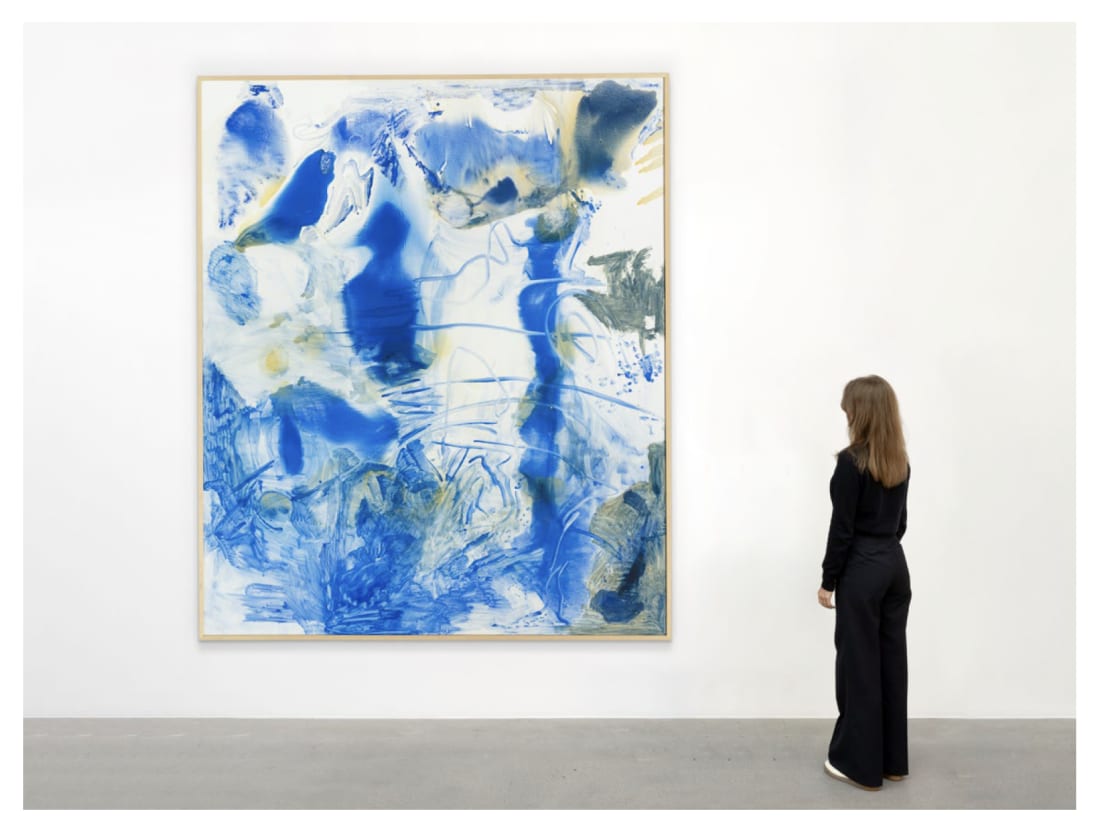
WW: Your paintings read as abstract at first, then slowly reveal themselves as inhabited. How do you build those hidden layers, and how does that sensibility travel into mosaic, ceramics, and iron wire?
MM: I’m going to tell you about a way that I build a painting, and you’re going to understand how I work. There’s a painting that reads, in French, Trois jours, un monde. “Three days and I give you a world.” That’s what Christopher Columbus said to his crew when they wanted to turn back. I took that because there’s a piece that looks like a sort of map of a sea, and I hung ceramic onto it that looks like horns. There’s a wire that goes through the horns. They can look like bows, or like the horns of animals, but they definitely look like something that was alive, like a residue of life.
When I think of a piece like that, it’s important that it brings a sense of hope, because it takes a lot of hope to say something like that to your crew. “We might die, but in three days I promise you a new world.” I think this is one of the most powerful statements a human being can say. Even though I’m not a Christopher Columbus fan, obviously, I think it’s important to be sensitive to our profound capacity to dream. And within that promise of hope, I brought these residues that can almost be perceived as bones.
Alchemy and the Four Elements
 Manuel Mathieu, “Uncertain Future,” 2025,
Mixed media on canvas,
30 x 36 in,
76.2 x 91.4 cm, © and courtesy of the artist and Galerie Poggi, photo © Guy L’Heureux.
WW: What does that mean for your use of ceramics?
MM: In this particular moment, I don’t understand the ceramic as ceramics. I’m a bit of an alchemist. I create these objects where I basically believe that I’m putting spiritual value into them. I think making art is that. You’re creating spiritual value in these objects, and these objects become residues.
There’s a difference between a painting that is meant to be a square, where there’s the aura of the painting, and an installation in a space where I’m using fabric, because for me fabric is another way to enter into relation with your body. Same thing for the smell. It’s a way to tell you that you’re inside of something. I always understood my relationship with installations as if I left the surface of the painting and brought certain things with me. All the elements that are existing sculptures, or proxies to the paintings, came in from the painting. I started with adding silicone on the side of the paintings, fabric, and then slowly objects started appearing.
The ceramic happened in a very natural way. I think the epitome of creating an object that has a spiritual value is to use the four elements: air, soil, fire, and water. For me, creating spiritual value with a painting is the same core as touching the soil and shaping it into something. That’s how all these things intertwine. They carry the same capacity to bring to life certain elements, or trigger our sensibility in very particular ways.
Being an artist is embracing generosity. I don’t think you can be an artist without being generous, because you’re continuously offering yourself. Whether people embrace it or not, you’re continuously giving and hoping. It’s faith. Making art is like praying.
“I don’t think you can be an artist without being generous, because you’re continuously offering yourself.”
—Manuel Mathieu
Haiti, Unfinished
 Manuel Mathieu, “Totem,” 2024, Photography,
Digital Print AP, 35 x 45 in, 88.9 x 114.3 cm, © and courtesy of the artist and Galerie Poggi, photo © Guy L’Heureux.
WW: Let’s talk about the photograph Totem. Why did it feel ready to be shown now, and what does it evoke today that it didn’t about ten years ago?
MM: I have a very particular relationship with Haiti. I have the feeling that this country is continuously being built or being destroyed. It’s not clear to me, but there’s a constant state of becoming. When I saw that object in a picture, hollow, with the metal coming out, and knowing how cement and metal were used to build, it looked like something that had started but wasn’t finished. It was interrupted because of resources, because of this, because of that.
For me that process was like a strange trace connected to hope, and how there’s an aesthetic to the failure of that hope. There’s a difference between dreaming something in your head and having it disappear without ever existing, and trying to build something and then abandoning it for whatever reason. There are a lot of things in the country that have this aesthetic of “we’re trying to build something, and then we can’t finish it, or we’re interrupted.” That particular composition was, for me, the epitome of that. It was like a missing bridge to something final. But there’s still the desire to make it happen.
Totem will be next to The Bed of Toussaint, which is called Le dernier sera le premier, “the first will be the last.” I love the idea that the builder of the country, the architect of the country, has his last place put next to this structure that is struggling to be built and finished, which is also the country. The bed is on feet, and the structure is also vertical, so you’re looking at two vertical compositions, but for two different reasons. It’s the last place that held the body of the ultimate builder.
They captured him, and he died from the cold rather than in prison. I couldn’t stop thinking about how the colonial instrument of violence is still using the same codes to erase history or alter history. That’s why I connected all these dots and said, “Okay, I need to go to Toussaint Louverture and breathe that air.” The message they sent by capturing him and letting him die like this is to say to anyone who has the desire to sacrifice for dignity, for a group of people: “That’s how you will be treated.” So it’s heavy, right? But then there’s a lot of beautiful things also in the show. I want you to have a complex relationship with it, just like my perfumes.
“I couldn’t stop thinking about how the colonial instrument of violence is still using the same codes to erase history or alter history.”
—Manuel Mathieu
A Show Is Like a Scream
 Installation view of Manuel Mathieu’s “Ayizan at Galerie Poggi, 2026, courtesy and © Manuel Mathieu and Galerie Poggi, photo © Younes Lagrouni.
WW: You mentioned that a selection of works will also be at Art Basel Paris.
MM: I’m very picky with the pieces. There was a painting called Study on Death that was not too far from Totem and the bed. It’s extremely beautiful color-wise, very vibrant, and I wanted it in the show. But the gallery said, “This painting is so strong, we should bring it to the fair.” So I accepted that the statement will be spread in different places in the city. Which is not necessarily bad, because technically the gallery is just a vessel to those ideas, and these ideas are bigger than the gallery. They’re bigger than us.
WW: Was preparing for this show different from your usual studio process?
MM: The process is to create time for things to happen. I thought a lot about this show because, more than ever, the question of what it is that I want to say felt heavier. I’m Haitian, and I had an accident in 2015 that taught me to always work with urgency. If this was my last show, what would it be about? If I can’t answer, then I need to search. A show and a life are like a scream. It’s one breath. Imagine you scream to the end of your lungs. You empty it. That’s what a scream is. That’s what life is, and so it needs to be meaningful.
What could be subversive is to claim history in a very particular way, saying: it’s not your art history, it’s not your history. It’s ours, and I’m going to play with it. The thing that you consider the peak of your soul, and I’m not doing it disrespectfully. I’m just doing it because now it’s free. I’m giving myself the freedom to enter and come out of a legacy that is not mine, that was used on me, but that today I can just play with. Whether it’s through my Blackness, through history, through particular places, there’s a playfulness, because the drawings are so playful. When you put all these things together, there’s something light about it, something necessary, something very present. If this was my last show, it’d be very, very loud, and I’d accept it.
Color, Surface, and Scent
 Manuel Mathieu, “Skin Deep,” 2026, Mixed Media on paper,
11,43 × 13,34 cm,
4,5×5,25in, © and courtesy of the artist and Galerie Poggi, photo © Guy L’Heureux.
WW: The color palette of the show is stunning. You almost feel the colors before you register what they are.
MM: My relationship with color is directly related to the aura of the painting. It’s like seeing an object of a particular color in the night, or at the end of a road, and you ask, “What is this color?” And then that aura drives you in. I try to use color the same way as composition, as a way for you to navigate the painting. I want the painting to take your eyes, and then your body, and then your soul.
Then you’re scratching the surface more and more, and you enter my world. I organize the color so it’s sometimes very present, sometimes very muted. There are moments where I force you to approach the painting super close to understand the surface. There’s the illusion that it’s only up close that you realize, “Oh, this is paper.” The way I treated the paper gives you the sense of a relief, but it’s actually fun. That’s another way to play with vision, to make you stand in places where there’s nothing to see, or vice versa. And I think that part of playfulness is also a bit of mastery.
WW: Fragrance isn’t part of this show, but it’s hard not to ask about it.
MM: I’m thinking about it. We’re going to light the candle of the Biennale, that’s for sure, but I’m not going to have time to do a particular smell for this show. Still, I’m learning a lot, because a smell in a space totally changes an experience. The smell is teaching me a lot about movement in particular, which I’m trying to bring into my paintings. Space becomes the vessel that contains all the elements.
Music travels in space, but smell is like you’re traveling within your mind, and space is mental. It goes like a lyric to your memories, to the feeling you have in a particular space. There’s an emotion that comes with it. It’s the same thing when composing a painting, the same thing when composing music. What I’m learning is that there are references that you travel to, and references that you create.
I’m more versed in painting and drawing, in creating images, to ignite things, than I am with perfume. I’m still trying to master the consequences of that medium, but I will get there. Thankfully, I work with a nose who is also pushing us in that direction. We’re not trapped in reality. We’re basically trying to create it. It takes confidence and hope and love, because once you’ve done that, you are basically offering. Now I have to give it away and let people embrace it in ways that are completely outside of my control.
Beyond the Studio
 Manuel Mathieu, “Perles et écailles,” 2026,
Mosaic, 15 x 14 in
38.1 x 35.6 cm, © and courtesy of the artist and Galerie Poggi, photo © Guy L’Heureux.
WW: Is there anything you’re working on that you’d like to speak to?
MM: I’m working on perfumes, obviously. I’m wearing a new perfume today that I’m working on. It’s not even done yet, but I’m trying it, just to have it on me and see what it feels like. At the end of this year, I want to draw more, because the drawings that I did for the show ignited a desire in me to focus differently on the surface of things.
On a different note, I executive produced a movie called The Fight for Haiti. It’s a political activist film about corruption and impunity in Haiti. Now is the time to put the movie out into the world, so this is something I need to talk to my father about. Today I spoke to a friend who’s a filmmaker in Haiti for advice about how to put it out. It’s something that is very dear to me. I don’t know what it will cost in my life, but I want to stand for what’s right, at least for my people.
WW: Your commitments reach far beyond the studio. The Metro mosaics in Montreal and the AWARE program named after your grandmother are part of your art. What changes would you like to see in the cultural field?
MM: Parity between men and women when it comes to collections is something I already fought for at the museum. That’s why I’m also invested in AWARE, because I think a cultural world without the point of view of women is incomplete. I would love to have more of that, and in politics too, not just culturally. I don’t think the future can exist without that level of action.
I hope to have a deeper understanding of politics in the future so I can eventually facilitate these dreams at scale. I want to build cities also, and learn from people who’ve done it, so that we don’t build as if in a vacuum, but make cities more livable and more equitable than what they are. This is a lifelong journey. It’s not going to happen overnight, and I don’t feel ready yet to contribute at that scale. It’s important to acknowledge when we’re ready and when we’re not.
I’m planning a trip to Haiti with my father. We’ve been trying to plan this trip for a while. If I wanted to contribute at that scale in Haiti, I need to at least start with his perspective, understand his points of view and what he learned through all these years, and the building he built, and contribute from that place. So what I want is to learn.
“Ayizan” is on view at Galerie Poggi in Paris through November 28, 2026.
 Manuel Mathieu, Biennale 2026, © Matteo Losurdo.


