


During London Frieze Week, the Ministry of Nomads (M.O.N) Art Foundation presented “Maria Kreyn: Dream Logic,” a solo exhibition of new works installed inside the Swiss Church in Covent Garden. Built in 1855 and later restored by the Basel architects Christ & Gantenbein, the church pairs classical proportions with a pared-back Swiss minimalism, including a folded mirrored screen that scatters light across the nave. Kreyn has hung the show along the building’s spatial and symbolic axes rather than treating it as a neutral container.
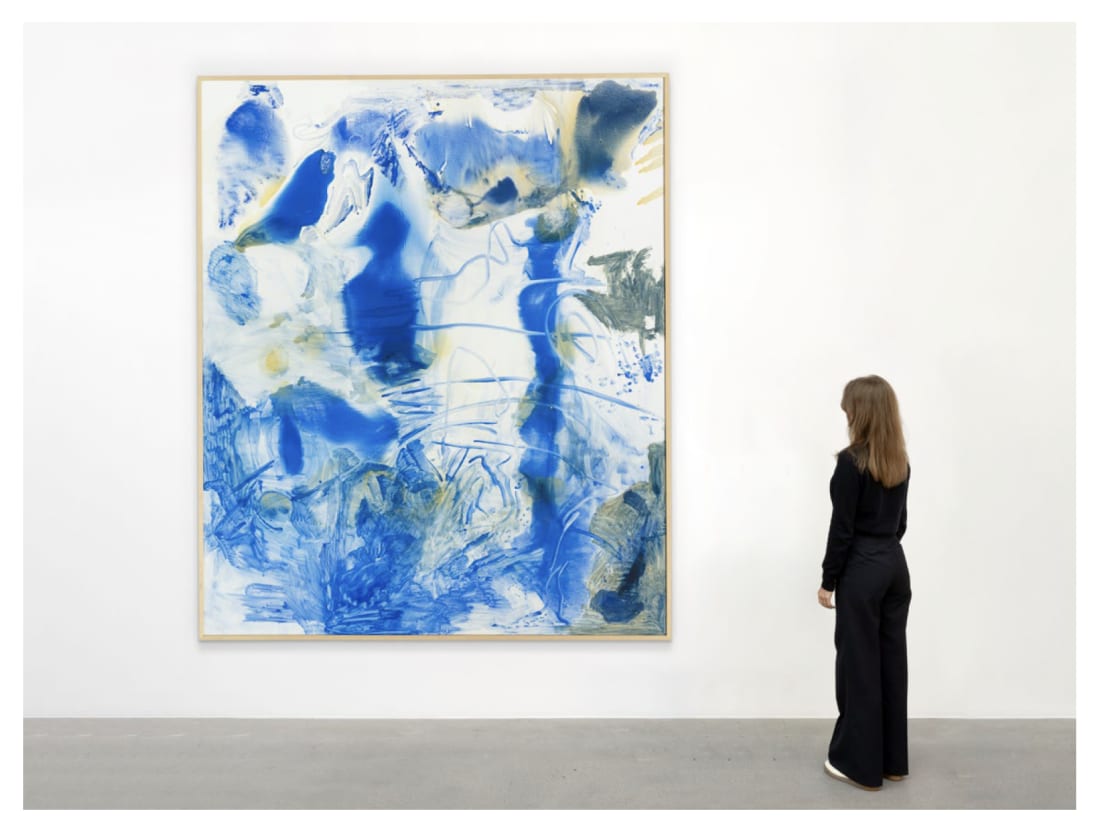
At the center are her storm paintings: turbulent skies and shifting fields of light crossed by prismatic planes and ovoid, parabolic forms. The works draw on the Romantic sublime of J.M.W. Turner and Claude-Joseph Vernet while folding in ideas from mathematics and contemporary physics. At the altar, The Alchemist’s Coil, a golden landscape threaded by a spiral that reads as both staircase and DNA helix, takes the place of a traditional altarpiece.
Born in 1987 in Nizhny Novgorod and based in New York, Kreyn studied mathematics and philosophy at the University of Chicago before teaching herself to paint. “Dream Logic” follows “Chronos” at St. George’s Anglican Church during the 60th Venice Biennale in 2024 and “Hyperobject” at the Fitzrovia Chapel in London in 2025. Her “Shakespeare Cycle,” eight monumental paintings commissioned by Andrew Lloyd Webber, is on permanent view at the Theatre Royal Drury Lane.
Whitewall spoke with Maria Kreyn about the intelligence of dreams, painting storms, and what a church offers that a gallery cannot.
The Dream Logic of Painting
 Installation view of “Maria Kreyn: Dream Logic,” 2026. Photo by David Owens @davidowensphoto. Courtesy of the artist and M.O.N. Art Foundation.
WHITEWALL: Your exhibition is titled “Dream Logic.” What does the logic of a dream allow you to explore that the waking world cannot?
MARIA KREYN: I love the idea that the dream state has its own kind of intelligence. It suspends the familiar rules of causality, chronology, gravity, orientation, yet somehow remains coherent while we’re inside it. We can inhabit impossible architectures, move between expanding and contracting timelines, recognize things fully without knowing how we know them.
I think painting has a similar capacity. It’s an elliptical medium, always open-ended, like music. It can communicate something emotionally or intuitively without relying on a linear narrative or specific syntax. I’m interested in that space where our ordinary categories of perception begin to dissolve, where the boundaries between inner and outer worlds, between personal and cosmic scales, become porous. There’s something in the scrambling of ordinary information that expands and amplifies our poetic capacity, and our intuition.
“The dream state has its own kind of intelligence,”
—Maria Kreyn
WW: You studied mathematics and philosophy before becoming a painter. How do these disciplines continue to shape the way you construct space, movement, and atmosphere in your paintings?
MK: Coming from a STEM background, I have a deep respect for science, for the inquiry, and for scientific method. The geometries in my work are often visual thought experiments, puzzles, games, and metaphors exploring our understanding of ideas at the edges of objective inquiry, where our intuitions and our data still feel mysterious.
What would the world look like if your eyeball were a prism rather than a sphere? What if space-time could fold like origami? What would it mean to see into multiple dimensions? To feel them simultaneously?
I’m not trying to illustrate mathematical concepts literally. I’m interested in the point where rigorous systems of thought meet the limits of our intuition. Painting allows me to play in that territory, to construct spaces that feel physically convincing and yet remain fundamentally impossible.
Painting the Storms Within
 Installation view of “Maria Kreyn: Dream Logic,” 2026. Photo by Frank Martinez @mrjamesfrank. Courtesy of the artist and M.O.N. Art Foundation.
 Maria Kreyn, “A Palm Readers Manual,” 2026, oil on panel, 36×24 inches. Courtesy of the artist.
WW: Storms are central to this exhibition. What draws you to these moments of turbulence, and how do you see the relationship between natural forces and human emotion?
MK: Weather is such a profound metaphor for the human condition. A storm is a dynamical system, governed by physical laws, and yet its complexity makes it extraordinarily difficult to predict. Our emotional lives are similarly turbulent. We can identify patterns, understand some of the mechanisms, but the totality of the system remains elusive. Self-knowledge and awareness are always seen in parts, in flares, like through a prism.
I like to imagine that the structures of our inner lives rhyme with nature, that there’s something fractal in this relationship. And there’s a wonderful tension in the actual process of painting these storms, where highly controlled technical skill meets paint that behaves according to its own physics. I’m interested in that meeting point between intention and accident, between our desire to understand and the incalculability of the world.
WW: The Alchemist’s Coil occupies the altar of the Swiss Church. The painting evokes both a spiral staircase and the structure of DNA. What ideas about creation, memory, and transformation were you exploring through this work?
MK: I’ve been fascinated by the idea that matter might carry a memory of its own making from the beginning of time. And so the work is a meditation on the origins of life, the relationship between matter, information, time, and consciousness. The coil in the painting is part staircase, part DNA helix, part serpentine form. It’s an ascending path, but also a recursive one. It suggests movement and transformation, but also recurrence.
Alchemy was concerned with transformation long before we had a scientific language for molecular processes. I like the meeting of these two ways of understanding the world: the ancient, symbolic imagination and the contemporary scientific one. Placed at the altar, the painting becomes a kind of secular altarpiece, an invitation to sit with the mystery of matter organizing itself into life, and life becoming aware of itself.
The Sacred and the Sublime
 Maria Kreyn, “The Second Concerto,” 2026, oil on linen, 80×60 inches. Courtesy of the artist.
 Installation view of “Maria Kreyn: Dream Logic,” 2026. Photo by Frank Martinez @mrjamesfrank. Courtesy of the artist and M.O.N. Art Foundation.
WW: Following your exhibitions in sacred spaces in Venice and London, what does exhibiting in a church offer that a traditional gallery cannot? How does the architecture change the experience of your paintings?
MK: We’re already primed for reverence when we enter a church, even if we ignore the doctrine. Working with that inherited emotional architecture, an exhibition in a church is a collaboration with the space, and perhaps also a benevolent coup: borrowing the language of reverence without requiring adherence to a particular belief system.
A gallery is often designed to disappear around the artwork. A church rarely disappears. It carries an accumulated intention, ritual, and collective memory. The Swiss Church magically does both. It is austere, all white, and the work stands on its own on a neutral backdrop just like in a gallery. Yet its vast vaulted ceiling and skylight offer a majestic experience above eye level that feels expansive and resonant with the work.
Historically, the church was one of the great patrons of painting, and the altarpiece was often intended to communicate a specific religious narrative. But paintings have the capacity to transcend that function. Exhibiting in reverent spaces is a beautiful way of expanding out towards the collective spiritual, away from the specificity of a language-based story or doctrine. My idea of an altarpiece is a space to which humans of any creed can come home. We are all travelers in this cosmos together.
“I think we’re wired for enchantment,”
—Maria Kreyn
WW: Your paintings bring together Romantic traditions and ideas drawn from contemporary science. What do you hope viewers experience when they encounter something that feels simultaneously familiar and impossible?
MK: I think we’re wired for enchantment. We’re riveted by mystery. We intuitively move towards awe. We gravitate toward mountains, oceans, storms, the night sky, because they confront us with something larger than ourselves. We are tiny in the cosmos, yet continuous with it. The Romantic painters understood this beautifully. At their best, their landscapes are not simply representations of nature, but portals into a particular state of consciousness.
Science has only made the universe more fascinating. Our descriptions of it are as rigorous as they are poetic. The painting lures you in with the familiar, yet is strange enough that you can’t quite resolve it, and I find particular pleasure in encountering something that seems real, yet refuses to conform to reality.