



There is something fitting about encountering Marie de Villepin’s paintings beneath the earth, surrounded by vines and the particular light of Provence. At Château La Coste, where architecture, landscape, wine and contemporary art have long been brought into conversation, her new exhibition “Chimera” finds an unusually resonant home. Presented September 19–October 22 in Renzo Piano’s pavilion, the exhibition brings together paintings made between 2023 and 2026, tracing an artist increasingly interested in what happens when one form begins to dissolve into another.
The title offers an immediate point of entry, but not necessarily an explanation. De Villepin’s chimera is not the mythological creature waiting to be identified within the image. It is a way of thinking, and perhaps more importantly, a way of painting. Her canvases refuse the comfort of a single reading. An animal can become a landscape; a body can become a memory; a blot of color can suddenly reveal itself as a face, a creature or a fragment of a world that seems to exist somewhere between waking and dreaming. The paintings remain deliberately unresolved, allowing several realities to occupy the same surface without one cancelling out the other.
Painting in the In-Between
 Portrait of Marie de Villepin, courtesy of the artist.
 Marie de Villepin, “Chimera,” 2023,
Oil on canvas,
214.5 x 139.5 cm, courtesy of the artist.
This sense of coexistence is central to de Villepin’s practice. She paints through accumulation and erasure, using the palette knife, brush and rag, but also her hands and, at times, her entire body. A painting is built, covered, scraped back and rebuilt. Earlier gestures are never entirely lost. Colors buried beneath subsequent layers continue to emerge, while drips and abrasions preserve something of the physical history of the work. The canvas becomes less an image than a record of transformation.
It is perhaps this physical process that makes the works feel so alive. In Chimera (2023), the painting that lends the exhibition its name, a ghostly presence appears to rise from a blue-green magma, as if emerging from beneath the surface of the earth. The creature is never completely defined; its head dissolves almost like smoke, while red, yellow and green marks seem to propel the composition outward. Painted shortly after de Villepin’s return from the Munch exhibition at the Musée d’Orsay, the work carries a certain melancholy, but also a primitive energy, as though something ancient were attempting to become visible.
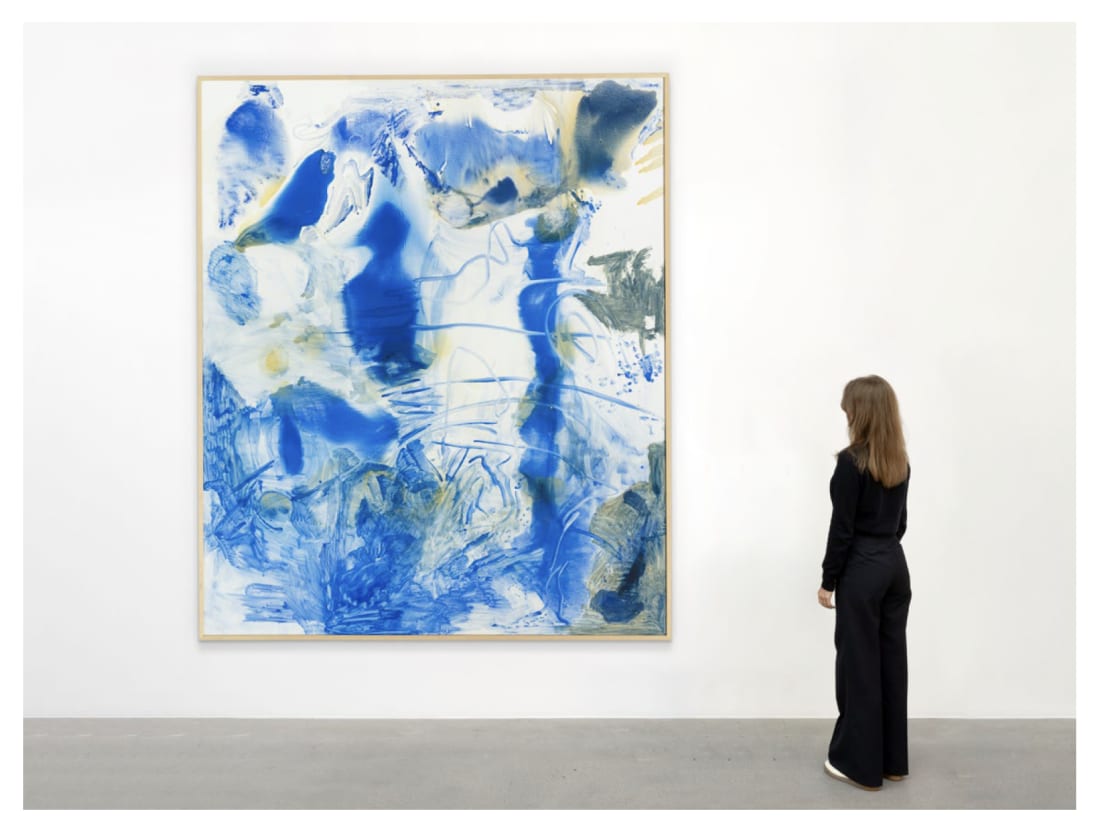
Elsewhere, the threshold between presence and disappearance becomes even more fragile. What You Saw Was Never There reduces the vocabulary of the painting almost to its essentials, leaving a partly erased blue helix punctuated by isolated marks. Yet the apparent simplicity opens the work rather than closing it. The longer one looks, the more the surface begins to populate itself. A profile might emerge, then disappear; a figure becomes a ghost, matter becomes memory. Meaning is generated not by what the artist definitively places on the canvas, but by what the viewer brings into it.
This movement between states becomes particularly clear in Dormiveglia, whose title describes that strange moment between sleep and waking. The work seems to inhabit precisely that unstable territory, where consciousness has not yet completely organized what it sees. De Villepin’s engagement with Zao Wou-Ki is also palpable here, particularly in the importance given to the mass of green and the physicality of the gesture. Her paintings are deeply informed by an art history that moves between European modernism and post-war American abstraction, but they never feel simply referential. The influences become absorbed into a vocabulary of their own.
Multiple Rhythms, One Canvas
 Marie de Villepin, “Visions of Collisions,” 2023,
Oil on canvas,
218 x 282 cm, courtesy of the artist.
Music plays an equally important role. De Villepin’s studio practice has developed alongside an intense engagement with sound, from Lou Reed and Syd Barrett to Nine Inch Nails and, most significantly, Don Van Vliet, better known as Captain Beefheart. Trout Mask Replica became an important revelation for her because of its seemingly impossible coexistence of rhythms: different instruments moving according to different internal logics, threatening to collapse but somehow remaining together. It offered a model for the painting itself. How can several rhythms inhabit the same work without one being reduced to silence?
That question is present throughout “Chimera.” It can be felt in the tension between abstraction and figuration, between violence and humor, between the controlled and the instinctive. In Visions of Collisions, the first work in a series de Villepin hopes to pursue throughout her life, Vincent van Gogh becomes a point of departure. Imagining the artist’s final walk through the fields toward the Auberge Ravoux, she transforms landscape, memory, color and psychological rupture into a single turbulent field. Crows, wheat, sky and fragments of thought become difficult to distinguish from one another.
History in Motion
 Marie de Villepin, “Moth to a Flame,” 2026, detail,
Oil on canvas,
275 x 323 cm, courtesy of the artist.
If Visions of Collisions turns inward toward the imagination of another artist, Predator’s Ball expands outward toward history itself. Here, empires appear not as fixed territories but as unstable bodies, overlapping, colliding and consuming one another. Long silhouettes move across the canvas in something between a dance and a battle, suggesting how seduction and violence can occupy the same gesture. The painting sits on the edge of abstraction while recalling the grotesque theatricality of Jacques Callot’s Balli di Sfessania, where celebration and threat are similarly impossible to separate.
At the other end of the exhibition, Moth to a Flame is perhaps the most visceral expression of de Villepin’s physical approach to painting. The monumental canvas was worked on the floor, brought back to the wall and returned again to the floor, leaving behind traces of fingers, enormous brushes and bodily movement. Orange, scarlet, red and violet masses turn around areas where the raw canvas remains visible. The title evokes the familiar image of desire moving toward its own destruction, but here the movement feels less like a flight than a gravitational pull. Figures, birds and animals gradually emerge from the color, as though the painting were producing its own inhabitants.
Architecture as Another Body
 Marie de Villepin, “The Old World Melts Like a Candle,” 2023-2024,
Oil on canvas,
152 x 192 cm, courtesy of the artist.
The setting intensifies this sense of emergence. Renzo Piano’s pavilion is partially buried within the landscape, reached by a narrow ramp between two raw-concrete walls. Its roof follows the graphic rhythm of the surrounding vines, while glazed openings allow the changing Provençal light to enter the gallery. The architecture does not impose itself upon the work; instead, it creates an environment in which the paintings can continue their conversation with nature.
This relationship is fundamental to Chimera. De Villepin recognizes in Piano’s building another kind of hybrid proposition: architecture that seeks not to dominate nature, but to exist within it. The pavilion becomes almost another body in the exhibition, partially concealed, partially revealed, and shaped by the landscape around it.
Born in Washington, D.C., and raised between the United States and India, de Villepin developed her practice through movement between places, cultures and forms of expression. Drawing began as a diary and refuge, filling notebooks with fleeting observations and emotions before becoming the foundation from which her imaginary landscapes, creatures and machines emerged. Music, drawing and painting gradually converged into a practice that refuses to establish firm borders between them.
That refusal is ultimately what gives “Chimera” its contemporary charge. At a moment when so much of culture is organized around categories, identities and increasingly rigid definitions, de Villepin proposes another possibility: a body can contain contradictions without resolving them. A painting can be many things at once. It can carry the memory of what came before while remaining open to what has not yet appeared.
And perhaps that is why these paintings resist being fully explained. Their subject is not the creature hidden within them, but the possibility of transformation itself. By the time one reaches the end of the exhibition, the question is no longer what the chimera is. It is how many lives, memories, rhythms and possibilities a single body, or a single canvas, can contain without silencing any of them.
 Marie de Villepin, “Dormiveglia,” 2025,
Oil on canvas,
130 x 160 cm, courtesy of the artist.


