


There is a moment every night when the mind lets go and hasn’t yet surrendered. Not waking, not sleep. For six years, Nicolas Lefeuvre has lived there, and now he is showing us what he found. “Hypnagogies,” on view at Galerie Rabouan Moussion in Paris from September 12–October 31, gathers the paintings born from that in-between state, the hypnagogic zone, the flicker of images that arrive right before the body drops off.
Lefeuvre calls them mental photographs. Not dreams. Not memories exactly. Instants of acute consciousness where the outside world passes through the body as much as it lands on the eye. He has been chasing this idea across three prior series, Landscapes, The State I’m In, Self Archeology, each one pushing further inward. Hypnagogies goes deeper still. Past the conscious mind. Into the porous zone where control loosens and images form uninvited.
Nicolas Lefeuvre Painting the Space Between Waking and Sleep
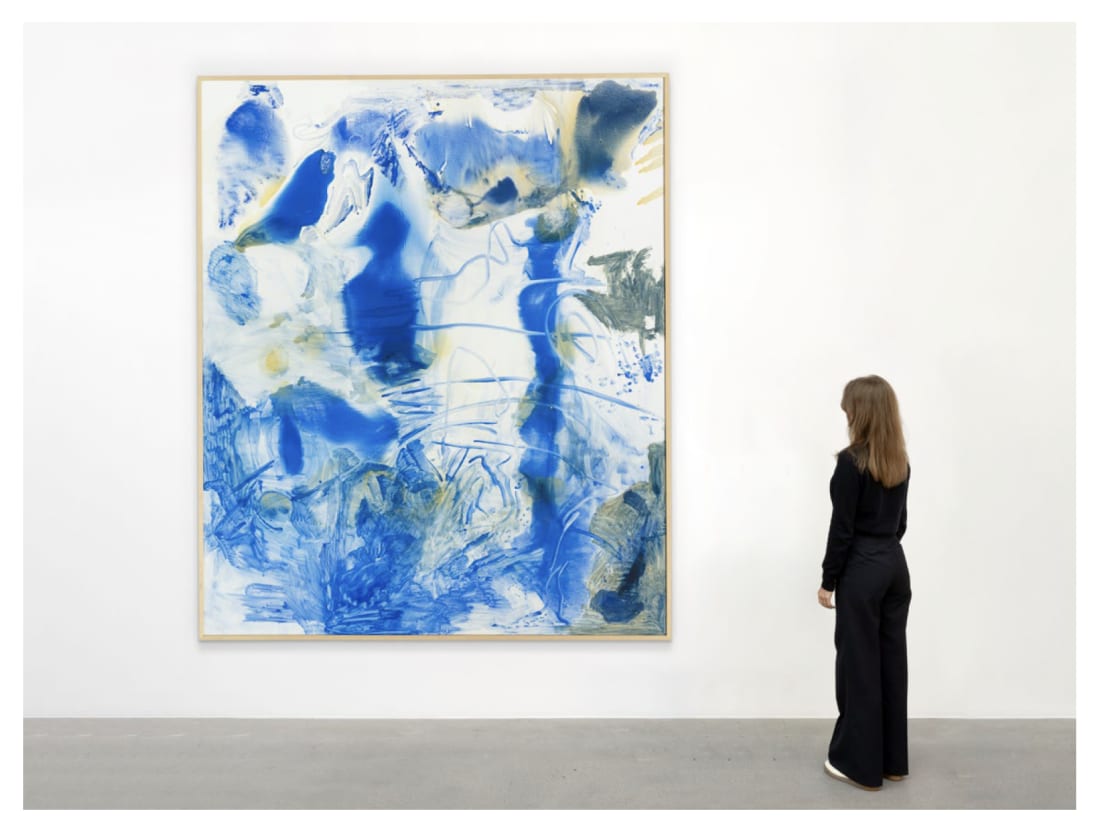
 Nicolas Berat, “Hypnagogie,” 2026, 152x190cm. Courtesy of the artist and Galerie Rabouan Moussion.
The work looks like night looks when you close your eyes too hard. Dense fields of black and indigo ink, layered transparency after transparence, until something buried starts to surface rather than disappear. Electric lines pulled taut through darkness. Narrow alleys. Passages. Thresholds within thresholds, fitting, for an artist obsessed with the state between waking and sleep. And underneath all of it, a physical sensation Lefeuvre keeps returning to: wet asphalt, hot dust, pavement after rain. A world that dissolves the moment it appears.
This is not automatic painting. Nicolas Lefeuvre is precise about that. Everything is considered, planned, balanced. The only improvisation he allows is the accident of ink itself poured in successive layers on paper, each pass revealing what was hidden rather than burying it further. On large formats, from a dark and dense ground, forms emerge slowly. Light keeps its promise. Lines become alleys become wires become passages. What was fleeting becomes real.
From Architecture to Abstraction
 Nicolas Berat, “Hypnagogie Cb,” 2026, 152x120cm. Courtesy of the artist and Galerie Rabouan Moussion.
 Nicolas Berat, “Hypnagogie D1a,” 2026, 111.7x85cm. Courtesy of the artist and Galerie Rabouan Moussion.
Born in Rennes in 1975, Lefeuvre trained first at the Beaux-Arts there, then at the École Camondo in Paris, graduating in 2000 with a degree spanning architecture and design. That dual foundation shows. His paintings behave like structures as much as images, built, weighted, engineered to hold light in specific places. After Camondo, he moved to Asia, opening a design studio and gallery in Singapore in 2001. In 2004, he became creative director for Chanel, first in Tokyo, then Hong Kong, painting the entire time. The luxury world and the studio were never separate pursuits for him. They ran in parallel, each one sharpening the other.
His material vocabulary is unusual and personal. Ink and acrylic, yes, but also everyday objects gathered from the countries he has passed through, kimonos, Japanese shoes, mahjong dice. Tools that are not tools, pressed into service as instruments of mark-making. It is a working method that mirrors the content: objects carrying memory, deployed to surface something that resists direct description.
Lefeuvre now lives and works in Lisbon, and his exhibition history traces the same restless geography as his biography: Singapore to Tokyo, Hong Kong to Shanghai, Brussels to Paris, with stops in Italy and Portugal along the way. 2026 alone brings him to Art Paris, to Art Central in Hong Kong, to group shows in Antwerp and Namur and Singapore, and to solo presentations in Brussels and Taipei, alongside “Hypnagogies” in Paris. This is an artist in full stride, showing widely, and doing it without diluting the interior focus that has defined his work since the beginning.
Giving the Fleeting a Form
 Nicolas Berat, “Hypnagogie Da,” 2026, 111.7x90cm. Courtesy of the artist and Galerie Rabouan Moussion.
Nicolas Lefeuvre says that he is not trying to analyze these images, or psychoanalyze them, or resolve them into meaning. He is not interested in decoding the symbols his own subconscious hands him. His job, as he sees it, is to extend their life. To pull them out of the fragility of the night and give them a body, paper, ink, scale, so they can exist beyond him.
That is the invitation “Hypnagogies” extends to whoever walks into Rabouan Moussion this fall. Step into spaces that are dark and luminous at once. Let something resonate without needing to know exactly why. Lefeuvre isn’t offering answers. He’s offering a continuation, the dream picked back up where it broke off, now large enough, and permanent enough, for someone else to enter it too.


