

At 91, Park Kwang-Jin remains devoted to painting, dividing his time between Seoul and Jeju Island. More than seven decades after beginning his artistic life, he continues to find reasons to look closely, to return to the canvas, and to see what might emerge from that intimate encounter. His career has unfolded alongside some of the most important chapters in Korea’s postwar art history, while his own path has remained distinctly his: deeply attentive to Mother Nature, grounded in the traditions of painting, and continually open to change.
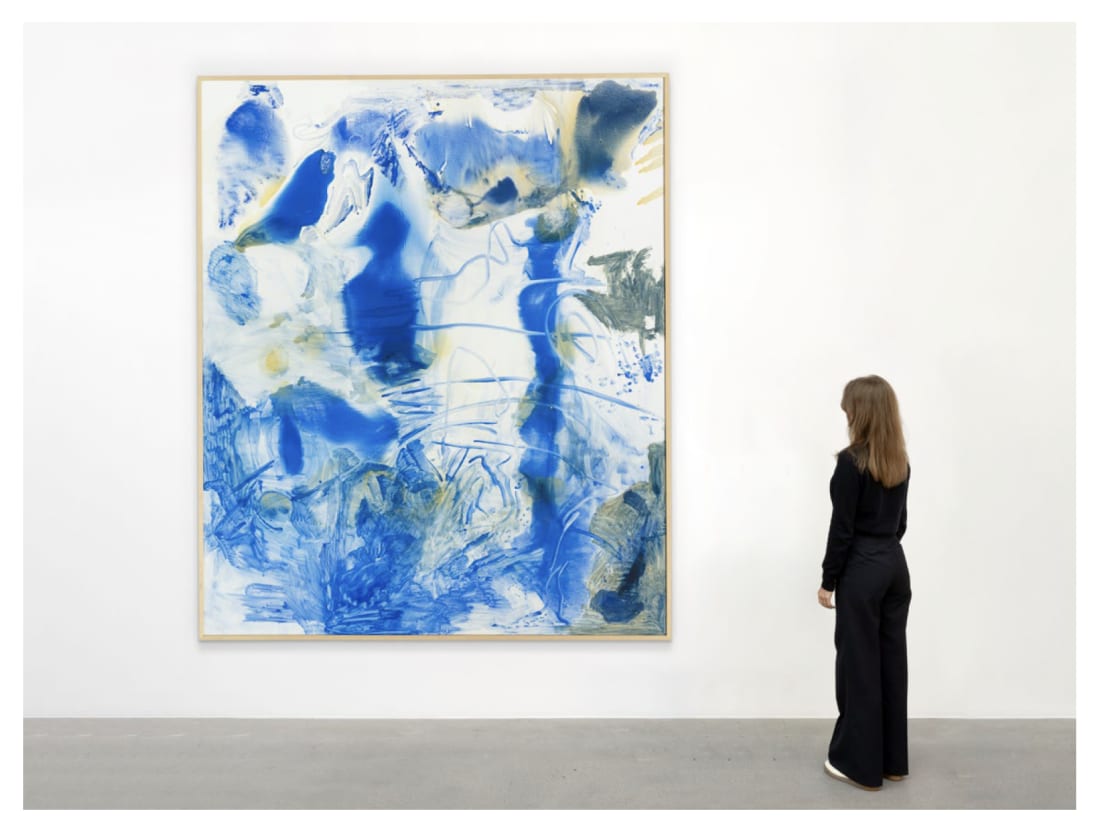
This September, Hunter Dunbar Projects presents “Park Kwang-Jin: Seeker of Nature,” bringing the artist’s work to New York for his first major solo presentation in the United States. On view September 17—October 24, the exhibition spans nearly four decades, from a 1986 landscape to a 2025 work, allowing viewers to embark upon the remarkable continuity, and tender transformation, within Park’s practice. An elusive space of mesmerizing color, rhythm, and imagination awaits.
Born in Seoul in 1935, Park has held an exceptional position in Korea’s postwar art history while maintaining a singular commitment to the visible world. As a founding member of the Mokwoohoe, he developed a practice in which traditional observation could meet a modernist sensibility without surrendering the vitality of either. His long engagement with education and cultural institutions has likewise extended his influence beyond the studio: he taught at Seoul National University of Education for decades, chaired the Korean Fine Arts Association, and played significant roles in the development of major cultural platforms, including the Korean Pavilion at the Venice Biennale and the Gwangju Biennale. At the pure heart of it all remains his enduring relationship with nature.
The occasion carries a particular resonance. Park’s first New York exhibition took place at the Korean Cultural Center in 1985. More than forty years later, he returns with a presentation that brings together different moments in his artistic life, offering a chance to consider the depth of a practice shaped by sustained attention and an enduring faith in painting.
The prolific visionary took the time to speak with Whitewall about the landscapes that have stayed with him, the places that have shaped his vision, and the continuing possibilities he finds in painting.
Nature and the Language of Painting
 Park Kwang-Jin,
“Sound of Nature,” 2024,
Oil on canvas,
Framed: 19 1/4 x 29 in.,(48.9 x 73.7 cm),
Image courtesy of the artist and Hunter Dunbar Projects.
WHITEWALL: You have spent more than four decades returning to landscape as a subject. What continues to draw you back to nature, and how has your understanding of it changed over the course of your career?
PARK KWANG-JIN: Nature is essential to human existence. We can only exist because nature exists, and the many cultures of the world have developed within it. Art is also born from nature, and art enriches our lives and our emotional sensibilities.
I was born and raised in a city, and because Korea is a relatively small country, I had few opportunities to encounter expansive natural landscapes while growing up. As I became an adult and began traveling throughout Korea, I encountered aspects of nature that I had not experienced in the city: the landscape, the air, the sounds. I found great pleasure in capturing these subtle qualities of nature on canvas, and I have continued doing so throughout my life.
At the same time, I have watched these pristine landscapes continually damaged by human activity. It saddens me to see so much of our clear, unspoiled natural environment disappearing. I sometimes feel that people do not fully understand how precious nature is to us, or how important it is to preserve it.
My work has never been about transferring a landscape exactly as it appears onto canvas, as a photograph might. Instead, when I encounter a vast landscape, I emphasize what strikes me as particularly beautiful or essential about nature.
Painting is an act of creation, so I am always trying to bring something new to the canvas. Nature itself may not change, but as I encounter different kinds of landscapes, I continually discover new sensations and impressions within their vastness. My own thinking has changed through the process of finding new ways to give those experiences form and structure within a painting.
 Park Kwang-Jin,
“Sound of Nature,” 2021,
Oil on canvas,
24 3/4 x 24 3/4 in. (63 x 63 cm),
Image courtesy of the artist and Hunter Dunbar Projects.
“Nature is essential to human existence. We can only exist because nature exists, and the many cultures of the world have developed within it.”
—Park Kwang-Jin
WW: Your paintings hold a fascinating space between observation and abstraction. How do you decide what to preserve from the landscape and what to transform through painting?
PKJ: Because painting is a creative act, I am always pursuing something new. Although my compositions begin with observing nature, I flatten and reorganize what I see. Only certain elements remain representational, while others become abstracted. I think of this as a harmony between figuration and abstraction, with both existing together within a single composition.
It is impossible to contain an entire landscape within the limited dimensions of a canvas. From the vastness of nature, I therefore select what affects me most strongly, whether a tree, a mountain, a road, or a field, and bring it to the center of the composition. Elements of the landscape that do not evoke a strong feeling in me are boldly omitted. A skilled landscape painter is sometimes described as someone who knows what to add and what to subtract. That process of selection and transformation is ultimately what turns the original landscape into a painting.
WW: The vertical line became an important element in your work after your encounter with Jesús Rafael Soto’s art in Paris in 1994. What was it about that experience that opened a new direction for your painting?
PKJ: Before encountering Soto’s work, I tended to understand landscape through the horizontal line. I thought of the horizon as something infinite, a line along which all of nature exists. In Soto’s vertical lines, however, I discovered a different sense of infinity.
That experience led me to concentrate more deeply on the relationship between horizontal and vertical lines in my own compositions. It may also have marked the beginning of a greater sense of rhythm and variation in the way I used those lines.
WW: In works depicting Jeju’s reeds and canola fields, the lines can suggest movement, rhythm, wind, or even sound. When you are painting, do you think of these elements as something you are observing, remembering, or imagining?
PKJ: All of my landscape paintings begin with working directly on site. When I encounter a landscape that particularly captivates me, I later develop it into a larger painting in the studio. In that sense, the works made on site are very important because they allow me to translate the true character of a landscape through my own visual sensibility.
Reeds, in particular, have to be experienced together with the wind to fully understand their beauty. Even when making large-scale paintings in the studio, I often returned to the sites in Jeju to observe them again.
Observation always comes first. But imagination, particularly when abstraction enters the work, is also important. Once I am back in the studio, the process becomes almost entirely one of imagination.
 Park Kwang-Jin, “Sound of Nature (Hallasan),” 2023, detail,
oil on canvas,
49 x 45 x 1.75 in,
124.5 x 114.3 x 4.44 cm,
Image credit: ShootArt, courtesy of the artist and Hunter Dunbar Projects.
“Reeds, in particular, have to be experienced together with the wind to fully understand their beauty.”
—Park Kwang-Jin
Jeju Island and a Life in the Studio
 Park Kwang-Jin,
“Sound of Nature,” 2016,
signed and dated at center left of the right canvas,
oil on canvas,
Overall: 36 3/4 x 71 1/2 in. (93.4 x 181.6 cm),
Each canvas: 36 3/4 x 35 3/4 in. (93.4 x 90.8 cm),
Image courtesy of the artist and Hunter Dunbar Projects.
WW: Jeju Island has been an important part of your life and practice, particularly since establishing a studio there in the early 1980s and later relocating there. What has living and working on Jeju made possible in your painting?
PKJ: Korea is geographically a relatively small country, but Jeju is entirely different from the mainland. Its ancient natural environment has remained remarkably well preserved, and throughout the island I encountered landscapes unlike anything I had previously experienced. The language, daily life, and culture of the people who live there are also distinct.
As a landscape painter, I became deeply captivated by the nature that exists only in Jeju, and the island became one of the primary places where I concentrated my practice. I was particularly drawn to its canola fields and reeds. Their colors create a powerful contrast against the deep black volcanic lava of Jeju, yet they coexist in remarkable harmony. That combination gave me tremendous energy as a painter. For me, this contrast of colors is one of nature’s most powerful and harmonious expressions.
WW: Could you walk us through a typical day in your studio? What does your process look like from the moment you begin working to when you step away from the painting?
PKJ: When I am in my best condition, I usually work from morning until late afternoon, almost the entire day. When I am not feeling as strong, I may work for only half a day. Compared with many of my fellow artists, I have always spent a great deal of time working.
I generally concentrate on one painting each day, but depending on the characteristics of the materials and the process involved, I often work on several paintings simultaneously, particularly when I am working with rollers.
WW: Your work has always maintained a relationship with figuration, even as abstraction became increasingly important to your visual language. What does painting from the visible world allow you to explore that a purely abstract approach might not?
PKJ: Beginning with something I have actually seen and experienced allows me to move beyond simple vision. From what I observe, many more thoughts emerge, and I try to express the sense of an infinite world that those thoughts allow me to imagine.
Every artist has a particular disposition. By nature, I am rather conservative, and I have always placed great importance on the traditions of painting. At the same time, the world has changed dramatically, and our lives have changed with it. I have increasingly come to believe that figurative painting must also evolve creatively in response to the changing times.
Toward New Possibilities
 Park Kwang-Jin,
“Sound of Nature,” 2025,
oil on canvas,
49 x 45 x 1.75 in,
124.46 x 114.3 x 4.44 cm,
Image credit: ShootArt, courtesy of the artist and Hunter Dunbar Projects.
WW: The exhibition brings together paintings from 1986 through 2025, including a recent landscape in which you return to direct observation and a new palette. What does it mean to you to look back across such an important span of work, and what continues to inspire and challenge you in your practice today?
PKJ: I recognize that I am now approaching the later stage of my life as an artist. To have works from the beginning, middle, and present stages of my career shown together in New York, a city filled with contemporary art from around the world, is deeply meaningful to me. My first exhibition in New York was at the Korean Cultural Center in 1985, and returning now with this broader presentation gives me the opportunity to show the development of my artistic world across many decades. Like any artist, I hope these works will be thoughtfully considered, appreciated, and loved.
Compared with my earlier work, my paintings today have become much more simplified and abstracted. I also incorporate more abstract elements drawn from the imagination. Through them, I hope to offer viewers something open-ended, allowing each person to receive and interpret the work through their own feelings.
WW: This exhibition marks your first major solo presentation in the United States. What are you curious to see in the encounter between your paintings and an American audience, and how do you hope viewers might enter the landscapes you have painted?
PKJ: I hope American audiences can experience through my landscapes something of Korea’s distinctive natural environment, the landscape of what has traditionally been called the “Land of the Morning Calm.” I also hope the exhibition can encourage greater exchange through art.
More than anything, I hope viewers can sense the connections among color, rhythm, and sound within the landscapes.
 Park Kwang-Jin,
“Sound of Nature (Lakeside),” 2023, detail,
oil on canvas,
110 x 120 cm,
43.31 x 47.24 in,
Image credit: ShootArt, courtesy of the artist and Hunter Dunbar Projects.
“I hope to offer viewers something open-ended, allowing each person to receive and interpret the work through their own feelings.”
–Park Kwang-Jin
WW: What can we look forward to seeing you work on next?
PKJ: I would like to simplify my work even further and create paintings in which abstract elements occupy the entire canvas. But such work requires tremendous physical strength, and at this stage of my life, I recognize that I am approaching the limits of what my body will allow me to do.
 Park Kwang-Jin,
“Sound of Nature,” 2001,
Oil on canvas,
Framed: 34 3/4 x 34 3/4 in. (88.3 x 88.3 cm),
Image courtesy of the artist and Hunter Dunbar Projects.
 Park Kwang-Jin,
“Sound of Nature (Winter in South America),” 2005, detail,
oil on canvas,
45 x 49 x 1.75 in,
114.3 x 124.46 x 4.44 cm,
Image credit: ShootArt, courtesy of the artist and Hunter Dunbar Projects.
 Park Kwang-Jin,
“”Sound of Nature, 2003,
Signed (center right); dated,
Oil on canvas,
Framed: 56 3/4 x 51 3/4 in. (144.2 x 131.5 cm),
Image courtesy of the artist and Hunter Dunbar Projects.