


Tokyo is a city that rarely reveals itself through a single destination. Its galleries, museums, architecture, restaurants, bookshops, gardens, and streets form a constantly shifting landscape in which contemporary culture moves easily between disciplines.
This September, that energy comes into particular focus as Tokyo Gendai returns for its fourth edition at PACIFICO Yokohama from September 11–13, 2026, following an invitation-only vernissage and VIP preview on September 10. Galleries from Japan, Asia, Europe, the Americas, and beyond come together across five sectors, while exhibitions and cultural programs extend the conversation throughout Tokyo and Yokohama.
For a few days, the region becomes a meeting point between the local and the global, established institutions and emerging galleries, and the commercial art market and the wider creative ecosystem that makes Japan such a singular cultural destination.
For Whitewall, the week is best approached accordingly: not simply as an art fair, but as an opportunity to move between art, architecture, fashion, design, food, and the city itself.
Tokyo Gendai 2026 Brings the International Art World to Yokohama
 Yukino Yamanaka, “under,” 2025. Courtesy of the artist and CON.
 Zheng Lu, “Water in Dripping Windward,” 2024. Courtesy of Sundaram Tagore Gallery.
Presented across PACIFICO Yokohama’s Exhibition Halls C and D in Minatomirai, Tokyo Gendai’s 2026 edition unfolds across five sectors.
The principal Galleries section is joined by Hana, Eda, and Tane, while the new Miki sector turns its attention toward works on paper and printed matter, including photography. The format creates a dialogue between established international programs and younger or more focused presentations while maintaining the fair’s particular relationship with Japan and the wider Asian art ecosystem.
Among the galleries to seek out are Pace Gallery, Sadie Coles HQ, Taka Ishii Gallery, TARO NASU, KOTARO NUKAGA, Mizuma Art Gallery, Gana Art, Ceysson & Bénétière, The Page Gallery, and A Lighthouse called Kanata.
But the more interesting way into this year’s fair may be through the artists themselves.
Umar Rashid, also known as Frohawk Two Feathers, is the recipient of the 2026 AMA Artist Award and presents new work created specifically in connection with Tokyo Gendai.
At Taka Ishii Gallery, new works by Adam Pendleton appear alongside paintings by Fu Nagasawa, while KOTARO NUKAGA brings together practices including José Parlá, Tomokazu Matsuyama, and Keita Morimoto.
Together, these presentations point toward one of Tokyo Gendai’s most compelling qualities: the possibility of encountering internationally familiar practices alongside artists and galleries whose contexts remain distinctly connected to Japan and Asia.
The fair’s Art Talks extend that conversation, bringing together artists, architects, curators, collectors, gallerists, and figures from fashion around moving image, architecture, collecting, international artistic practice, and the evolving relationship between art and fashion.
Beyond Tokyo Gendai, the City Becomes an Extended Exhibition
 Ryoichi Kurokawa, “Oscillating Continuum 2,” 2013. Courtesy of Studio Ryoichi Kurokawa, Takuro Someya Contemporary Art.
Tokyo Gendai may provide the center of gravity, but the cultural experience of the week extends considerably beyond PACIFICO Yokohama.
Yokohama itself deserves time. The Minatomirai waterfront and Yokohama Museum of Art provide a natural extension of the fair, while the city’s creative districts reveal another side of a place too often treated simply as Tokyo Gendai’s host.
Returning to Tokyo changes the rhythm again.
Roppongi, Aoyama, Omotesando, Daikanyama, Nakameguro, and Shibuya form overlapping cultural territories rather than a conventional gallery district. Architecture, fashion, restaurants, design, and contemporary art exist alongside one another, often without clear boundaries.
This is where Tokyo rewards selectivity. A museum can lead to a gallery, a gallery to a bookshop, a bookshop to dinner, and the experience of the city becomes less about completing an itinerary than understanding the relationships between its different creative worlds.
That quality feels particularly relevant during Tokyo Gendai. The fair becomes less an isolated destination than a point of entry into the city.
Hiroshi Sugimoto’s Extinction Brings Art, Time, and Dior Together
 Claude, Viallat, “1999144,” 1999. Courtesy of the artist and Ceysson & Benetiere.
One of the week’s essential exhibitions is also one of its most timely.
“Hiroshi Sugimoto: Extinction” remains on view at the National Museum of Modern Art, Tokyo through September 13, meaning Tokyo Gendai weekend is the final opportunity to see the exhibition.
Bringing together approximately 60 gelatin silver prints, the exhibition moves through Sugimoto’s sustained investigations into photography, time, preservation, memory, and the ways civilization constructs its understanding of history.
Sugimoto has long resisted the boundaries of a single discipline. Photography exists in dialogue with architecture, theater, Japanese classical culture, calligraphy, ceramics, and questions that reach far beyond the photographic image itself.
That makes Extinction particularly resonant during a week in which Tokyo’s cultural landscape similarly refuses neat divisions.
There is also an intriguing connection to Dior, which joins Tokyo Gendai this year as Official Premium Partner and is a special sponsor of Sugimoto’s exhibition at MOMAT.
Before becoming a couturier, Christian Dior was a gallery owner and collector, establishing an early relationship between the House and the artists of his time. But the more compelling connection in Tokyo is found within Sugimoto’s work itself.
Stylized Sculpture 120, Christian Dior, Bar, 1947, created in 2025, transforms one of fashion history’s defining silhouettes through Sugimoto’s photographic language.
The convergence feels unusually precise: Christian Dior’s 1947 Bar silhouette interpreted by one of Japan’s most significant contemporary artists, exhibited in Tokyo during the same week Dior partners with the city’s international art fair.
Rather than positioning fashion alongside art, the work suggests something more interesting: how an object created in one cultural language can become material for another.
What Else to See in Tokyo During Tokyo Gendai
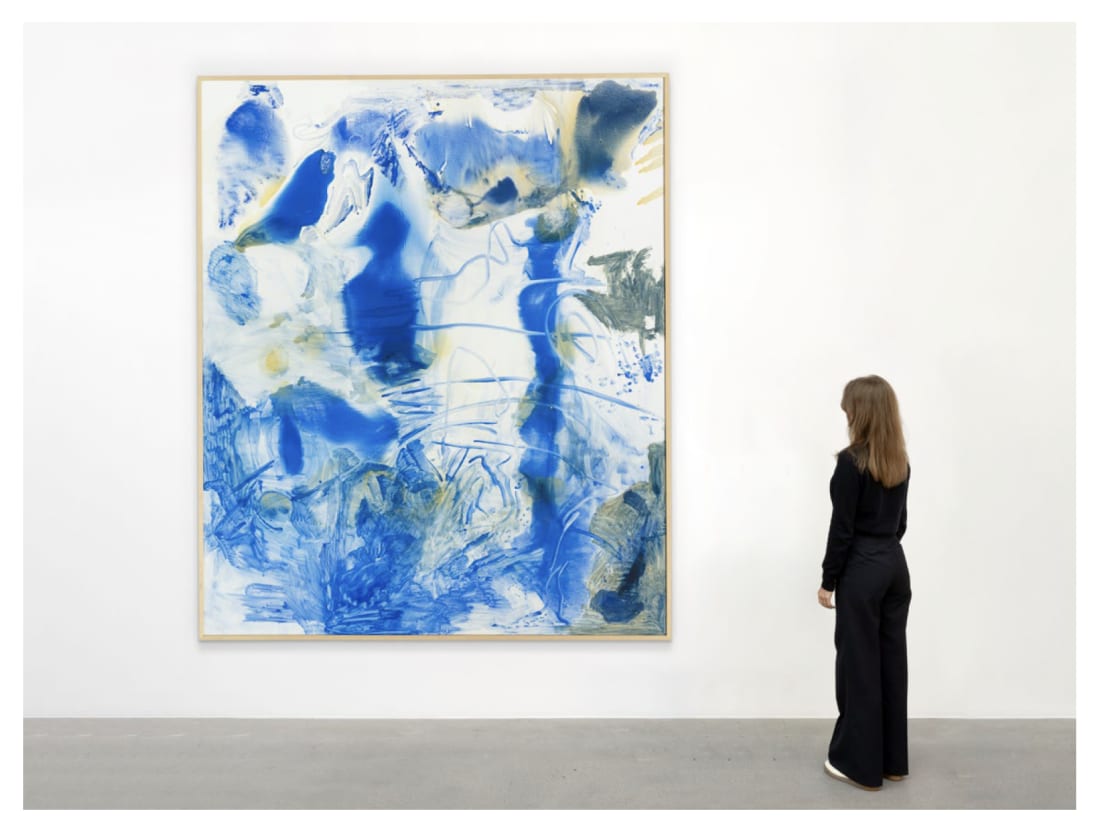
 Mia Liu, “Blue and White Tarp,” 2022. Courtesy of the artist and UP Gallery.
 Yuka Mori, “Mesh,” 2025. Photo by Osamu Sakamoto. Courtesy of Yutaka Kikutake Gallery.
The city’s museum program makes the journey beyond Yokohama particularly worthwhile.
At Mori Art Museum, Ron Mueck offers a dramatically different encounter with the human figure. Mueck’s manipulation of scale gives his hyperreal sculptures a psychological intensity that can make the familiar body appear suddenly strange, vulnerable, or monumental.
Roppongi also provides a natural starting point for moving through Tokyo’s gallery landscape before continuing toward Aoyama and Omotesando.
At The National Art Center, Tokyo, Masterpieces of the Renaissance from the Musée du Louvre introduces an entirely different historical register.
The contrast is precisely what makes the city compelling during an art week. Renaissance painting, Sugimoto’s conceptual photography, Mueck’s sculptural bodies, contemporary gallery presentations, fashion, architecture, and design can all occupy the same day without feeling disconnected.
Tokyo has an unusual ability to make those juxtapositions feel natural.
Art and Fashion Find Common Ground at Tokyo Gendai
 Anastasia Samoylova, “Albino Alligator,” 2026. Courtesy of the artist and UP Gallery.
The relationship between art and fashion emerges repeatedly across Tokyo Gendai this year.
Dior’s presence is one expression of it, but the conversation extends into the fair’s programming, including “Art Meets Fashion / The Future of Creativity” on the final day.
The subject reflects a broader shift visible well beyond Tokyo. Fashion houses have become commissioners, collectors, exhibition partners, architectural patrons, and increasingly important participants in contemporary cultural production.
Tokyo provides a particularly interesting setting for that evolution because distinctions between disciplines have long been unusually fluid here. Fashion can function as design, retail spaces can become architectural statements, restaurants can express craft with almost curatorial precision, and contemporary art can exist within the same cultural geography.
Tokyo Gendai enters that ecosystem rather than standing apart from it.
The fair’s partners also include SMBC Group as Principal Partner and Perrier-Jouët as Official Champagne Partner, alongside Dior as Official Premium Partner.
Why Tokyo Gendai Matters Now
 Ozawa Tsuyoshi, “Vegetable Weapon – Saury fish ball hot pot,” 2021/2023. Courtesy of the artist and MISA SHIN GALLERY.
Tokyo Gendai arrives at a moment when the city’s position within the international art calendar continues to evolve.
Later in the autumn, Art Week Tokyo, organized in collaboration with Art Basel, again connects galleries and institutions across the city.
These initiatives are contributing to something larger than an increasingly crowded cultural calendar.
For international galleries and collectors, Japan represents a sophisticated market with a distinctive collecting history. For artists and institutions, Tokyo offers an environment where contemporary practices exist alongside extraordinary traditions of craft, architecture, design, and visual culture.
And for visitors, the attraction increasingly lies in precisely those intersections.
Tokyo does not need to become another Basel, Paris, or Hong Kong. Its cultural relevance comes from offering something structurally different.
Tokyo Gendai is most compelling when understood within that context.


