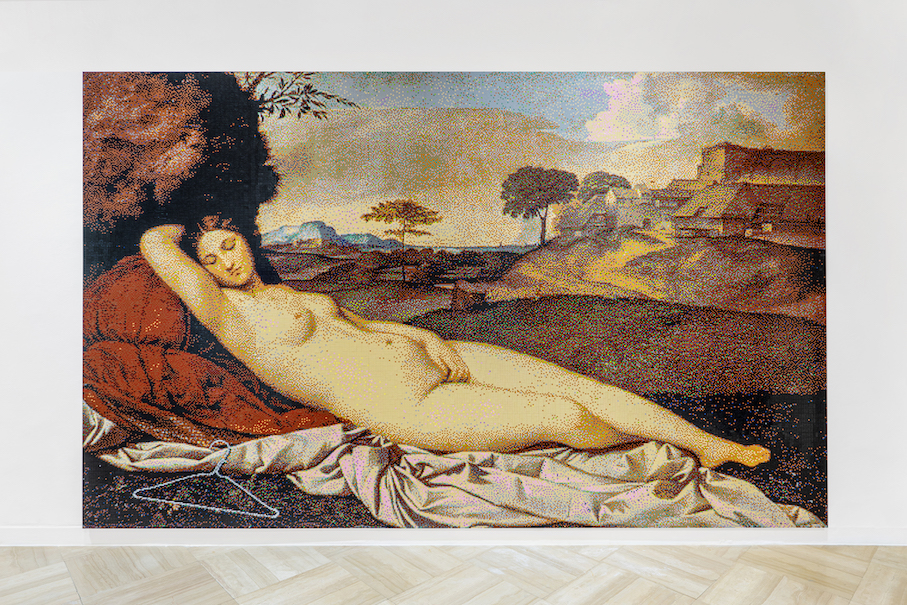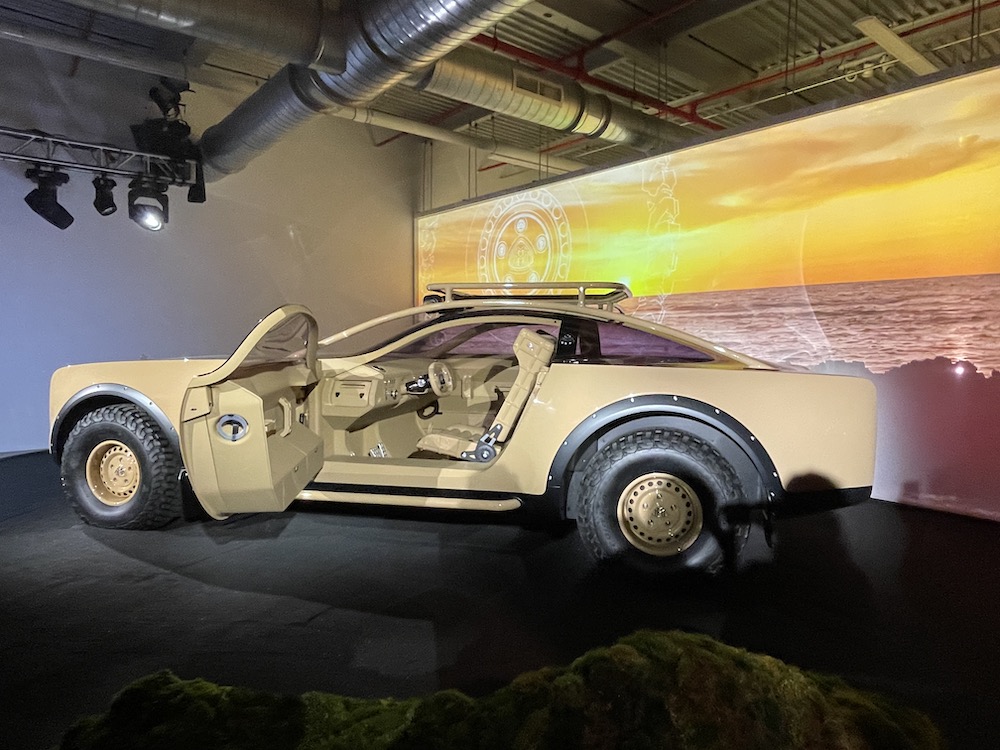
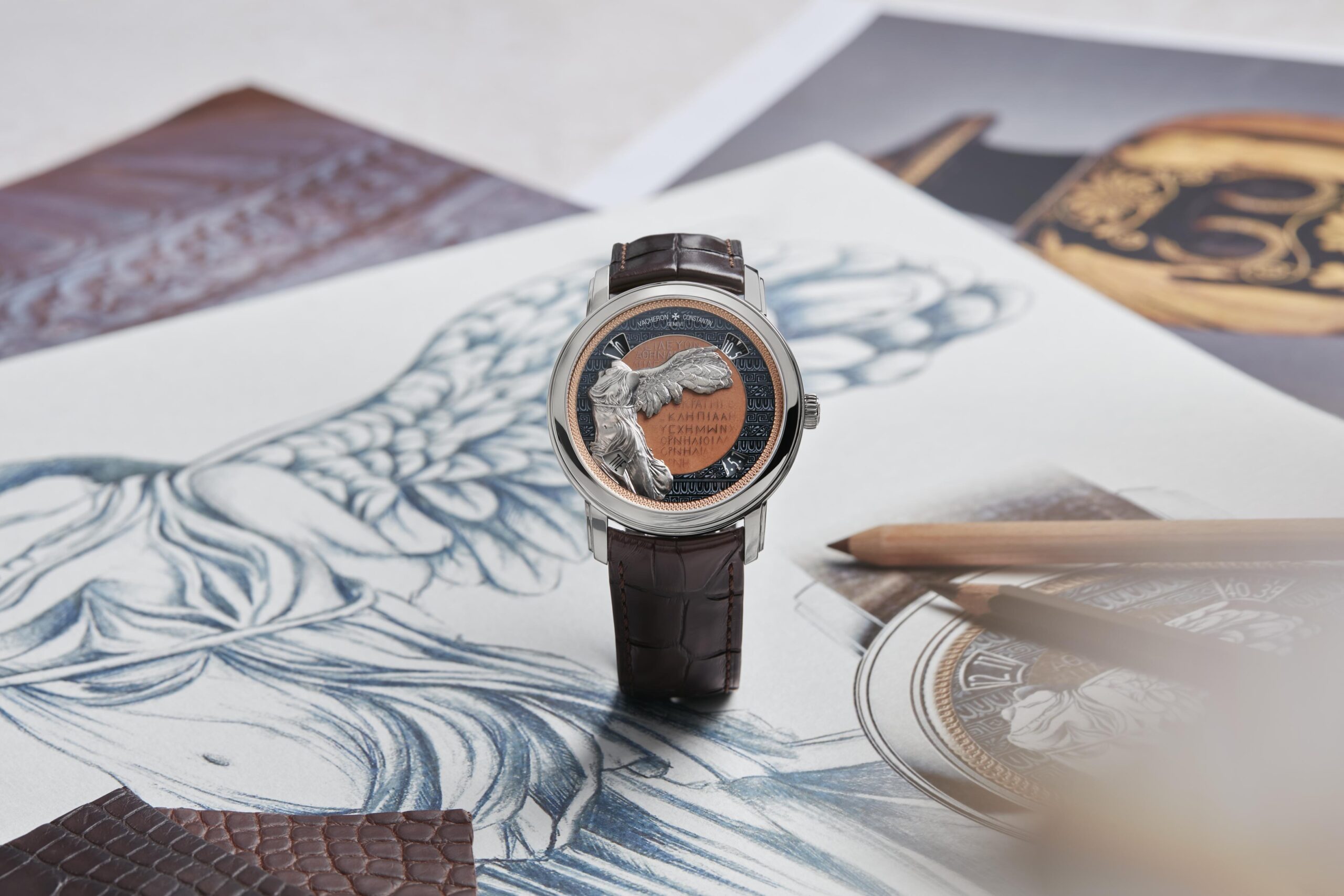
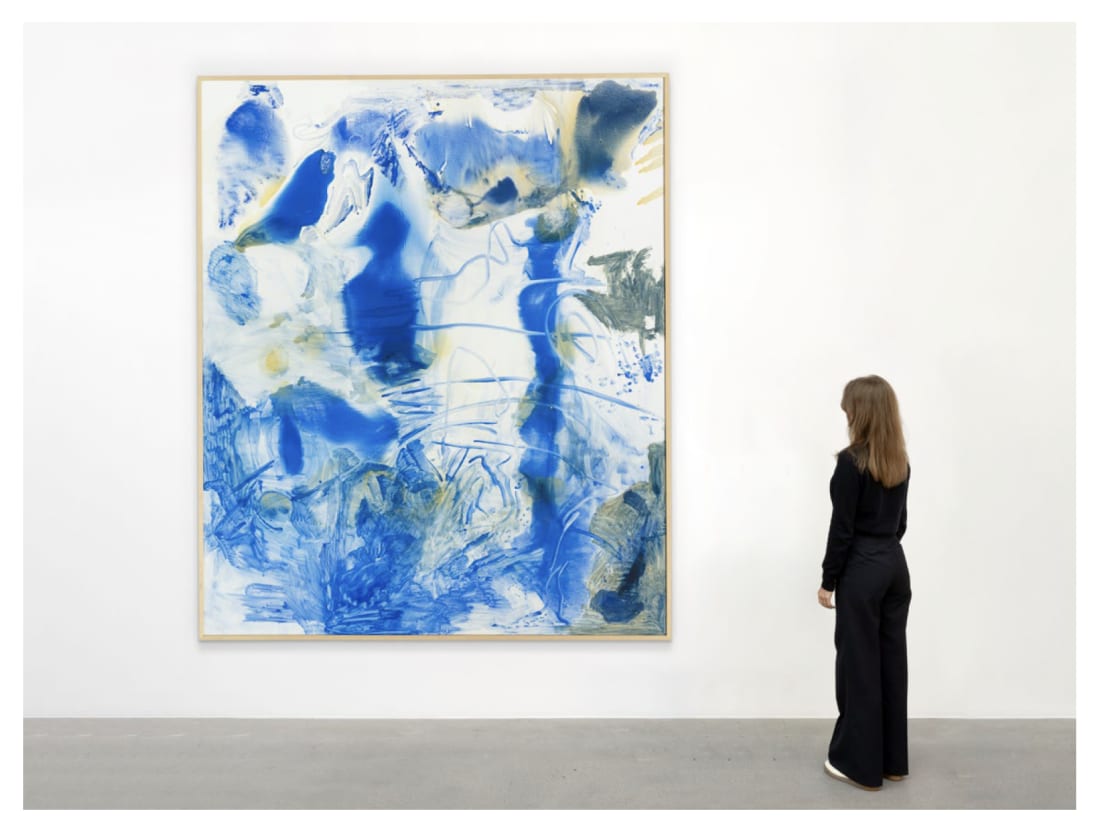


At the heart of Venice during the Biennale, the city itself becomes an expansive exhibition space—where historic architecture, sacred sites, and contemporary interventions converge. These exhibitions highlight artists working across disciplines, engaging directly with place, material, and perception. The result is a series of encounters that feel both intimate and monumental, inviting viewers to reconsider how art is experienced within—and in response to—the city.
Negozio Olivetti (FAI – Fondo per l’Ambiente Italiano ETS)
Leandro Erlich: “Hybrids. Leandro Erlich at the Negozio Olivetti”
San Marco
 Leandro Erlich, “The Cloud – L’Espoir” (2024) Stampa digitale con inchiostro ceramico su vetro ultra-chiaro, cassa in legno e luci LED 175 × 91 × 50 cm Courtesy the artist, Photographer Duccio Benvenuti.
Curated by Marcello Dantas, “Hybrids. Leandro Erlich at the Negozio Olivetti” brings the Argentine artist’s immersive, illusion-driven practice into dialogue with Carlo Scarpa’s iconic architectural masterpiece overlooking Piazza San Marco. Featuring around 20 sculptures—some previously unseen—the exhibition unfolds as a series of perceptual encounters in which everyday objects morph, architectural forms dissolve, and natural elements fragment into unexpected configurations. Organized in collaboration with FAI – Fondo per l’Ambiente Italiano and supported by Galleria Continua, the project is part of the “Arte all’Arte” program, which explores the relationship between art, architecture, and urban space.
What we love: The way Erlich transforms perception into a tactile, almost theatrical experience, where architecture becomes unstable and familiar objects slip into moments of quiet disorientation—inviting viewers to question not only what they see, but how they inhabit space itself.
Leandro Erlich: “Hybrids. Leandro Erlich at the Negozio Olivetti”
May 9 – November 22, 2026
Basilica di San Giorgio Maggiore
Barry X Ball: “The Shape of Time”
San Giorgio Maggiore
 Barry X Ball, “Pseudogroup of Giuseppe Panza,”
1998-2001, Macedonian marble, stainless steel, an
installation of 9 individually titled heads ranging from
45% of lifesize to 100% of lifesize.
Curated by Bob Nickas, “The Shape of Time” presents a major survey of Barry X Ball’s sculptural practice within the architectural masterpiece of Andrea Palladio’s Basilica di San Giorgio Maggiore. Bringing together 23 works—many on view for the first time—the exhibition explores the intersection of advanced digital technologies and traditional craftsmanship. Installed throughout the basilica’s nave, sacristy, and choir, Ball’s sculptures reinterpret historical masterpieces through materials such as translucent onyx, black marble, and precious metals. Series including the Medardo Rosso Project and monumental reimaginings of canonical works like the Pietà create a dialogue between past and present, sacred and contemporary. By integrating cutting-edge processes like 3D scanning with meticulous hand-finishing, Ball expands the language of sculpture while engaging deeply with art history. Set within a site of spiritual and architectural significance, the exhibition offers a striking meditation on time, transformation, and the enduring power of form.
What we love: The extraordinary tension between technological precision and devotional intensity, where centuries-old sculptural traditions are reimagined through luminous materials and contemporary processes, creating works that feel at once ancient, futuristic, and profoundly alive.
Barry X Ball: “The Shape of Time”
May 9 – November 22, 2026
Palazzo Rota Ivancich
Koen Vanmechelen: “We Thought We Were Alone”
Castello
 Koen Vanmechelen, “Will we ever exist,” Carrara White marble, patinated bronze, 220 x 200 x 100 cm, photo by Laura Veschi, 2026, © Koen Vanmechelen.
 Koen Vanmechelen, “Cosmopolitan Fossil,” bronze, 220 x 110 x 150 cm, photo by Philippe van Gelooven, 2026, © Koen Vanmechelen.
Curated by James Putnam, “We Thought We Were Alone” marks the first solo sculptural exhibition in Venice by Belgian artist Koen Vanmechelen, unfolding across three floors of the historic Palazzo Rota Ivancich. Bringing together 40 new works, the exhibition immerses visitors in the artist’s ongoing exploration of hybridity, identity, and biocultural diversity. Through a dynamic interplay of sculpture, installation, video, and sound—including a collaboration with musician Youssou N’Dour—Vanmechelen constructs an environment where human, animal, and ecological systems intersect. Classical forms are reimagined alongside hybrid creatures, reflecting on the limits of human-centered thinking and the necessity of coexistence. The palazzo itself becomes an active participant, its layered history echoing the exhibition’s themes of transformation and interconnectedness. Both philosophical and experiential, the exhibition positions art as a catalyst for rethinking humanity’s place within a shared global ecosystem.
What we love: The expansive, almost mythological vision of interconnected life, where hybrid forms blur boundaries between species and cultures, urging a more nuanced and empathetic understanding of coexistence in an increasingly complex world.
Koen Vanmechelen: “We Thought We Were Alone”
May 9 – November 22, 2026
Chapel of Santa Maria della Pietà
Wallace Chan: “Vessels of Other Worlds”
Castello
 Wallace Chan, “Vessels of Other Worlds,” work in progress.
Curated by James Putnam, “Vessels of Other Worlds” marks the most ambitious project to date by Wallace Chan, unfolding as part of a dual-site exhibition spanning Venice and Shanghai. In the Pietà Chapel—famously associated with Vivaldi—the presentation centers on three intricate titanium sculptures placed on the altar, inspired by the sacred oils used in Catholic rituals and symbolizing the stages of life: birth, growth, and death. Surrounding them, suspended forms evoke droplets in motion, imbuing the space with a sense of fluidity and transformation. A triptych of video screens acts as a portal, connecting the Venetian installation to monumental counterparts exhibited at the Long Museum in Shanghai. Drawing on influences from Hieronymus Bosch to Chan’s own innovations in material and form, the exhibition creates a contemplative dialogue between spirituality, technology, and the passage of time—bridging geographies while inviting reflection on the unseen worlds that lie beyond.
What we love: The ethereal fusion of sacred symbolism and futuristic materiality, where sculpture, light, and sound converge to create a deeply meditative environment that feels suspended between worlds, histories, and states of being.
Wallace Chan: “Vessels of Other Worlds”
May 8 – October 18, 2026
Istituto Veneto di Scienze, Lettere ed Arti – Palazzo Loredan
Sanya Kantarovsky: “Basic Failure”
San Marco
 Installation view, Sanya Kantarovsky, “Basic Failure,” Istituto Veneto di Scienze, Lettere ed Arti, Palazzo Loredan, Campo Santo Stefano, Venice, 2026. Courtesy of the artist.
“Basic Failure” sees Sanya Kantarovsky extend his interdisciplinary practice through a series of site-specific interventions within the historic Palazzo Loredan. Bringing together new paintings, ceramic works, and a sculpture produced in collaboration with a Murano glass studio, the exhibition engages directly with the building’s architecture, creating a layered dialogue between contemporary figuration and Venetian context. Known for his psychologically charged imagery, Kantarovsky continues his exploration of vulnerability, alienation, and the human condition, drawing on both art historical references and literary undertones. His figures—often suspended in ambiguous, introspective states—navigate tensions between interiority and performance, presence and disconnection. Installed across the palazzo’s spaces, the works unfold as a nuanced meditation on spirituality and fragility, positioning the artist’s distinctive visual language within a broader continuum of figurative painting.
What we love: The raw psychological depth of Kantarovsky’s figures, whose uneasy stillness and emotional ambiguity resonate powerfully within the ornate historic setting, creating a haunting dialogue between inner life and external form.
Sanya Kantarovsky: “Basic Failure”
May 6 – November 22, 2026
AMA Venezia
“AURA”
Cannaregio
 Charles Ray,
“Everyone takes off their pants at least once a day”, 2024,
Handmade paper,
106 3/8 x 32 1/2 x 42 5/8 inches,
270 x 83 x 108 cm,
©Charles Ray, Courtesy of the artist and AMA Collection Installation view by Sebastiano Pellion di Persano.
Bringing together a powerhouse group of artists—including Arthur Jafa, Jenny Saville, Ed Ruscha, Richard Serra, Laura Owens, and Tino Sehgal—“AURA” unfolds as a dynamic, evolving exhibition drawn entirely from the AMA Collection. Installed within a restored industrial space in Cannaregio, the presentation explores themes of presence, perception, and material intensity through a sequence of shifting encounters. Highlights include a new work by Ruscha that bridges Venice, California and Venice, Italy, and Sehgal’s Kiss (Clean Version), experienced in total darkness as a live, immaterial work. The exhibition culminates in the unveiling of Saville’s largest painting to date, conceived specifically for the space. Rather than a fixed narrative, “AURA” emphasizes duration and transformation, inviting viewers into a sustained engagement with works that challenge how art is experienced—physically, emotionally, and conceptually.
What we love: The exhibition’s insistence on experience over object, where moments of darkness, scale, and material intensity unfold gradually—rewarding sustained attention and reshaping how we physically and emotionally encounter art.
“AURA”
May 5 – November 22, 2026
Museo di Palazzo Grimani
Amoako Boafo: “IT DOESN’T HAVE TO ALWAYS MAKE SENSE”
Castello
 Installation view, “Amoako Boafo: It doesn’t have to always make sense,” Museo di Palazzo Grimani, Venice, May 6–November 22, 2026. Artwork © Amoako Boafo. Photo: Leonardo Cestari.
The Ghanaian artist’s first solo exhibition in Italy unfolds within the Renaissance interiors of Museo di Palazzo Grimani. Known for his expressive, finger-painted portraits, Amoako Boafo reimagines the canon of portraiture through a contemporary lens, foregrounding identity, style, and the presence of Black subjects historically underrepresented in Western art. Created in response to the palazzo’s architecture and Venetian painting traditions, a new body of work is installed on the second floor, establishing a dialogue between Boafo’s tactile, intimate compositions and the grandeur of the historic setting. Figures meet the viewer’s gaze with confidence and individuality, asserting a powerful sense of self. Bridging past and present, the exhibition underscores Boafo’s role in shaping a global contemporary discourse around representation and portraiture.
What we love: The striking immediacy of Boafo’s portraits, where gesture and gaze carry a powerful sense of presence—reclaiming space within art history while creating deeply human, intimate encounters that linger long after viewing.
Amoako Boafo: “IT DOESN’T HAVE TO ALWAYS MAKE SENSE”
May 6 – November 22, 2026