

Los Angeles in late February is operating at full voltage. The marine layer burns off over Santa Monica Airport, the wildfire wounds of Altadena have quietly reorganized the community’s resolve, and a city that spent 2025 rebuilding arrives at its seventh Frieze determined to hold the center. This is not the tentative LA art world of a decade ago. It is a fully formed global capital, and Frieze Week is the moment the rest of the world is forced to acknowledge what the city already knows about itself.
This is the curated edit for the visitor who values strategic intelligence over sheer volume. The essential exhibitions by name, the restaurants that matter by category, and the routing that separates the informed from the overwhelmed.
Art Fairs
Frieze Los Angeles
 Jeffrey Deitch. Frieze Los Angeles 2023, photo by James Jackman / CKA, courtesy of Frieze.
Santa Monica Airport | Feb 26 – March 1, 2026
Now in its fourth year at the Santa Monica Airport, the 7th edition of the fair unfolds inside a custom indoor-outdoor structure that mirrors the city’s open, permeable character. This edition carries the weight of continuity. Take time to explore the Focus section curated by Essence Harden, featuring solo presentations from US galleries founded in or after 2014. Overall highlights include Yvonne Wells, Ebony G. Patterson, and Jessie Homer French.
Felix Art Fair
 Courtesty of Joe Zaldivar and Tierra Del Sol gallery.
Hollywood Roosevelt Hotel | Feb 25 – March 1, 2026
The essential counterpoint to Frieze, now in its 7th edition. Felix takes over the guest suites and poolside cabanas of the Hollywood Roosevelt—art in domestic scale, viewed one room at a time. Founded by Al Morán, Mills Morán and collector Dean Valentine, it privileges the intimate encounter over the institutional statement. The poolside on a warm LA afternoon during preview week is one of the better social environments in the art world calendar. Arrive early, stay for drinks.
The Other Art Fair
 Courtesy of The Other Art Fair.
3Labs, Culver City | Feb 26 – March 1, 2026
Saatchi Art‘s platform for independent, unrepresented artists. New Culver City location. The place to discover work before it enters the blue-chip circuit—and to feel the city’s grassroots vitality beneath the market machinery.
Museums and Exhibitions
 Installation view of the LACMA exhibition “Zeng Fanzhi: Near and Fa/ Now and Then,” at Scuola Grande della Misericordia in Venice, photo by Stefan Altenbruger, Photography Zürich, © Zeng Fanzhi, courtesy of the artist and LACMA.
LACMA
- Sueño Perro: A Film Installation by Alejandro G. Iñárritu (Feb 22 – July 26) — 25th anniversary of Amores Perros. Over a million feet of unseen cutting-room footage from the 1999 edit, illuminated by an assemblage of 35mm projectors. Film as living material. An immersive, essential experience.
- “Village Square: Gifts of Modern Art from the Pearlman Collection” (Feb 22 – July 5) — Nearly 50 works by Cézanne, Degas, Manet, Modigliani, Toulouse-Lautrec, and others. Their final public outing before being gifted to museums across the country. A farewell.
- “Fútbol Is Life: Animated Sportraits by Lyndon J. Barrois, Sr.” (Feb 15 – July 12) — World Cup preview. Miniature sculptures and stop-motion animations made from gum wrappers and paint. More rigorous than the premise suggests.
 Haegue Yang, The Intermediate – Unmanned Peacock Rocks, 2017. Courtesy of ART SG 2026.
MOCA
- “MONUMENTS” at Geffen Contemporary + The Brick (through May 3)—The landmark 2025 exhibition continues: decommissioned Confederate monuments paired with contemporary works by Kara Walker, Martin Puryear, Hank Willis Thomas, Stan Douglas, Bethany Collins, Leonardo Drew, Jon Henry and others. The best exhibition of 2025, still on view.
- Haegue Yang: Star-Crossed Rendezvous (Feb 24 – Aug 2)—U.S. premiere of immersive installation by the Korean artist, opening during Frieze Week.
- “Michael Asher” (Feb 24 – Aug 2)—Focused survey of the influential LA conceptual artist’s site-specific work: twenty projects through material components, documentation, and an accompanying guide.
- MOCA Focus: Diane Severin Nguyen—WAR SONGS (Feb 27 – March 1) at WAREHOUSE/Geffen—West Coast premiere. A live performance reimagining anti-Vietnam War protest music. Three nights only, directly coinciding with Frieze Weekend. The most time-sensitive event of the week.
 Tala Madani, “Biscuits,” installation view, The Geffen Contemporary at MOCA, courtesy of the artist and MOCA.
The Broad
- “Robert Therrien: This Is a Story” (through April 5)—The late LA artist’s oversized domestic objects: stacked plates, a folding table, a bunk bed scaled to architectural dimensions. The uncanny weight of ordinary things made monumental. In tandem, orchestral collective Wild Up performs Cornelius Cardew‘s The Great Learning with 30 non-musicians.
Getty Center
- “How to Be a Guerrilla Girl”—The first major museum survey of the legendary anonymous feminist art collective, 40 years into their intervention. Arriving with perfect timing.
Hammer Museum
- “Made in L.A. 2025” (continuing) — The biennial survey of LA-based artists, co-curated by Essence Harden—also curating the Focus section at Frieze. Seeing both in the same week creates an essential dialogue: the fair and the city’s most important biennial sharing the same curatorial eye.
ICA Los Angeles
- “Sandra Vásquez de la Horra: The Awake Volcanoes” (through March 1)—The Chilean artist’s ink and wax drawings on translucent paper. Figurative, dreamlike, unnerving. Closes the Sunday of Frieze weekend. Last chance.
Where to Stay in Los Angeles
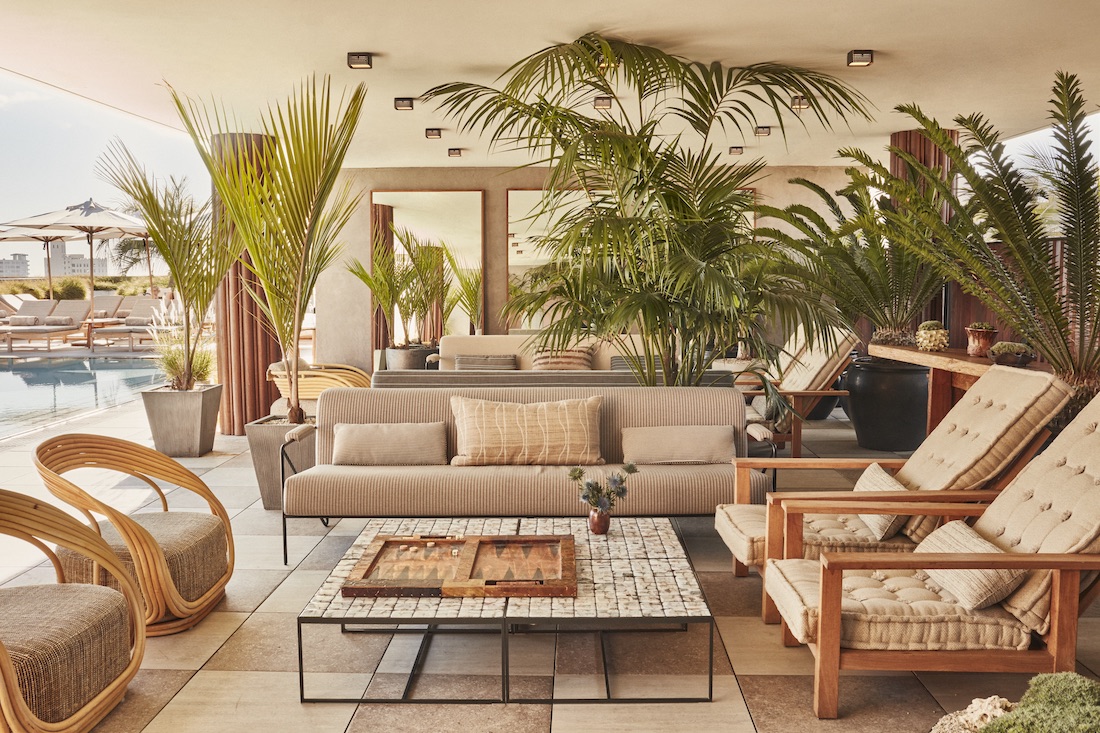 Santa Monica Proper hotel, courtesy of Kelly Wearstler.
- Santa Monica Proper: The strategic choice for Frieze. Kelly Wearstler interiors, rooftop pool, Calabra restaurant. Walkable to the airport campus. Book well ahead.
- Chateau Marmont: West Hollywood. The art world’s unofficial hotel for forty years. Bungalows only, if possible. Essential if your week is centered on Felix and the West Hollywood gallery circuit.
- Nomad Los Angeles: Adjacent to MOCA, The Broad, and Walt Disney Concert Hall. Restaurant Leo, rooftop pool, 1920s building.
- The Line: Koreatown. Architecturally considered, central location bridging Westside (fair) and Eastside (museums).
Where to Dine during Los Angeles Art Week
 Courtesy of Ardor.
Art World Power Table
- Michael’s Santa Monica: For 45 years, the McCartys‘ restaurant has been where LA’s art world conducts its most important lunches. The walls carry Marlene Dumas, David Hockney, Billy Al Bengston. The garden patio in late February is among the great lunch settings in the city. If you only have one power meal, this is it.
- Osteria Mozza: The mozzarella bar remains one of the great restaurant concepts in America. The ricotta-and-egg-yolk ravioli, Nancy’s Caesar, the duck rillettes crostino. One Michelin star, culturally worth three. Connected to Chi Spacca and Pizzeria Mozza next door.
- Manuela at Hauser & Wirth: Southern-inflected California cuisine. Natural wine program. The most strategically located lunch of Frieze Week—eat here between the Hauser & Wirth openings and the DTLA gallery circuit.
Atmospheric & Late Night
- Vespertine: Jordan Kahn‘s otherworldly two-star experience inside Eric Owen Moss’s tower. A complete sensory environment.
- Ardor at The Edition: John Fraser‘s vegetable-forward menu inside the West Hollywood EDITION. The plant-filled room is the ultimate reset between opening nights.
- Guelaguetza: The essential Oaxacan restaurant of Los Angeles. Order the mole negro. One of the few restaurants in the city that has nothing to prove to anyone. The antidote to fair-week tasting-menu fatigue.
Getting the Most of Frieze Week in Los Angeles
 Photo by Marc Patrick/ BFA, courtesy of LA Dance Project and Getty Villa Museum.
- Transportation: Santa Monica Airport is 30–45 minutes from Downtown in normal conditions; plan 60–75 during peak fair hours. Geographic clustering is the strategic key.
- Booking: The Broad benefits from advance timed-entry booking. ICA LA and Hammer are free and require nothing.
- The Fair: Saturday morning, first two hours—the best time for serious viewing. Focus section first; the work that will matter in five years is currently priced accessibly. The Art Production Fund outdoor projects are best seen in natural afternoon light.