



For the second edition of “Designers of Tomorrow,” presented with Design Miami at L’Hôtel de Maisons during Design Miami Paris, curator Rodman Primack invited four emerging practices to respond to a single theme: presence. Isabel Rower, Parafernalia, Salem S. Charabi and Yoonjeong Lee each produced a new work. What connects them is not a material or a style but a way of working, in which the phone, the tablet and the laptop sit on the same bench as the chisel, the clay and the veneer.
Design for Presence, in a Distracted Age
 Isabel Rower at work on “Padded Chair 1860,” 2026. Courtesy of the artist and Design Miami Paris.
 Yoonjeong Lee at work on “New Form” 2026. Courtesy of the artist and Design Miami Paris.
For Primack, the theme grew out of a simple observation: contemporary life is crowded, and objects can create moments in which attention settles. The four works answer that proposition differently, but all of them insist on physical encounter. They ask to be touched, opened, sat in or walked around.
The setting suits the question. Design Miami Paris places historical pieces alongside new works whose histories are only beginning. In that context, “Designers of Tomorrow” does not present technology as the opposite of craft. The designers work in ceramics, wood, paper, stone and steel, and they also work through screens, cameras and shared files. Their ideas move between the two.
Isabel Rower: An Archive Outside the Algorithm
 Portrait of Isabel Rower. Courtesy of the subject and Design Miami Paris.
 Isabel Rower, “Padded Chair 1860,” 2026. Courtesy of the artist and Design Miami Paris.
Brooklyn-based Isabel Rower presented Padded Chair 1860, built on found furniture recovered from the curb near her studio and reworked in papier-mâché and paper pulp composite. Its trim is made of more than 1,500 handmade ceramic beads, tinted to recall the marble and mother-of-pearl of eighteenth- and nineteenth-century European papier-mâché furniture. When touched, the beads make a faint sound, turning the act of sitting into an act of noticing.
Rower uses her iPhone camera and notes to collect references, and her MacBook as a personal visual library. She describes building it “outside of the endless algorithmic scroll of Instagram.” The screen holds the research; the chair is where it lands.
Parafernalia: A Studio Spread Across Two Cities
 Portrait of Genki Matsumura and Sebastián Zorrilla. Courtesy of the subjects and Design Miami Paris.
 Genki Matsumura and Sebastián Zorrilla, Detail of “MonoAmbiente 1,” 2026. Courtesy of the artists and Design Miami Paris.
Parafernalia, founded by Genki Matsumura and Sebastián Zorrilla and based between Monterrey and Mexico City, has no shared desk. The two designers keep a running conversation going throughout the day over FaceTime, Messages and WhatsApp, trading sketches, photographs and references.
Their piece, MonoAmbiente 1, makes that dialogue physical. Closed, it reads as a landscape in acid-etched stainless steel. Opened, its rocks become two stools and a table, a place for two people to talk, play chess or share a drink. The object shifts from something to look at to something to inhabit. As the studio puts it, technology “helps us engage with [craftsmanship] more closely.”
Yoonjeong Lee: Letting the Hand Lead
 Portrait of Yoonjeong Lee. Courtesy of the subject and Design Miami Paris.
 Yoonjeong Lee, “New Form” 2026. Courtesy of the artist and Design Miami Paris.
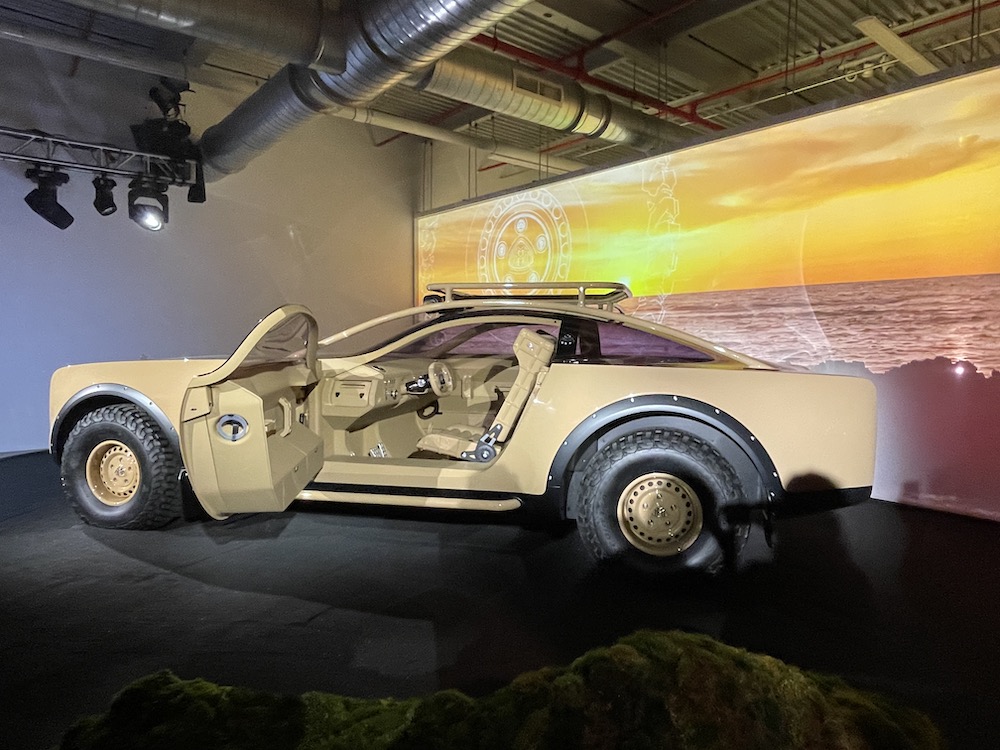
Seoul-based Yoonjeong Lee builds her practice around overlooked elements: nails, hidden structures, small units that make up a whole. New Form begins with a nearly used-up pencil, ground down and fitted with a metal core to become a nail. Paired with paper for its ability to carry light, it grew into a lamp, set on a table built from roughly 5,000 stacked sheets of veneer.
“I make my hands the main actor in my work and follow where they lead,” Lee said. She uses an iPad Pro and Apple Pencil to record what her hands make, then returns to those records as references for the next piece.
Salem S. Charabi: The MacBook and the Chisel
 Portrait of Salem S. Charabi. Courtesy of the subject and Design Miami Paris.
 Salem S. Charabi, Detail of “The Emergence of Light,” 2026. Courtesy of the artist and Design Miami Paris.
Salem S. Charabi, an Egyptian-Danish architect based in Cairo, presented The Emergence of Light, a lantern combining date palm ribs from Saqqara, banana palm paper from Beheira in the Nile Delta, and limestone from the Galala Mountains. He sketched and modeled the piece in 3D on a MacBook Pro before returning to cutting, splitting, drilling and assembling by hand, drawing on the palm-cleaving methods of the qafassin, Egypt’s traditional box and tray makers.
“Technology and crafts are one and the same thing,” Charabi said. “I don’t distinguish between a MacBook and a chisel, they share equal importance in my practice.”
When the Idea Leaves the Screen
 Salem S. Charabi, “The Emergence of Light,” 2026. Courtesy of the artist and Design Miami Paris.
Taken together, the four works suggest that the useful question is no longer whether design is handmade or digital, but how ideas travel between the two. An idea can start as a note on a phone, develop through a conversation between two cities, take shape on a tablet or laptop, and still need hundreds of hours of physical work before anyone can encounter it in a room.
That is where the exhibition’s theme of presence lands. The digital process shaped every one of these pieces, but each is judged in person: by a bead that moves under the hand, a layer of veneer, a landscape that opens into a seat.
“Designers of Tomorrow” was on view at L’Hôtel de Maisons, 51 rue de l’Université, Paris, October 21–25, 2026, during Design Miami Paris. Images by Élodie Croquet.


