

There is a moment, somewhere around the third day of Milan Design Week, when the spectacle begins to flatten. The openings blur. The champagne is the same temperature in every courtyard. And somewhere between the seventh immersive installation and the ninth brand activation, you find yourself looking for something that earns your attention rather than demands it. Fuorisalone and the Porta Venezia Design District has, quietly and with some conviction, built itself into the week’s most intellectually considered address. This year it returns under the theme Design is Act — drawn from the thinking of Tomás Maldonado, the Argentine-Italian designer and theorist who understood design not as decoration but as a form of ethical practice, a dialectical tension between memory and possibility. It is a framework that suits the neighborhood: Liberty architecture, a long tradition of artisan manufacture, and an increasingly international creative community that has chosen to work here rather than in the more photographed quarters of Brera or Tortona.
The district welcomed over 80,000 visitors last year — a 33% increase on 2024 — with 56 projects and more than 350 designers and curators participating. Growth at that scale risks dilution. What is notable in 2026 is how well the programming holds its character. The installations surveyed here share a quality that is difficult to manufacture: genuine restraint in the presence of a genuine idea.
DEORON


DEORON — Factory Eleven, Via Padova 11
The most unfashionable thing a designer can do during Design Week is say almost nothing. DEORON does this with precision. In a large, emptied industrial space, a single figure holds an oversized black form — something between a flag and a shadow—against a bare grey floor. There is no explanation offered on the wall. The work doesn’t need one. What Factory Eleven demonstrates is that scale can be achieved through reduction rather than accumulation—that the room you empty is sometimes more eloquent than the room you fill. In a week engineered for Instagram, it has the quiet authority of something built to last.
Edible Reveries
Studio Yellowdot for Artisia — Via Melzo 34
 Studio Yellowdot x ARTISIA, “EDIBLE REVERIES,” 2026. Courtesy of the studio.
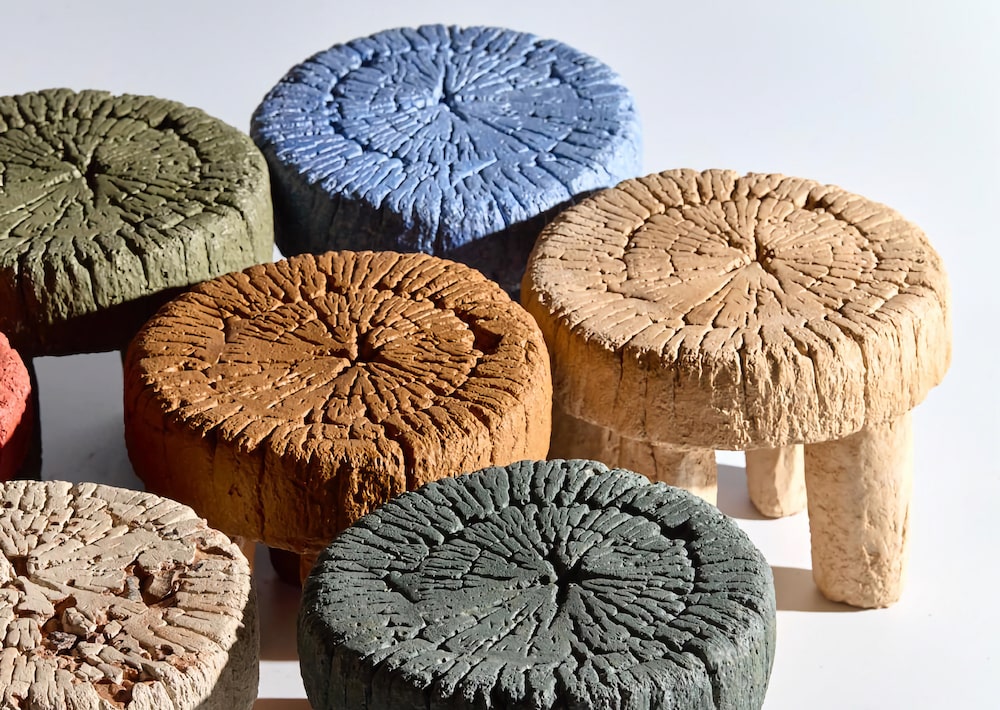
Studio Yellowdot arrives with a vision that dissolves the boundary between object, landscape, and the imagination entirely. A dreamed terrain of corrugated, sand-colored forms inhabit the space between furniture and terrain. The surfaces are ridged, almost geological; the palette is entirely of earth and grain. Small objects are suspended within the composition like specimens pinned in a vitrine, part artifact, part still life. The title gestures toward synesthesia — the overlap of taste and vision — and the work earns that conceptual territory. This is soft architecture in the most considered sense: form that invites contemplation of the body’s relationship to the made world.
The Sensory Lab
Sara Ricciardi for Eccentrico — Via Malpighi 7
 The Sensory Lab by Sara Ricciardi x Eccentrico. Photo by Laura Baiardini. Courtesy of Sara Ricciardi x Eccentrico.
Sara Ricciardi has long been one of Italian design’s more rigorous thinkers about the relationship between object and atmosphere. The Sensory Lab, made for Eccentrico, transforms ceramics into a sensory language capable of activating gestures, everyday rituals, and new spatial relationships. The installation is immersive in the most architectural sense: deep burgundy drapery frames a tiled environment of lavender and terracotta, the pattern working as both surface and spatial choreography. The space transforms ceramics into a sensory and narrative language that feels rooted in the history of the material — Italian tilework, bathhouse architecture, the long memory of the decorated wall — while remaining entirely of the present.
One, Two, Many
Movimento Gallery — Via Giacosa 37
 Courtesy of Movimento Gallery.
 Courtesy of Movimento Gallery.
Movimento Gallery brings together seven international designers — Corpus Studio, LC Atelier, Felix Millory, Neemesi, Chris Shao, Tipstudio and Ju Wang — for One, Two, Many, with soundscapes by Hidden Mountain. The exhibition takes seriality as both subject and working method — examining what occurs when an object is multiplied, echoed, or fractured across a space. A stool in burnished steel with a coarse fur seat anchors the room: deliberately elemental, slightly confrontational in its refusal to beautify. The sound component refuses to let the objects be simply admired in silence, which is the right instinct. Design here is treated as a question about accumulation — what we reproduce, what we keep, and what repetition does to meaning over time.
L’Appartamento
Artemest — Via Gaetano Donizetti 48
 L’Appartamento by Artemest. The Living Room by March and White DesignSketch.
L’Appartamento, hosted at Palazzo Donizetti, brings together international designers and interior designers who reinterpret the rooms of a Milanese residence through furniture, lighting, and objects made by Italian master artisans — a contemporary reading of the country’s manufacturing heritage. The visual language is one of gilded enfilades, rooms seen through open doorways in warm amber light, each interior a different interpretation of Italian domesticity at its most historically self-aware. Artemest has always understood that the Italian design canon is both an inheritance and a living argument; this installation makes that argument well, without nostalgia.
Renaissance of the Real
USM × Snøhetta and Annabelle Schneider— Fondazione Luigi Rovati, Corso Venezia 52
 USM × Snøhetta and Annabelle Schneider, “Renaissance of the Real,” 2026. Courtesy of USM × Snøhetta and Annabelle Schneider.
The pairing of Swiss systems manufacturer USM, the Norwegian architecture firm Snøhetta, and artist Annabelle Schneider is on paper, an unlikely one. In practice, it is exactly right. USM’s modular steel furniture system — one of the defining rationalist objects of the late twentieth century — is placed here in dialogue with Snøhetta’s characteristically organic spatial intelligence. The result is a soft-focus vision of structure returning from an extended period of ideological rigidity: modernism still present, still structurally coherent, but now understood through feeling rather than doctrine. At Fondazione Luigi Rovati, one of Milan’s more serious private cultural institutions, the location adds a layer of meaning the work earns.
Octo X
David Lopez Quincoces for Zucchetti — Corso Venezia 29
 ZUCCHETTI x David Lopez Quincoces, “Octo X,” 2026. Photo by Louis De Belle.
 ZUCCHETTI Showroom. Photo by Giulio Ghirardi.
Spanish designer David Lopez Quincoces strips the bathroom fixture to its essence. Octo X presents Zucchetti‘s new faucet collection staged on stacked kraft cardboard boxes — a deliberate contrast of industrial material and precision engineering that asks us to look at an object we typically ignore. The brushed steel of precision-engineered taps against kraft paper produces an image of quiet authority. What Quincoces is arguing — and the staging makes the argument clearly — is that an object this considered requires no theatrical apparatus. The faucet is the spectacle.
Food for Thought
Ikea — Spazio Maiocchi, Via Maiocchi 7
At Spazio Maiocchi, Ikea presents an immersive experience dedicated to the rituals of cooking and being together, in dialogue with its concept of Democratic Design. Food for Thought is, within the context of a week dominated by limited-edition collectibles and brand activations for the ultra-high-net-worth, a deliberately populist gesture — and a necessary one. The argument it makes, that design for the many is no less rigorous than design for the few, is one the design world periodically needs to hear. Spazio Maiocchi is the right venue: unpretentious, properly Milanese, with good bones.
The Swedish Home
Electrolux — Via Melzo 12
 Courtesy of Electrolux.
Electrolux presents The Swedish Home as an environment inspired by Swedish domestic culture, where simplicity, well-being, and connection with nature become central elements of the design experience, accompanied by talks, workshops, and moments of conviviality. The installation transforms the interior into a dense planted forest — canopy light filtered through hanging greenery, technology present but not announced. The proposition is one that Scandinavian design has been advancing since the mid-twentieth century, but rarely with this level of atmospheric confidence: the home as living system, domesticity as ecology. It wears its references lightly.
Over and Over and Over and Over
6:AM — Piscina Romano, Via Ampère 24
 Courtesy of 6:AM. Photo by ©Tommaso Mariniello.
 Courtesy of 6:AM. Photo by ©Tommaso Mariniello.
At the historic Piscina Romano, 6:AM installs one of the week’s more meditative works. A large copper-red panel — richly textured, deeply material — is suspended in an otherwise emptied corridor, its reflection fracturing on the floor below. The title does what it promises: repetition as practice, as ritual, as the kind of sustained attention that contemporary visual culture systematically discourages. In a week built around novelty, a work that insists on duration makes a considered argument. The choice of venue — an Art Deco swimming pool, architecture built for the long effort — is not accidental.
Yoox Camerino
Keta Bart for Yoox — Via Lazzaro Palazzi 24
 Courtesy of Yoox.
Yoox presents an immersive three-room installation by Viennese digital artist Keta Bart, built around the concept of the dressing room as a liminal space of transformation. The imagery is deliberately hallucinatory — the figure in sculptural silk, the crystalline headpiece, the iridescent wings against a cloud-pink sky. Bart’s practice has always been interested in the threshold between identity and artifice, and the dressing room is precisely the right locus for that inquiry: a space that exists to enable transformation, to try on not just clothes but versions of a self. Where fashion and design intersect, it is usually superficially; here, the intersection is structural.
Responsive Nature
Elisa Ossino Studio for Molteni&C — Garden Senato, Via Senato 14
 Molteni&C’s “Garden Senato.” Courtesy of Elisa Ossino Studio.
Elisa Ossino is one of Italian design’s more thoughtful voices on the relationship between material culture and the natural world. Her installation for Molteni&C in the outdoor Garden Senato begins with an image that holds: a human head submerged in dense dark foliage, ear to the earth, listening. The gesture is old — humility before the natural world is the oldest design philosophy there is — but in the context of a furniture house with Molteni&C’s history of craft and material seriousness, it reads as renewal rather than nostalgia. Not a showroom. A posture toward the world.
Anima Mundi
Studio Dotdotdot for Geely Auto — Istituto dei Ciechi, Via Vivaio 7
 Courtesy of Studio Dotdotdot.
Studio Dotdotdot is among the more technically sophisticated creative studios working in immersive installation, and Anima Mundi demonstrates why. At the Istituto dei Ciechi — an institution with its own complex history at the intersection of perception and architecture — they layer algorithmic data visualization over Baroque imagery: neural geometries dissolving into frescoed faces, ascending forms moving through organ pipe architecture. The effect is genuinely disquieting in the best sense, the kind of work that changes the resolution at which you see the room around you afterward. For Geely Auto, the ambition of the brief is as interesting as the result.
Insieme
Vanity Fair, curated by Sabato De Sarno (Creative Director, Gucci) — Piscina Cozzi, Viale Tunisia 35
 Levaggi. Courtesy of Insieme.
Insieme, curated by Sabato De Sarno, shifts the focus from objects to people. At Piscina Cozzi — Milanese Art Deco at its most unapologetically civic — the Gucci creative director brings Vanity Fair‘s archival intelligence to bear on a room dense with plaster casts, accumulated craft, and the texture of collective memory. What De Sarno understands, and what this installation articulates with some clarity, is that the objects a culture makes are inseparable from the people who make and use them — that design history is, finally, social history. The most emotionally resonant work in the district, and the most quietly political.
Ooooh, That’s Epiq!
Ulises Studio for Škoda Auto — Palazzo Senato, Via Senato 10
 Courtesy of Ulises Studio.
The courtyard of Palazzo Senato is reinterpreted as a landscape of soft sculptural volumes and moldable surfaces, developed by Ricardo Orts, founder of Ulises Studio, a Spanish digital artist named one of Forbes’ Top 100 Best Creatives for Business in 2024. The work is tied to the launch of the Škoda Epiq electric SUV, but it operates at a distance from conventional product staging. The palette is toy-box bright; the forms are body-scaled and slightly absurd; the effect is of a piazza temporarily returned to the logic of play. In a district with a tendency toward gravitas, this is a welcome interruption.
The Meanwhile Club
Park for Le Cannibale — Park Hub, Via Garofalo 31
 Courtesy of Le Cannibale x Park. Photo by Nicola Colella.
Park‘s installation for Le Cannibale takes the provisional as its subject: panels of recycled cork, corrugated plastic, and speckled composite stand in a graffitied industrial space — materials of the in-between, the not-yet-resolved. The Meanwhile Club asks what design looks like in the pause between intention and outcome, when the form has not yet decided what it wants to be. It is the most understated work in the district, and perhaps the most honest. Not every design question requires an answer by the end of the week.