
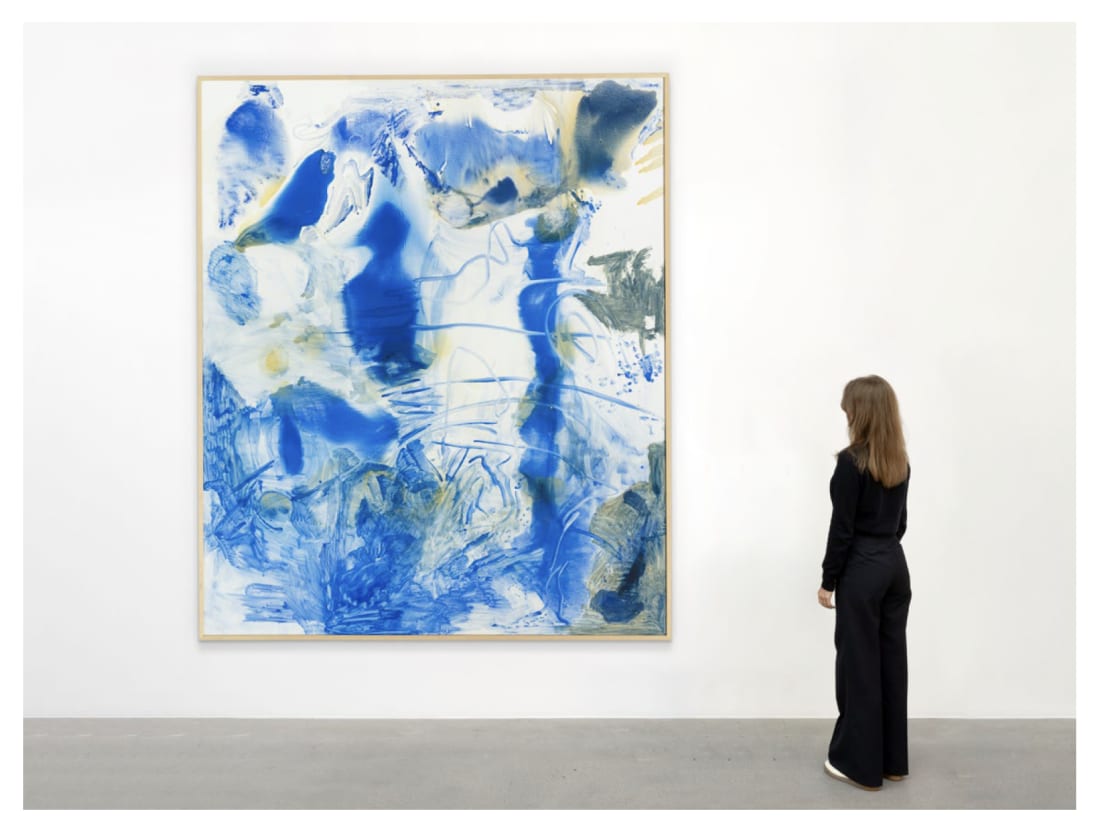



At Akris, precision begins with fabric. For Spring/Summer 2027, Albert Kriemler brought that discipline into contact with Martha Jungwirth‘s physical approach to painting, in which fingerprints, scratches, and even shoeprints remain on the surface. Presented at the Palais de Tokyo on October 4, the collection translated her gestures into ribbons, reversed jacquards, and translucent layers. Its apparent spontaneity was carefully constructed.
The opening look made an immediate impression: a sheer red silk knit gown with a flared skirt, an open back, and an ajouré bodice. A red wool crêpe double-face trouser suit followed, its jacket shaped with peplum flaps and layered over openwork knitwear, including a sashed apron top. The contrast established the collection’s rhythm. Tailoring gave the body definition; sheer fabric and trailing ties allowed the silhouette to shift.
Colors of Feeling
 Courtesy of Akris.
 Courtesy of Akris.
“Seeing Martha’s colors for the first time, I was struck by their sheer audacity,” Kriemler wrote in his show note. “Her paintings never give themselves away at once. You have to keep looking.” Reds, pinks, and violets (Jungwirth’s “Gefühlsfarben,” or colors of feeling) offered him a way into dressing as an intuitive act. His note connected appearance to “what we carry within: instinct, habit, desire, memory, fantasy. Life, really.”
“Seeing Martha’s colors for the first time, I was struck by their sheer audacity,”
—Albert Kriemler
Born in Vienna in 1940, Jungwirth works between abstraction and figuration, drawing on encounters, travel, literature, current affairs, and art history. She works primarily on paper, leaving broad areas untouched while lines and blotches retain the force of their application. Despite recognition at documenta 6 in 1977, she spent decades largely outside the public eye. Renewed attention brought major institutional exhibitions, including at the Albertina in 2018 and the Guggenheim Museum Bilbao in 2024. For Kriemler, the productive connection lay in her handling of material: the surface records the body that made it.
Gesture Woven into Fabric
 Courtesy of Akris.
 Courtesy of Akris.
He pursued that connection through construction. Ribbons developed in-house and applied by hand followed the zigzag of her brushstrokes, their loose ends left to trail. Reversed jacquards exposed threads and open structures usually concealed, while inverted laser-cut fringe redirected movement. Alongside prints drawn from her paintings, these techniques brought the act of making into the finished textile.
Collector and cultural patron Christine Wuerfel-Stauss, known for curating art–fashion dialogues, observed how the ribbons’ different textures echo the varying densities of Jungwirth’s paint. “This is what I find especially remarkable: the idea that the process of making leaves its own traces in the finished work is translated into the making of the textile itself,” she said.
The clothes gave that observation substance. A violet Senso fringed jacquard shirt jacket met red silk taffeta trousers, its textured surface heightened by the smooth fabric beneath. Pink Brushstroke print spread across a flared silk organza gown. In Sienna, Goya’s Dog jacquard became a pencil skirt and a jacket with fully buttoned slit sleeves; yellow Deikoon jacquard appeared as a coat and faux-wrap pencil skirt. The painterly surfaces found structure in familiar wardrobe forms.
Black brought line and volume into sharper focus. An Equus ribbon-appliqué bustier gown combined a defined bodice with a cascading back panel. A black-and-ecru “Her” print midi dress carried floating fringe embroidery, followed by an off-the-shoulder panama silk organza gown with the “Her Scribble” application and cascading side panels. This was the collection’s most compelling passage: the marks extended around the wearer, shifting with her movement.
The Apron, Reimagined
 Courtesy of Akris.
 Courtesy of Akris.
The apron supplied a more intimate connection. Part of Jungwirth’s working wardrobe, it also belongs to Akris’s beginnings. In 1922, Kriemler’s grandmother, Alice Kriemler-Schoch, opened an apron atelier in St. Gallen; her name would give the house its own. Here, small, sashed apron tops in knit and organza introduced a delicate layer over blouses and dresses. Alice ribbon embroidery recalled one of his grandmother’s designs from the 1950s, appearing on organza pieces in ecru, cerulean, and yellow. An ecru apron top worn with a boxy blouse and pencil skirt made the reference particularly clear. A garment associated with work became a means of composing an outfit.
That sense of ease continued in a cerulean suede bomber with a button-front A-line skirt, a mint ribbon-embroidered jacket, and an orange organza trench-style jacket over openwork silk knit layers. Each gave the eye a different encounter with color: absorbed by suede, interrupted by embroidery, or filtered through transparency.
Emotion Given Form
 Courtesy of Akris.
 Courtesy of Akris.
For Wuerfel-Stauss, this is another connection between painter and designer. “For Jungwirth, color is a bearer of emotion—her ‘feeling-colors.'” Kriemler’s interest, she noted, extends to which fabric allows a particular hue to work best and how a dress affects the wearer’s perception of herself. The accessories carried the same material attentiveness: Brushstroke embroidery reached a canvas Ai tote, while horsehair Alice bags echoed the palette in compact form.
“For Jungwirth, color is a bearer of emotion—her ‘feeling-colors.'”
—Albert Kriemler
The finale gathered print, texture, and movement into an ecru-and-yellow Cambodia print silk georgette bustier gown with floating fringe embroidery. Watching the runway, Wuerfel-Stauss identified the exchange running through the collection. “Movement is present at both ends,” she said. “Jungwirth’s own physical movement is part of the way she paints. In the collection, that movement is translated into material, and once the clothes are worn, another body puts that material into motion.” Fashion, she added, “can take an artistic idea somewhere the original medium cannot.”
Kriemler closed his note with “Emotion given form.” A brushstroke records a movement already made; a ribbon can move again.


