



As one of the first major shows of Paris Fashion Week, Dior Spring/Summer 2027 arrived just as autumn began to settle over the city. Jonathan Anderson returned to the Jardin des Tuileries, where editors, collectors, and friends of the house gathered around an octagonal structure around a pond. At its center, six camphor trees—three on either side of the white runway—created the illusion of a single tree, mist rising from their roots as models walked past.
The invitation offered the first clue to Anderson’s thinking: a pair of wenwan walnuts. Traditionally rolled together in one hand until their hard, textured surfaces develop a smooth sheen, the walnuts are difficult to match perfectly in shape and size. Asymmetry is natural, symmetry becomes something to search for.
The same question extended into Anderson’s collection, which balanced the constructed against the weightless, the archival against the new and the deliberately unfinished against Dior’s exacting technique.
Spring/Summer 2027 An Exercise in Lightness
 Courtesy of DIOR. © DIOR.
 Courtesy of DIOR. © DIOR.
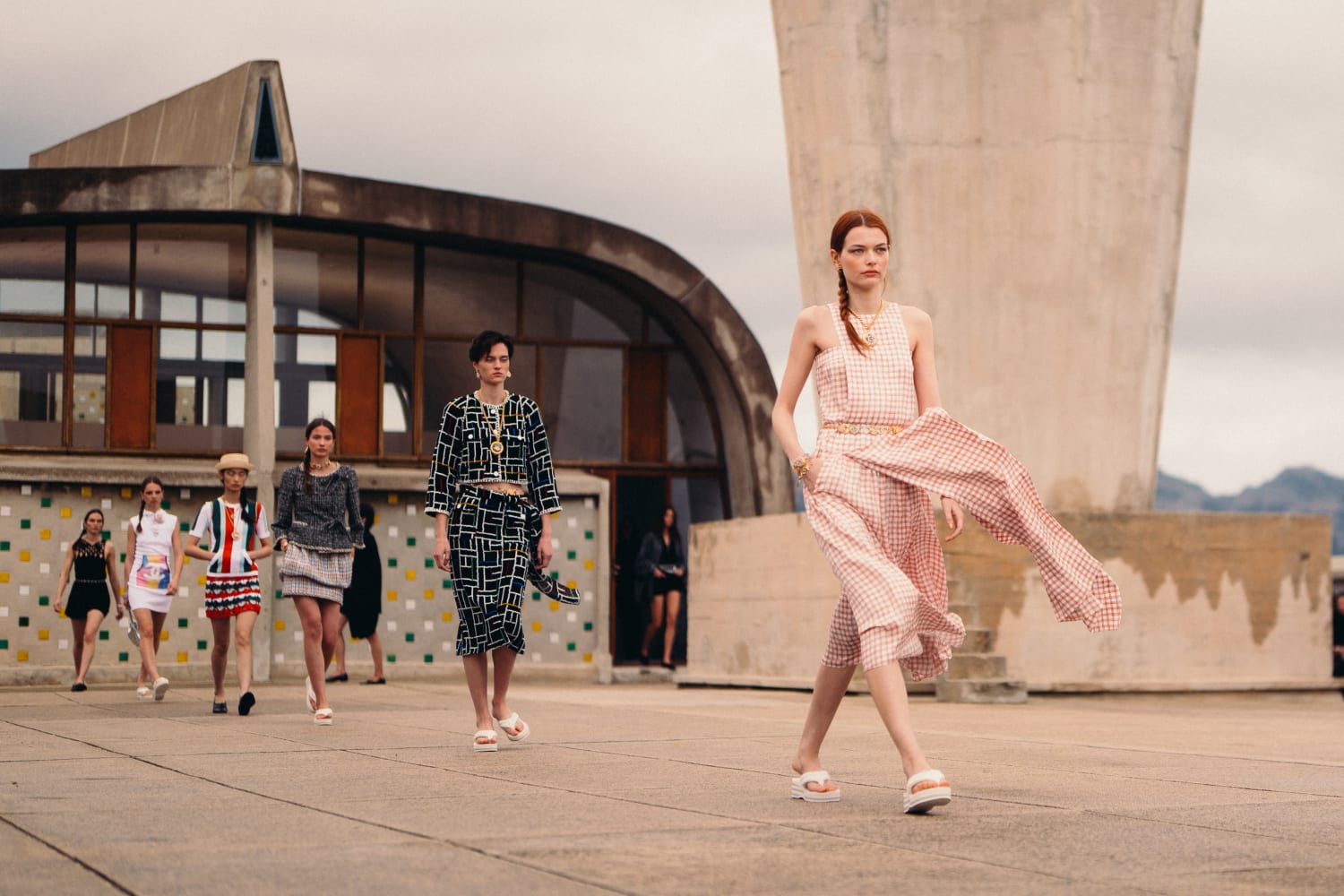
The Spring/Summer 2027 collection opened with translucent chiffon jackets layered over raw-hemmed miniskirts, establishing a tension that would continue throughout the show: garments could be built up without becoming heavy. Cocktail and sundresses appeared in multiple iterations, filtering familiar Dior silhouettes through Anderson’s increasingly recognizable vocabulary at the house.
Nature entered subtly. Floral prints surfaced across dresses and separates without overwhelming their silhouettes, while petals became three-dimensional embellishments. Earrings offered an especially playful study in asymmetry: on one side, a long beaded strand; on the other, scaled chiffon petals or strands cascaded downward. Different forms performed essentially the same function.
Petal-like layers also softened skirts and dresses, while fringe extended from bags and flared hems pushed outward from the body, swaying with each step. Houndstooth, checks and stripes punctuated the pastels and solids, grounding the collection in familiar house codes.
Accessories appeared almost casually accumulated: heeled flip-flops, T-strap sandals, body chains, mismatched earrings and handbags gave otherwise meticulous looks an appealing sense of spontaneity.
Structure Without Weight
 Courtesy of DIOR. © DIOR.
 Courtesy of DIOR. © DIOR.
If the collection looked effortless, its construction suggested otherwise. Paper-thin fabrics were pleated with remarkable precision, densely worked at the top before loosening and billowing outward. Raw hems interrupted that technical exactitude, allowing refinement and incompleteness to coexist within a single garment.
Peplums offered another version of the contradiction. Structured but never rigid, they projected outward while retaining the collection’s prevailing lightness. Material experimentation was present, but it never became the central story. One standout look paired light-green metallic snakeskin trousers with a green striped button-down, a camel trench tossed over the top.
Instead, Anderson concentrated on silhouette, opacity and the vocabulary of Dior itself. Tailoring softened, flou acquired structure. Volume appeared and disappeared around the body. Even when garments seemed to float, something—a sharp waist, a pleat, a stripe, a weighted accessory—pulled them gently back toward earth.
A Study of True Symmetry
 Courtesy of DIOR. © DIOR.
 Courtesy of DIOR. © DIOR.
The show notes returned to the questions behind the clothes: “Does lace hold air?” “How light can a garment be?” “What if tailleur is imagined as flou?” and, ultimately, “Where is true symmetry?”
“The inherent nature of a piece from the archive is articulated in new ways,” Anderson writes. “Long before a tree spreads its branches to the sky, the nut holds the knowledge of its form.”
That idea offered perhaps the clearest reading of the Spring/Summer 2027 collection. Rather than simply reproducing Dior’s archive, Anderson treated it as something containing the possibility of another form—recognizable in its origins but capable of growing elsewhere.
 Courtesy of Dior. © Adrien Dirand.
The trees at the center of the set will themselves continue that cycle: following the show, they are to be replanted in the Jardin des Tuileries, remaining long after the runway has disappeared.
Dior Spring/Summer 2027 was dedicated to the late Mathilde Favier, the house’s longtime International Director of Celebrity Relations. Between the ephemeral clothes, the archival references and trees intended to outlive the spectacle, Anderson’s meditation on symmetry ultimately became one about continuity: what remains, what changes and how one form can quietly contain the beginnings of the next.