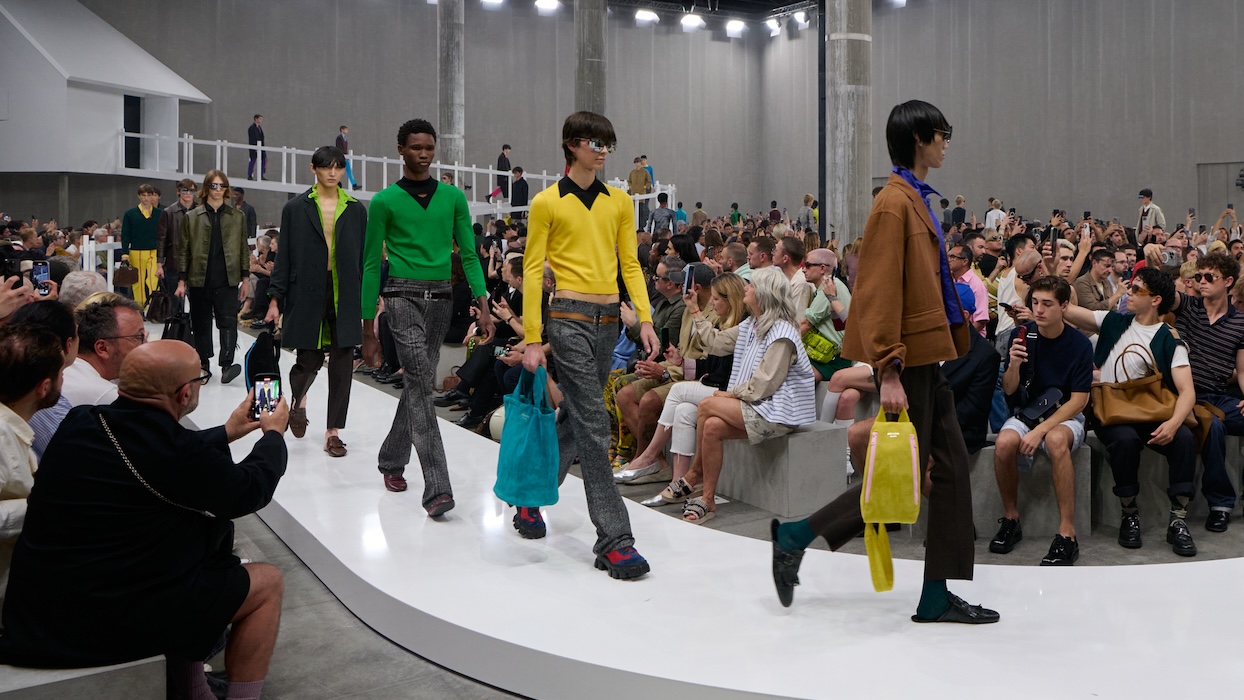



All eyes turn to Milan for Fall/Winter 2026 as Fashion Month draws to a close. Beyond the season’s headline debuts, a quieter throughline emerged across the city: a collective return to tailoring and craft as Milan’s true signature. At Brioni, precision softened into feminine fluidity. Brunello Cucinelli explored texture and memory through relaxed structure. Ferrari sculpted garments as second skins, while PORTS 1961 framed tailoring as movement across cities and roles. At Tod’s, leather craftsmanship and artisanal techniques anchored the conversation.
Feminine tailoring stood at the forefront—sometimes architectural, sometimes intimate—shifting between volume and body-conscious lines. A palette of beige, grey, black, ivory, burgundy, and deep earth tones dominated, reinforcing restraint over spectacle. Leather persisted as both structure and accent. In Milan, heritage is not nostalgia; it is a living discipline, refined season after season.
Brioni: Feminine Tailoring
 Courtesy of Brioni.
 Courtesy of Brioni.
At the historic Milanese apartment Salotto Colla, Brioni unveiled Fall Winter 2026, a collection grounded in craftsmanship and quiet authority. Classic forms are elevated into a distinctly feminine language—precise, tactile, and modern. The Brioni woman moves through a pared-back palette of clay, grey, peach, blue, brown, and deep wine. Tailoring remains the cornerstone. Jackets and suits are constructed with a second-skin sensibility, lightweight yet structured, balancing fluidity with control. Outerwear introduces subtle contrast: a reimagined safari jacket with a knitted collar and detachable scarf, cinched with leather; a reversible cashmere car coat pairing solid and checkered wool; and trench coats in cotton canvas, herringbone, or wool, finished with leather lapel accents.
For evening, a tuxedo coat with a plunging neckline appears in silk satin, designed to function as either coat or dress. Through the new La Donna Atelier “Su Misura” project, each look becomes customizable—fabric, lining, button—allowing individuality to emerge within timeless restraint.
Ferrari: SKINS I AM IN
 Courtesy of Ferrari.
 Courtesy of Ferrari.
On the final day of February, Ferrari Creative Director Rocco Iannone turned inward—toward skin. Titled “SKINS I AM IN,” the collection considers the body’s largest organ as both boundary and beginning: the surface we dress, protect, and reveal. Garments function as a second skin. Leather, structured wool, and fluid cupro move between firmness and liquidity, transforming nudity into coverage with composure rather than concealment. Lines trace and magnify the body’s natural architecture; knit patterns echo musculature and curve. Silhouettes follow form closely, enhancing rather than disguising.
The palette explores tonal nudes alongside dark green, burgundy, and black. A series of ombré looks—shifting from pale nude to deep brown in liquid fabrics—created a sunset-like gradient against the otherwise controlled chromatic field. Accessories reinforce the corporeal narrative. Wedge heels mirror the natural curve of the foot, while soft bags are secured with piercing hardware. The result is tactile, intimate, and unapologetically physical; a meditation on what it means to inhabit one’s own skin.
Brunello Cucinelli: Pages from Landscapes
 Courtesy of Brunello Cucinelli.
 Courtesy of Brunello Cucinelli.
Set against the misty quiet of the British countryside, Brunello Cucinelli unveiled Fall Winter 2026 as a meditation on landscape, memory, and touch. The collection reads like pages lifted from a pastoral novel, rooted in heritage yet softened for a new sensibility. Craftsmanship remains central. Tailoring, long the house’s anchor, shifts gently away from rigidity toward ease, blurring the line between daywear and evening. Precision is not abandoned, but relaxed. Silhouettes move with spontaneity, embracing comfort without sacrificing refinement.
British codes surface through checks, houndstooth, windowpane, and tartan in a restrained, neutral palette. Yet the focus is less chromatic than tactile. Fabrics of varying density and transparency are layered deliberately—lace against tweed, embroidery against brushed wool—creating contrast through texture rather than color. Knitwear takes the lead. Mohair, fringe, fur-like stitches, and subtle strands of sequins amplify the sensory dimension. It is country couture with restraint: romantic, grounded, and quietly evolving toward a generation that values softness over spectacle.
PORTS 1961: Dressing Is A Little Like Embarking
 Courtesy of PORTS 1961.
 Courtesy of PORTS 1961.
Marking its 65th anniversary, PORTS 1961 centers its latest collection on the idea of the traveler; a woman moving between cities, climates, and roles within hours. Dressing, here, becomes a form of departure. The PORTS woman seeks function with quiet refinement. Her wardrobe is not a constraint but a framework for freedom—mobility, expression, and continuity between destinations. A utilitarian palette of black, navy, grey, ivory, and camel is punctuated by military green, avio blue, pink, red, and brown.
Silhouettes shift across garments through geometric asymmetries, raw edges, and stitching. Knots reappear as sculptural buttons and fastenings on tops and skirts—both functional and ornamental. Prints introduce rhythm, tracing routes like lines on a map, while abstract argyle nods subtly to fashion’s ongoing Y2K revival. Structure gives way to softness without losing precision. She moves between tailored daywear and relaxed volume seamlessly—grounded, composed, and always aware of her place, no matter the terrain.
Tod’s: Italian Signature
 Courtesy of TOD’S.
 Courtesy of TOD’S.
For Fall Winter 2026, Tod’s turns to the enduring language of Italian artisanal tradition. Heritage, the collection suggests, is not constructed with nostalgia in mind; it is built slowly, through devotion to craft and material excellence. Under Creative Director Matteo Tamburini, the wardrobe is grounded in research and leather expertise, drawing on saddlery techniques and meticulous hand-finishing.
Ready-to-wear balances volume and precision. Sleeves are subtly shortened, waists defined. The trench and peacoat are reinterpreted with restraint, while a quilted bomber in aged calfskin emerges as a standout. Foulard dresses introduce graphic patchwork, adding movement to a palette of caramel, ginger, and chocolate, sharpened by black and white.
Footwear evolves with quiet authority. The loafer appears with a rounded toe, the ankle boot references equestrian straps, and the Gommino sneaker is rendered in supple suede. The Wave, T Timeless, and Di Bag return with renewed detail. Metal lettering—on belts and jackets—offers discreet personalization, a contemporary gesture rooted in tradition rather than excess.