
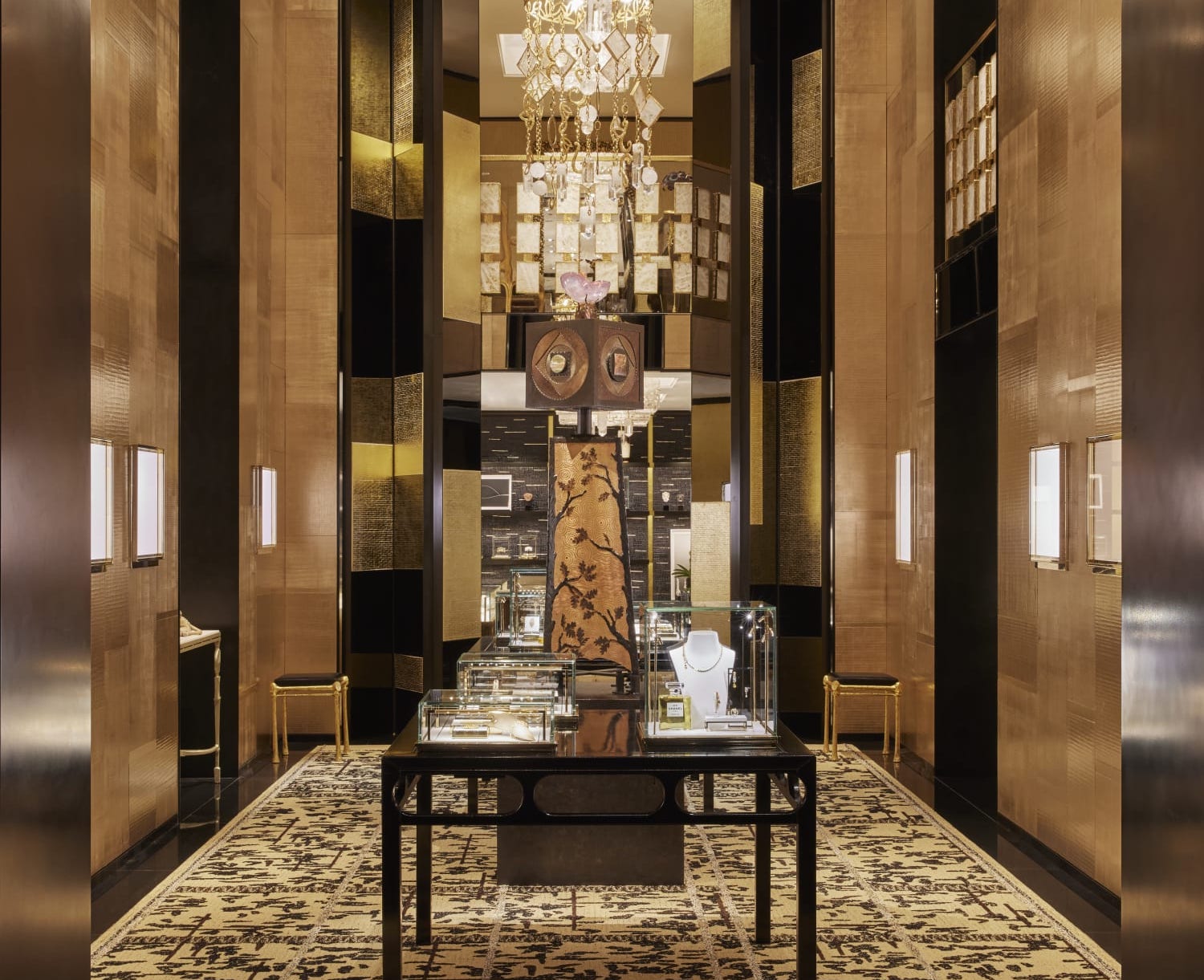


Since its founding in 1858, Boucheron has approached high jewelry as a space for creative freedom, technical experimentation, and a fresh perspective on precious materials. Now on view through October 18 in New York, the French maison brings that spirit to Christie’s Rockefeller Center galleries with “Boucheron: In Focus – A Monograph of a Visionary”—an exhibition that brings together approximately 80 creations spanning the maison’s history and contemporary practice.
Rather than organizing its collection chronologically, Boucheron invites visitors to explore four creative universes that have shaped its identity: Architecture, Nature, Couture, and Innovation. Historic jewels appear alongside contemporary creations, revealing how the ideas that informed founder Frédéric Boucheron’s vision continue to influence the Maison today. The exhibition also marks the American debut of the 2026 High Jewelry Carte Blanche collection, “Human Being,” conceived by Creative Director Claire Choisne, which was first unveiled in Paris in July.
The presentation is an opportunity to tell a story that extends beyond its archives. It is a closer look at the maison, whose pioneering spirit has remained central to its work for 168 years, connecting the ingenuity of its earliest creations with the possibilities of jewelry today. And for Hélène Poulit-Duquesne, CEO of Boucheron, the exhibition offers an opportunity to explore the ideas behind the objects, rather than simply presenting a sequence of historical milestones. The intention is to bring pieces from different eras into conversation, allowing visitors to recognize the continuity of Boucheron’s creative spirit.
“Our history with the United States goes back much further than our physical presence there. The first American clients appeared in Boucheron՚s order books as early as 1865, and in 1903, Louis Boucheron opened an office in New York to maintain these close ties. And yet, it was only in 2024 that we opened our first American boutique, on Madison Avenue,” said Poulit-Duquesne.
“This exhibition therefore marks an important new milestone in our American journey. It was conceived as a monograph, devoted to a single subject and exploring it in depth: rather than following dates, it lets us curate around meaning, around the ideas and the spirit that define who we are. That is the whole idea behind this immersive journey: to let visitors see how a piece from 1858 and a piece created today sit in the very same conversation. What I hope they take away is a real understanding of who Boucheron is—not a museum of the past, but a maison whose pioneering spirit has been consistent for 168 years. If American visitors leave feeling that Frédéric Boucheron՚s audacity is still alive in what we create today, then we will have told our story exactly as we wished.”
“If American visitors leave feeling that Frédéric Boucheron՚s audacity is still alive in what we create today, then we will have told our story exactly as we wished.”
—Hélène Poulit-Duquesne, CEO of Boucheron
Boucheron and Christie’s Share a History of Collecting
 Courtesy of Boucheron.
The exhibition opens with a timeline tracing the Maison’s milestones since 1858, establishing a historical framework for the objects and ideas that follow. Woven into this narrative is Boucheron’s longstanding relationship with the United States, which began well before the Maison established a physical presence in the country.
American clients first appeared in Boucheron’s order books in 1865. In 1903, Louis Boucheron opened a New York office to maintain those relationships, while the Maison’s first American boutique would not arrive until 2024, on Madison Avenue. The exhibition marks another significant chapter in that journey, bringing Boucheron’s heritage and contemporary vision into a major New York cultural setting.
Christie’s, meanwhile, has played a role in stewarding some of the Maison’s notable creations over the years. Among them are a scarf necklace made for the 1925 International Exhibition of Modern Decorative and Industrial Arts in Paris and an emerald and diamond tiara created for Lady Harcourt in 1920. Their presence in the broader story of Boucheron underscores the relationship between jewelry, collecting, and the preservation of exceptional craftsmanship.
“For 260 years, Christie՚s has had the privilege of connecting passionate collectors with unique, rare, and exceptional objects,” said Bonnie Brennan, Christie’s Global CEO. “Boucheron, a maison renowned for more than a century for its extraordinary craftsmanship and pursuit of beauty, has been a valued presence in our galleries around the world. We are honored to host this exhibition in our Rockefeller Center galleries, celebrating Boucheron՚s rich history in America, its remarkable creations, and its storied legacy. At its heart, this partnership is rooted in a shared set of values: a reverence for artistry, an uncompromising commitment to craftsmanship, and a belief that beauty has the power to transcend time and connect people across cultures and generations. We are excited to welcome visitors to experience this rare opportunity and to celebrate the enduring creativity that unites Boucheron and Christie՚s.”
“We are excited to welcome visitors to experience this rare opportunity and to celebrate the enduring creativity that unites Boucheron and Christie՚s.”
—Bonnie Brennan, Christie’s Global CEO
Architecture: From Paris to Place Vendôme
 Courtesy of Boucheron.
 Courtesy of Boucheron.
Paris has long been central to Boucheron’s visual language. The Architecture chapter considers how the city’s lines, volumes, and interplay of light have informed the Maison’s designs, from the modernity of Haussmannian streets to the geometry of Art Deco.
Frédéric Boucheron opened his first boutique at the Palais-Royal in 1858 before establishing the Maison at 26 Place Vendôme in 1893. His decision to become the first of the great contemporary jewelers to open a boutique on the celebrated square reflected an independent approach to business and design. The address would become inseparable from Boucheron’s identity.
Two creations make this relationship particularly clear. An Art Deco brooch from 1925, crafted in white gold, platinum, and diamonds, demonstrates the period’s fascination with symmetry, precision, and geometric form. The year also saw the Paris exhibition that gave Art Deco its name, a movement whose visual principles would continue to influence jewelry design.
Alongside it, a Lavallière necklace from Claire Choisne’s 2021 Histoire de Style collection, Art Déco, revisits that vocabulary through onyx, black lacquer, diamonds, and white gold. Nearly a century separates the two pieces, yet their shared attention to line, contrast, and structure makes their relationship immediately apparent. The pairing illustrates how Boucheron draws on its history without treating it as a fixed reference point.
Nature: A Living Source of Inspiration
 Courtesy of Boucheron.
 Courtesy of Boucheron.
Nature forms another essential part of Boucheron’s creative universe. Where many of Frédéric Boucheron’s contemporaries favored more conventional decorative motifs, he found inspiration in the natural world, seeking to capture the distinctive character of plants and animals through remarkably lifelike jewelry.
A highlight of this chapter is a foliage tiara commissioned in 1924 by Mary Ethel, Viscountess Harcourt, as a wedding gift for her daughter Doris. Crafted in platinum and diamonds, the piece takes the form of a branch, translating the irregularity and movement of foliage into a precious, wearable object. Mary Ethel, a great-niece of John Pierpont Morgan, was among Boucheron’s devoted collectors. More than a century after its creation, the tiara has returned to the Maison’s private collection.
Beside it, the Ivy Question Mark necklace offers a contemporary interpretation of the same fascination with the natural world. Revisiting a design first conceived in 1879, the necklace uses white gold and emeralds to recreate the delicate structure of an ivy branch with striking precision.
The original Question Mark necklace was itself a breakthrough in jewelry design. Its open, clasp-free construction allowed the wearer to put it on independently, offering a degree of freedom that challenged the conventions of the period. The design remains one of Boucheron’s most recognizable signatures, demonstrating how practical ingenuity and artistic inspiration can become inseparable.
Couture: When Jewelry Moves Like Fabric
 Courtesy of Boucheron.
Frédéric Boucheron was the son of a draper, and textiles have remained an enduring influence on the Maison’s work. The Couture chapter explores how the softness, structure, and movement of fabric can be translated into precious materials, transforming jewelry into something that feels less like a rigid ornament and more like an extension of personal style.
A 1959 necklace captures this sensibility through a ribbon rendered in gold. Its lifelike bow, lined with diamonds, ties at the front while the ends fall lightly around the body. The metal is woven and worked to imitate the suppleness of actual cloth, demonstrating the technical skill required to make a material as traditionally solid as gold appear fluid.
That pursuit continues in The Silhouette necklace, part of Choisne’s 2026 Histoire de Style collection, Nom: Boucheron, Prénom: Frédéric. Crafted in white gold and diamonds, the sculptural piece is designed to mold to the body and follow its movement. Its versatility is central to the concept: it can be worn in six configurations, including as a necklace with double shoulder adornments, two shoulder brooches, a double-drop sautoir, two separate necklaces, a graphic choker, or a pair of bracelets.
The comparison between the 1959 necklace and Choisne’s contemporary design reveals a consistent interest in jewelry that adapts to the wearer. Rather than simply decorating the body, these pieces respond to it, bringing together craftsmanship, movement, and individuality.
Innovation: Pushing the Boundaries of Precious Materials
 Courtesy of Boucheron.
Innovation has been part of Boucheron’s identity since its earliest days, and the exhibition’s final chapter examines how experimentation continues to expand the possibilities of High Jewelry. Here, unconventional materials and new techniques are not used simply to demonstrate technical prowess; they serve a larger creative purpose.
The Eternal Flowers from the 2018 Nature Triomphante High Jewelry collection offer one example. Using technology to crystallize real flowers, Boucheron developed a way to preserve the delicate beauty of a bloom in a lasting form. The process represented a first for the Maison and for High Jewelry, bringing the fleeting qualities of nature into dialogue with the permanence traditionally associated with precious objects.
Another highlight is the Jack de Boucheron Ultime brooch, which incorporates Cofalit, a material derived from recycled industrial waste. Cut, polished, and set with the same care given to a precious stone, the material takes on a new aesthetic value. The piece challenges conventional definitions of what deserves to be considered precious, suggesting that ingenuity and craftsmanship can transform even the most unexpected matter.
The chapter also provides context for the 2025 Carte Blanche collection, Impermanence, a separate presentation within the exhibition. Conceived by Choisne as a personal tribute to nature, the collection captures botanical forms in a progression from white to black, evoking the gradual disappearance of light. Ultra-high-resolution 3D printing, a couture diamond-setting technique developed for the project, and Vantablack®, among the darkest materials ever made, contribute to its exploration of beauty, transformation, and impermanence.
“Human Being”: A New Chapter in High Jewelry
 Courtesy of Boucheron.
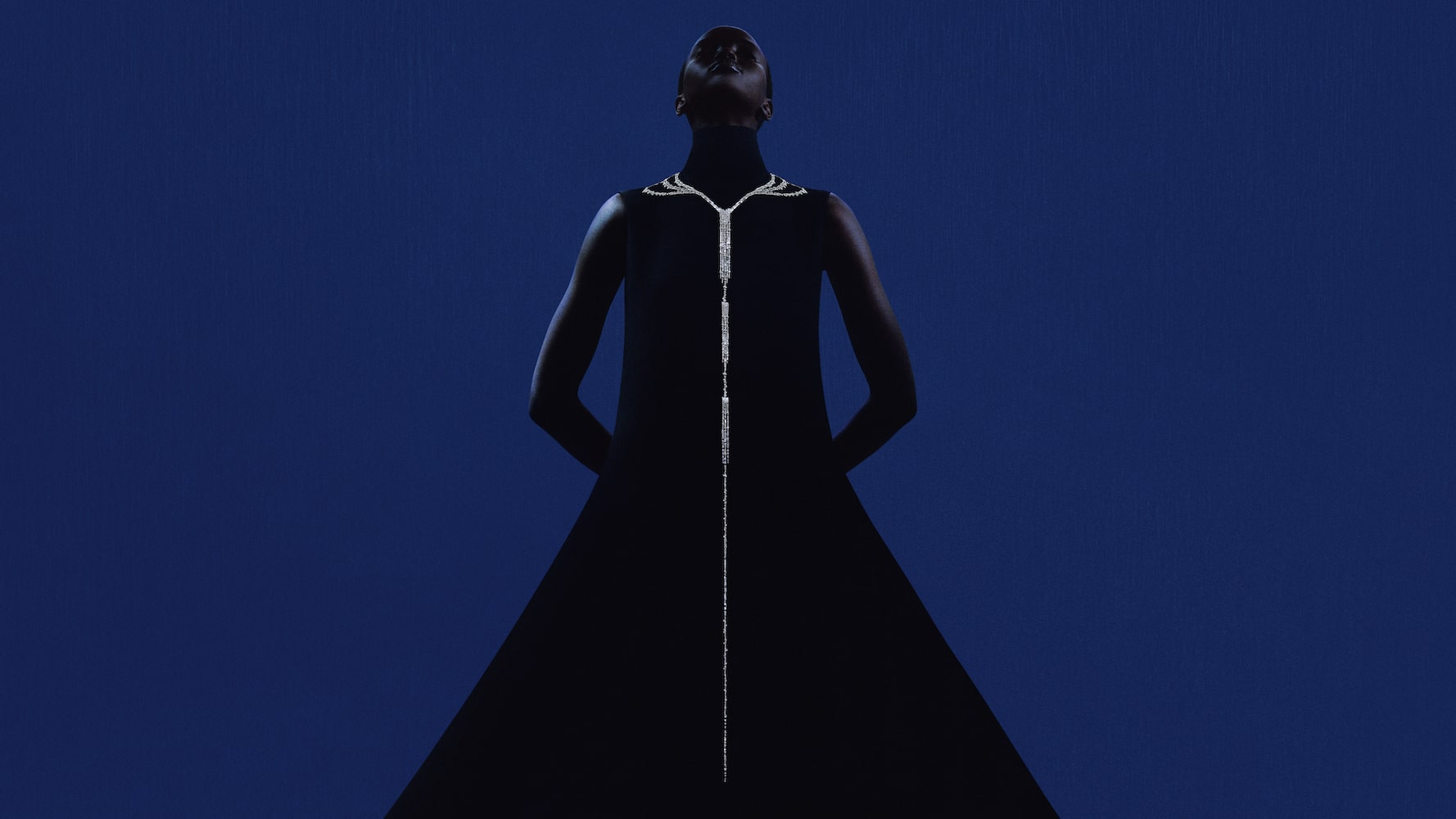
The exhibition culminates in “Human Being,” Boucheron’s 2026 High Jewelry Carte Blanche collection, presented in the United States for the first time. Each year, the Maison develops two distinct High Jewelry collections: Histoire de Style, which reinterprets its heritage through a contemporary lens, and Carte Blanche, which gives Choisne greater freedom to experiment with materials, forms, and the meaning of preciousness.
For “Human Being,” Choisne turns her attention to humanity itself. Across five jewelry sets, she explores the similarities that connect us and the differences that make each person unique. A shared silhouette unites the creations, while distinct combinations of gemstones, volume, light, and craftsmanship give each its own character.
The five sets—Rain, Flower, Light, Tattoo, and Checkers—demonstrate the breadth of this approach. Rain evokes diamonds cascading across the body through hollow rock-crystal droplets filled with layers of plant-based resin. Flower translates a floral motif onto rose quartz, while Light explores the movement of illumination through carefully selected morganite. Tattoo draws on the visual language of ink on skin, using intricately engraved smoky quartz. Checkers brings a graphic, houndstooth-inspired pattern to onyx through advanced laser engraving.
Together, the pieces reflect Choisne’s interest in the relationship between technology and the human hand. The collection required more than 14,000 hours of craftsmanship, with each set relying on a different savoir-faire despite its shared underlying form. The result is a meditation on individuality: what we have in common may be immediately recognizable, but the details emerge through closer observation.
That philosophy gives the exhibition a fitting conclusion. Across its four chapters, “Boucheron: In Focus – A Monograph of a Visionary” demonstrates how a maison can honor its history while continuing to question established ideas about design, materials, and craftsmanship. The past is present in every room, but it is never the final word.
“Boucheron: In Focus – A Monograph of a Visionary” Is on view at Christie’s New York, 20 Rockefeller Plaza, from October 9–18, 2026. The exhibition is open to the public Monday through Saturday, 10 a.m.–5 p.m., and Sunday, 1–5 p.m. For further information, visit Boucheron’s exhibition page or Christie’s.
 Courtesy of Boucheron.
 Courtesy of Boucheron.