




In Venice, where history is never quite behind us, craftsmanship has a particular way of revealing itself. At Homo Faber, the city becomes both setting and metaphor: a place where centuries of knowledge continue to coexist with new forms of creativity, and where the value of the hand feels increasingly relevant in a world moving rapidly toward the immaterial.
For Jaeger-LeCoultre, this conversation is deeply connected to the identity of the Manufacture itself. Founded almost two centuries ago on the principle of bringing together multiple métiers under one roof, the Maison has always understood watchmaking as more than the assembly of a mechanism. It is a culture of transmission, patience, invention, and the preservation of knowledge that might otherwise disappear.
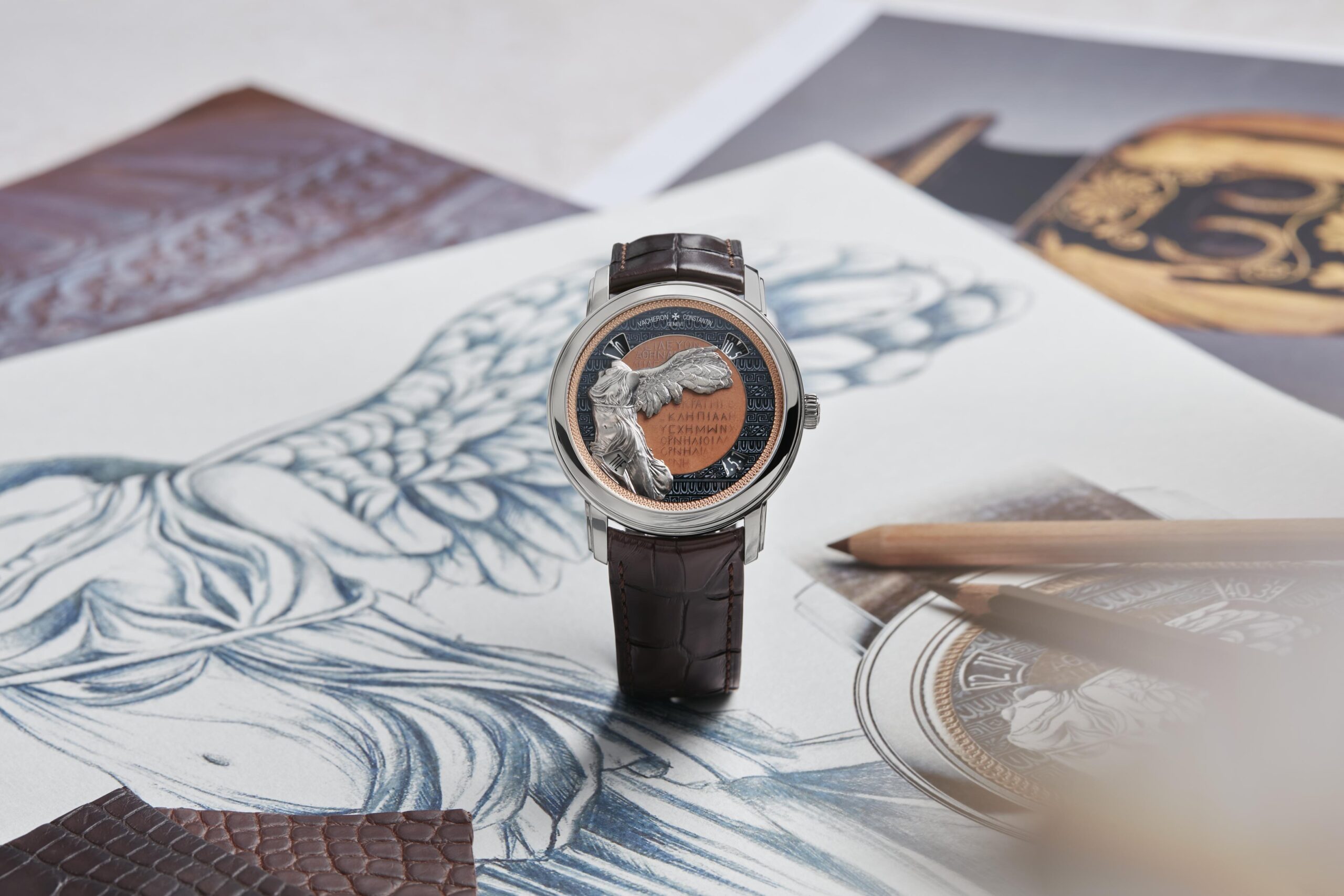
 Jaeger-LeCoultre Reverso Tribute Enamel Turner. Courtesy of Jaeger-LeCoultre.
At this edition of Homo Faber, that philosophy takes a particularly poetic form. Inspired by William Turner’s visions of Venice, Jaeger-LeCoultre presents miniature enamel paintings executed by hand on surfaces scarcely a centimeter wide, bringing together the atmosphere of the lagoon with one of the Manufacture’s rarest métiers.
We spoke with Matthieu Sauret, Product Marketing & Heritage Director at Jaeger-LeCoultre, about the meaning of craftsmanship today, the delicate balance between heritage and innovation, and the responsibility of passing knowledge from one generation to the next. From a remarkable 1933 Reverso bearing the coat of arms of the Maharaja of Jaipur to the future of craftsmanship in the age of AI, our conversation ultimately returns to a simple but increasingly powerful idea: that the things made by hand may become some of the most precious objects of tomorrow.
Craftsmanship Between Tradition and Innovation
 Jaeger-LeCoultre Reverso Tribute Enamel Turner. Courtesy of Jaeger-LeCoultre.
WHITEWALL: Homo Faber celebrates an exceptional dialogue between craftsmanship, creativity, and contemporary design. What does this platform represent for Jaeger-LeCoultre, and what role can it play in shaping the future of high craftsmanship?
MATHIEU SAURET: It is very important to us because the story of Jaeger-LeCoultre itself began with an idea very close to what Homo Faber represents today: bringing together different métiers and forms of craftsmanship around a creative purpose. Almost 200 years ago, our Maison was founded on the ambition to unite all the skills required to create a watch under one roof, becoming the first true watchmaking manufacture.
The idea of bringing great craftsmen and craftswomen together around a creative vision is therefore deeply embedded in who we are. Homo Faber does precisely this. It brings together extraordinary makers and their work to create a dialogue that can speak to a very broad audience.
But there is another dimension that is particularly important today: preservation. Many of these métiers are centuries old, and in an increasingly digitalized world, the act of making something with your own hands has acquired a new significance. Preserving that knowledge is not simply about looking backwards. It is about ensuring that these skills continue to have a future.
“Innovation therefore cannot come at the expense of longevity,”
—Mathieu Sauret
WW: The creations presented at Homo Faber are rooted in heritage while feeling distinctly contemporary. How do you approach the balance between preserving tradition and pushing the boundaries of innovation?
MS: It is always a challenge. We make watches that are no longer necessary as tools in the traditional sense. You can read the time everywhere today, including on your phone. So if we want to continue making watches that matter, we have to constantly push the boundaries of imagination and creation.
That means finding new ways of expressing time, exploring greater mechanical complexity, and experimenting with new crafts and technologies. But at the same time, we have to remain faithful to what we are.
A Jaeger-LeCoultre watch is designed to live for generations. A watch made 100 years ago can still tell time today and can be repaired by a skilled watchmaker. That is an extraordinary proposition in a world increasingly defined by disposability.
For us, innovation therefore cannot come at the expense of longevity. We want to introduce new ways of working with mechanisms and crafts while ensuring that what we create remains serviceable and repairable. There is something very powerful in the idea that a mechanical object could continue to function even in a world where electricity was no longer available.
The preservation of handcrafted mechanisms and handcrafted embellishments is therefore not an exercise in nostalgia. It is central to our understanding of what a watch can be.
The Art of Making
 Jaeger-LeCoultre Reverso Tribute Enamel Turner. Courtesy of Jaeger-LeCoultre.
WW: Tell us about the pieces Jaeger-LeCoultre has brought to Homo Faber this year.
MS: We were naturally inspired by the beauty of Venice, and we wanted to highlight a craft that is particularly important within our Manufacture: miniature enameling.
Almost 100 years ago, we introduced a watch that would become an icon, the Reverso. Its case could turn and swivel, creating a surface on the reverse that could be personalized and embellished. Some of the earliest clients asked for miniature paintings on the back of their watches, and this led us to the ancient craft of enameling.
We have continued to preserve this expertise within our Manufacture ever since. Today, we are the only watchmaking manufacture to still have miniature enameling entirely in-house.
For Homo Faber, we looked to William Turner, who was profoundly inspired by Venice. He visited the city around 200 years ago, producing numerous drawings before returning to England and translating his impressions into paintings whose hazy atmospheres almost anticipate Impressionism.
We have taken these visions of Venice and reproduced them as miniature paintings on pieces of white gold measuring approximately one centimeter. Each one takes around two weeks to complete and is entirely made by hand under a binocular microscope.
The people who make them have trained within our Manufacture for three or four years simply to learn this craft. It gives you a sense of the patience and concentration required to work at this scale.
 Jaeger-LeCoultre Reverso Tribute Enamel Turner. Courtesy of Jaeger-LeCoultre.
WW: How do you work with your artisans and craftspeople to ensure that heritage remains alive rather than simply being reproduced?
MS: We have a very strong tradition of apprenticeship at Jaeger-LeCoultre, particularly because some of the métiers we preserve are no longer taught in schools. In certain cases, there is simply nowhere else in the world where you can learn the craft.
So the transmission happens through a master-and-apprentice relationship within the Manufacture. An apprentice learns directly from someone who has spent years perfecting the métier. They may spend three or four years training before they are even able to produce a watch. This is particularly true for an enamelist.
Eventually, they become skilled enough to create their first watch with miniature enameling, but the same principle applies across many of our crafts.
The fascinating thing is that transmission is not about reproducing exactly what the previous generation did. Once an artisan has acquired the knowledge, they can begin to go beyond what their master taught them. They can be challenged by the designer, the watchmaker, or the Maison itself to find new solutions.
Then, eventually, that artisan becomes a master and takes on an apprentice of their own. And the apprentice, in turn, challenges the master.
That continuous dialogue between generations is what allows a craft to remain alive. Tradition survives precisely because each generation is given the possibility of transforming it.
Mathieu Sauret on the Future of the Hand
 Jaeger-LeCoultre Reverso Tribute Enamel Turner. Courtesy of Jaeger-LeCoultre.
WW: As Heritage Director, do you still encounter pieces that surprise you—objects that had effectively disappeared from the archives and suddenly reappear?
MS: That is one of the great pleasures of this work. We make watches that are designed to last, and because of that, their stories continue long after they leave our Manufacture.
Even though we live in a completely globalized world and sometimes have the impression that we have already seen everything, there is always another watch capable of surprising you.
Just this year, the family of a great Maharaja contacted us and showed us an early Reverso from 1933. On its reverse was the enameled coat of arms of the Maharaja of Jaipur.
The watch had been given to him by his wife. He was one of the great polo players of his time, which makes the story even more remarkable because the Reverso was originally created for polo players.
Suddenly, so many threads of the Jaeger-LeCoultre story came together in a single object: the Reverso, its original connection to polo, its history in India, and the enameled coat of arms on its reverse.
Enamel is one of the most sophisticated of our signature métiers, and certainly one of the crafts that resonates most deeply with us.
When we discovered this watch, it was an extraordinary moment. It felt almost like the quintessential expression of who we are as a Maison.
“The value of something made by hand becomes more apparent,”
—Mathieu Sauret
WW: Looking beyond Homo Faber, what do you believe is the future of high craftsmanship? How do you see craftsmanship living alongside AI and an increasingly digital world?
MS: It is fascinating because, as Alberto Cavalli discussed with us extensively while developing this exhibition, craftsmanship has moved from being something relatively niche to becoming a very powerful movement.
Of course, we are not suddenly going to have enormous numbers of new craftsmen and craftswomen. These skills require time, discipline, and years of training. But we strongly believe that the resonance of their work is changing.
As AI and digitalization become increasingly present in our lives, the value of something made by hand becomes more apparent. There is a human presence in it that cannot be replicated in the same way.
We see this at Jaeger-LeCoultre. More and more people are discovering fine watchmaking and becoming fascinated by both the mechanical sophistication of our watches and the extraordinary precision of their embellishment.
I believe that fascination will only grow as the digital world continues to expand.
The work of the hand is going to become the real definition of luxury tomorrow.


